

266
S. Kobatake
7.2 Azobenzene
Azobenzene is a photochromic compound that causes trans-cis photoisomerization, but its history began with dyes. In the nineteenth century, p-aminoazobenzene
(Aniline Yellow) was synthesized as a yellow dye among various azobenzene derivatives synthesized. It is applied to medicines and synthetic colorants, dichroic dyes,
and optical recording materials used for CD, DVD, and so on. These are not utilization
of trans-cis photoisomerization but have been utilized as functional dyes.
On the other hand, molecular functional materials utilizing the properties of
molecules themselves by photoisomerization are well known. Upon irradiation with
UV light, azobenzene causes photoisomerization from a pale yellowish colored transform to an orange-colored cis-form. The cis-form is unstable and quickly returns
to the trans-form by heating. As an example of skillfully exploiting the molecular
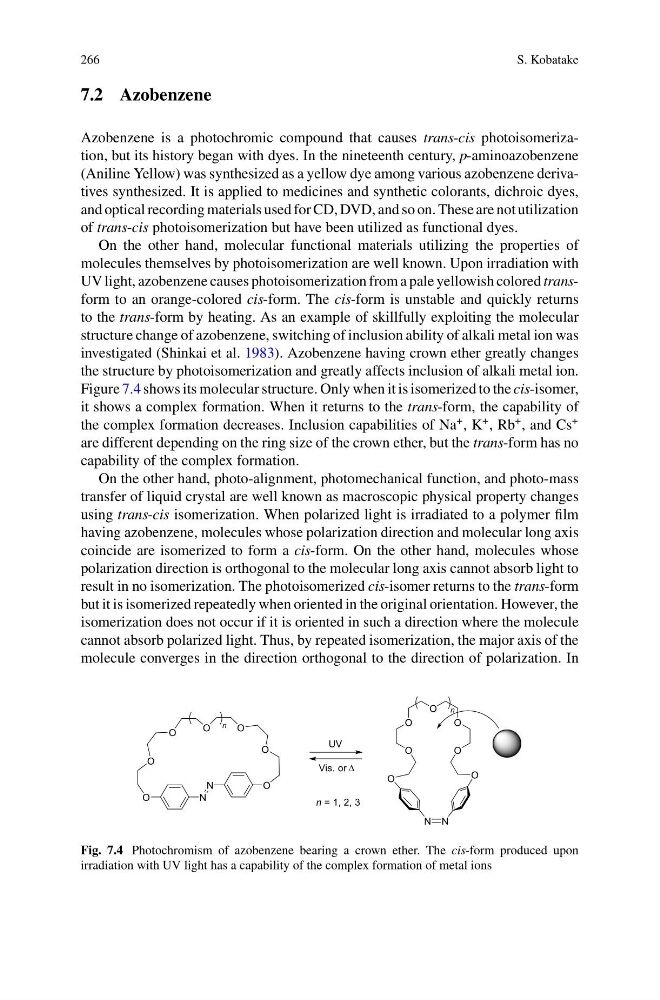
structure change of azobenzene, switching of inclusion ability of alkali metal ion was
investigated (Shinkai et al. 1983). Azobenzene having crown ether greatly changes
the structure by photoisomerization and greatly affects inclusion of alkali metal ion.
Figure 7.4 shows its molecular structure. Only when it is isomerized to the cis-isomer,
it shows a complex formation. When it returns to the trans-form, the capability of
the complex formation decreases. Inclusion capabilities of Na
+ , K
+ , Rb
+ , and Cs
+
are different depending on the ring size of the crown ether, but the trans-form has no
capability of the complex formation.
On the other hand, photo-alignment, photomechanical function, and photo-mass
transfer of liquid crystal are well known as macroscopic physical property changes
using trans-cis isomerization. When polarized light is irradiated to a polymer film
having azobenzene, molecules whose polarization direction and molecular long axis
coincide are isomerized to form a cis-form. On the other hand, molecules whose
polarization direction is orthogonal to the molecular long axis cannot absorb light to
result in no isomerization. The photoisomerized cis-isomer returns to the trans-form
but it is isomerized repeatedly when oriented in the original orientation. However, the
isomerization does not occur if it is oriented in such a direction where the molecule
cannot absorb polarized light. Thus, by repeated isomerization, the major axis of the
molecule converges in the direction orthogonal to the direction of polarization. In
N
N
UV
O
O
O
O
O
O
O
n
n = 1, 2, 3
N N
n
O
O
O
O
O
O
O
Vis. or Δ
Fig. 7.4 Photochromism of azobenzene bearing a crown ether. The cis-form produced upon
irradiation with UV light has a capability of the complex formation of metal ions
S. Kobatake
7.2 Azobenzene
Azobenzene is a photochromic compound that causes trans-cis photoisomerization, but its history began with dyes. In the nineteenth century, p-aminoazobenzene
(Aniline Yellow) was synthesized as a yellow dye among various azobenzene derivatives synthesized. It is applied to medicines and synthetic colorants, dichroic dyes,
and optical recording materials used for CD, DVD, and so on. These are not utilization
of trans-cis photoisomerization but have been utilized as functional dyes.
On the other hand, molecular functional materials utilizing the properties of
molecules themselves by photoisomerization are well known. Upon irradiation with
UV light, azobenzene causes photoisomerization from a pale yellowish colored transform to an orange-colored cis-form. The cis-form is unstable and quickly returns
to the trans-form by heating. As an example of skillfully exploiting the molecular
structure change of azobenzene, switching of inclusion ability of alkali metal ion was
investigated (Shinkai et al. 1983). Azobenzene having crown ether greatly changes
the structure by photoisomerization and greatly affects inclusion of alkali metal ion.
Figure 7.4 shows its molecular structure. Only when it is isomerized to the cis-isomer,
it shows a complex formation. When it returns to the trans-form, the capability of
the complex formation decreases. Inclusion capabilities of Na
+ , K
+ , Rb
+ , and Cs
+
are different depending on the ring size of the crown ether, but the trans-form has no
capability of the complex formation.
On the other hand, photo-alignment, photomechanical function, and photo-mass
transfer of liquid crystal are well known as macroscopic physical property changes
using trans-cis isomerization. When polarized light is irradiated to a polymer film
having azobenzene, molecules whose polarization direction and molecular long axis
coincide are isomerized to form a cis-form. On the other hand, molecules whose
polarization direction is orthogonal to the molecular long axis cannot absorb light to
result in no isomerization. The photoisomerized cis-isomer returns to the trans-form
but it is isomerized repeatedly when oriented in the original orientation. However, the
isomerization does not occur if it is oriented in such a direction where the molecule
cannot absorb polarized light. Thus, by repeated isomerization, the major axis of the
molecule converges in the direction orthogonal to the direction of polarization. In
N
N
UV
O
O
O
O
O
O
O
n
n = 1, 2, 3
N N
n
O
O
O
O
O
O
O
Vis. or Δ
Fig. 7.4 Photochromism of azobenzene bearing a crown ether. The cis-form produced upon
irradiation with UV light has a capability of the complex formation of metal ions