

264
S. Kobatake
Photochromic compounds can be roughly divided into two types, T- and P-types
(Fig. 7.1a). T-type photochromic compounds change to colored isomers by photoirradiation, and the colored isomers are thermally unstable to return to the initial colorless isomers. In contrast, P-type photochromic compounds change to thermally stable
colored isomers by photoirradiation. Thus, the P-type photochromic compounds can
be transformed between two isomers by only photoirradiation. Among the T-type
photochromic compounds, there are some compounds that the colored states are
thermally stable and the colorless states produced by photoirradiation are thermally
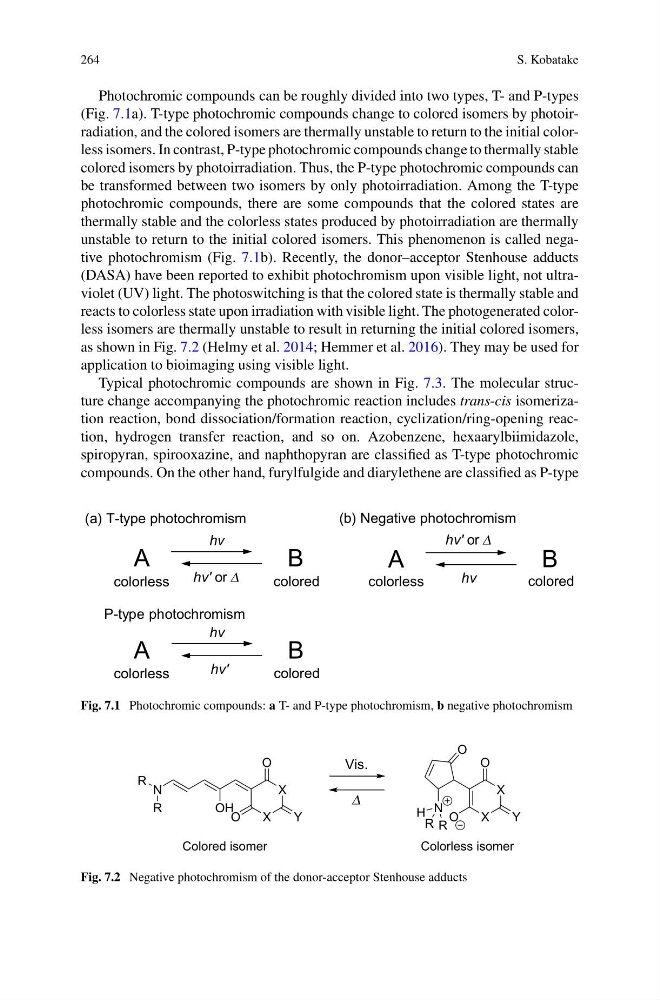
unstable to return to the initial colored isomers. This phenomenon is called negative photochromism (Fig. 7.1b). Recently, the donor–acceptor Stenhouse adducts
(DASA) have been reported to exhibit photochromism upon visible light, not ultraviolet (UV) light. The photoswitching is that the colored state is thermally stable and
reacts to colorless state upon irradiation with visible light. The photogenerated colorless isomers are thermally unstable to result in returning the initial colored isomers,
as shown in Fig. 7.2 (Helmy et al. 2014; Hemmer et al. 2016). They may be used for
application to bioimaging using visible light.
Typical photochromic compounds are shown in Fig. 7.3. The molecular structure change accompanying the photochromic reaction includes trans-cis isomerization reaction, bond dissociation/formation reaction, cyclization/ring-opening reaction, hydrogen transfer reaction, and so on. Azobenzene, hexaarylbiimidazole,
spiropyran, spirooxazine, and naphthopyran are classified as T-type photochromic
compounds. On the other hand, furylfulgide and diarylethene are classified as P-type
(a) T-type photochromism
P-type photochromism
A
B
hν
hν′ or Δ
A
B
(b) Negative photochromism
colorless
colored
colorless
colored
hν
hν′ or Δ
A
B
hν
hν′
colorless
colored
Fig. 7.1 Photochromic compounds: a T- and P-type photochromism, b negative photochromism
OH
O
X
X
N
R
O
Y
R
O
X
X
O
Y
O
N
R
R
H
Vis.
Colored isomer
Colorless isomer
Δ
Fig. 7.2 Negative photochromism of the donor-acceptor Stenhouse adducts
S. Kobatake
Photochromic compounds can be roughly divided into two types, T- and P-types
(Fig. 7.1a). T-type photochromic compounds change to colored isomers by photoirradiation, and the colored isomers are thermally unstable to return to the initial colorless isomers. In contrast, P-type photochromic compounds change to thermally stable
colored isomers by photoirradiation. Thus, the P-type photochromic compounds can
be transformed between two isomers by only photoirradiation. Among the T-type
photochromic compounds, there are some compounds that the colored states are
thermally stable and the colorless states produced by photoirradiation are thermally
unstable to return to the initial colored isomers. This phenomenon is called negative photochromism (Fig. 7.1b). Recently, the donor–acceptor Stenhouse adducts
(DASA) have been reported to exhibit photochromism upon visible light, not ultraviolet (UV) light. The photoswitching is that the colored state is thermally stable and
reacts to colorless state upon irradiation with visible light. The photogenerated colorless isomers are thermally unstable to result in returning the initial colored isomers,
as shown in Fig. 7.2 (Helmy et al. 2014; Hemmer et al. 2016). They may be used for
application to bioimaging using visible light.
Typical photochromic compounds are shown in Fig. 7.3. The molecular structure change accompanying the photochromic reaction includes trans-cis isomerization reaction, bond dissociation/formation reaction, cyclization/ring-opening reaction, hydrogen transfer reaction, and so on. Azobenzene, hexaarylbiimidazole,
spiropyran, spirooxazine, and naphthopyran are classified as T-type photochromic
compounds. On the other hand, furylfulgide and diarylethene are classified as P-type
(a) T-type photochromism
P-type photochromism
A
B
hν
hν′ or Δ
A
B
(b) Negative photochromism
colorless
colored
colorless
colored
hν
hν′ or Δ
A
B
hν
hν′
colorless
colored
Fig. 7.1 Photochromic compounds: a T- and P-type photochromism, b negative photochromism
OH
O
X
X
N
R
O
Y
R
O
X
X
O
Y
O
N
R
R
H
Vis.
Colored isomer
Colorless isomer
Δ
Fig. 7.2 Negative photochromism of the donor-acceptor Stenhouse adducts