

6 Molecular and Crystal Structures of Polymorphic …
231
(a) I
(b) II
(c) Y
(d) IV
(e) C
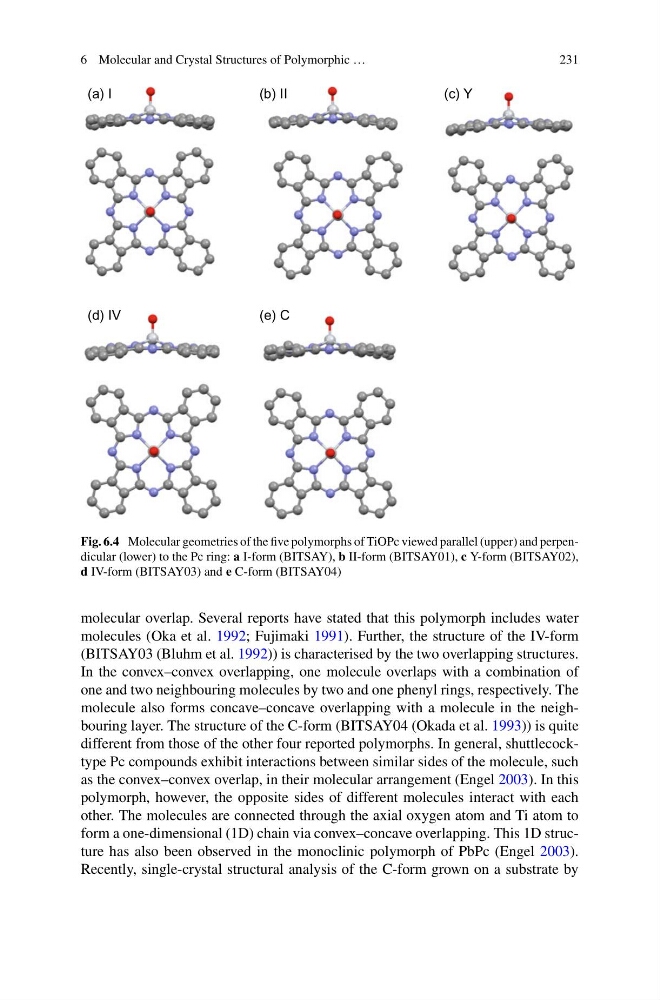
Fig. 6.4 Molecular geometries of the five polymorphs of TiOPc viewed parallel (upper) and perpendicular (lower) to the Pc ring: a I-form (BITSAY), b II-form (BITSAY01), c Y-form (BITSAY02),
d IV-form (BITSAY03) and e C-form (BITSAY04)
molecular overlap. Several reports have stated that this polymorph includes water
molecules (Oka et al. 1992; Fujimaki 1991). Further, the structure of the IV-form
(BITSAY03 (Bluhm et al. 1992)) is characterised by the two overlapping structures.
In the convex–convex overlapping, one molecule overlaps with a combination of
one and two neighbouring molecules by two and one phenyl rings, respectively. The
molecule also forms concave–concave overlapping with a molecule in the neighbouring layer. The structure of the C-form (BITSAY04 (Okada et al. 1993)) is quite
different from those of the other four reported polymorphs. In general, shuttlecocktype Pc compounds exhibit interactions between similar sides of the molecule, such
as the convex–convex overlap, in their molecular arrangement (Engel 2003). In this
polymorph, however, the opposite sides of different molecules interact with each
other. The molecules are connected through the axial oxygen atom and Ti atom to
form a one-dimensional (1D) chain via convex–concave overlapping. This 1D structure has also been observed in the monoclinic polymorph of PbPc (Engel 2003).
Recently, single-crystal structural analysis of the C-form grown on a substrate by
231
(a) I
(b) II
(c) Y
(d) IV
(e) C
Fig. 6.4 Molecular geometries of the five polymorphs of TiOPc viewed parallel (upper) and perpendicular (lower) to the Pc ring: a I-form (BITSAY), b II-form (BITSAY01), c Y-form (BITSAY02),
d IV-form (BITSAY03) and e C-form (BITSAY04)
molecular overlap. Several reports have stated that this polymorph includes water
molecules (Oka et al. 1992; Fujimaki 1991). Further, the structure of the IV-form
(BITSAY03 (Bluhm et al. 1992)) is characterised by the two overlapping structures.
In the convex–convex overlapping, one molecule overlaps with a combination of
one and two neighbouring molecules by two and one phenyl rings, respectively. The
molecule also forms concave–concave overlapping with a molecule in the neighbouring layer. The structure of the C-form (BITSAY04 (Okada et al. 1993)) is quite
different from those of the other four reported polymorphs. In general, shuttlecocktype Pc compounds exhibit interactions between similar sides of the molecule, such
as the convex–convex overlap, in their molecular arrangement (Engel 2003). In this
polymorph, however, the opposite sides of different molecules interact with each
other. The molecules are connected through the axial oxygen atom and Ti atom to
form a one-dimensional (1D) chain via convex–concave overlapping. This 1D structure has also been observed in the monoclinic polymorph of PbPc (Engel 2003).
Recently, single-crystal structural analysis of the C-form grown on a substrate by