

232
S. Matsumoto and J. Hwang
(a) I
(b) II
(c) Y
a
b
O
c
b
O
a
c
a
b
O
c
b
O
c
a
a
b
O
c
a
b
O
c
(d) IV
(e) C
a
b
O
c
a
O
c
b
a
b
O
c
a
b
O
c
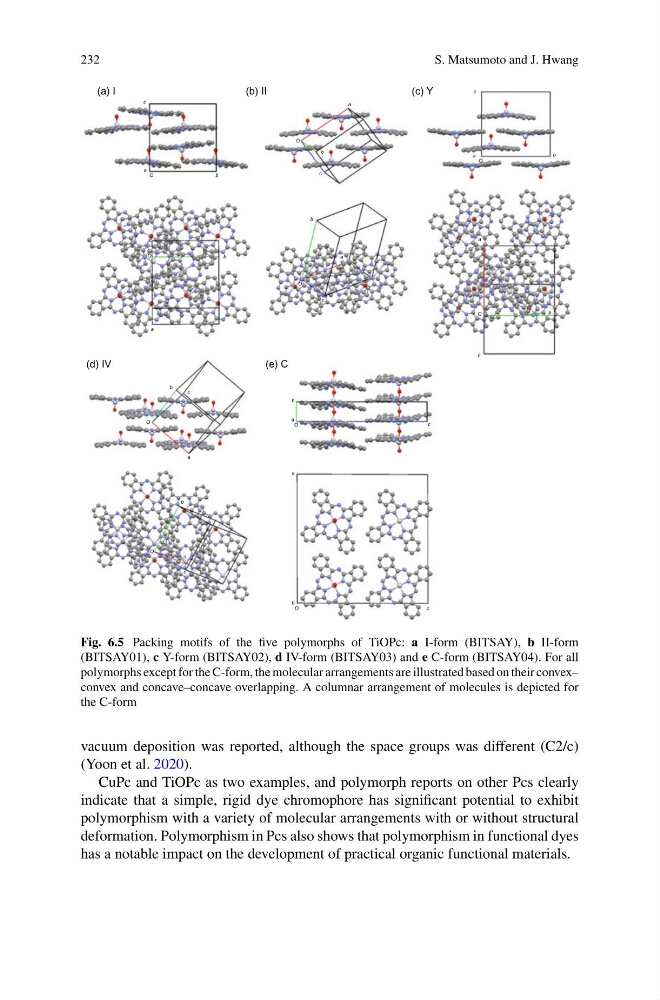
Fig. 6.5 Packing motifs of the five polymorphs of TiOPc: a I-form (BITSAY), b II-form
(BITSAY01), c Y-form (BITSAY02), d IV-form (BITSAY03) and e C-form (BITSAY04). For all
polymorphs except for the C-form, the molecular arrangements are illustrated based on their convex–
convex and concave–concave overlapping. A columnar arrangement of molecules is depicted for
the C-form
vacuum deposition was reported, although the space groups was different (C2/c)
(Yoon et al. 2020).
CuPc and TiOPc as two examples, and polymorph reports on other Pcs clearly
indicate that a simple, rigid dye chromophore has significant potential to exhibit
polymorphism with a variety of molecular arrangements with or without structural
deformation. Polymorphism in Pcs also shows that polymorphism in functional dyes
has a notable impact on the development of practical organic functional materials.
S. Matsumoto and J. Hwang
(a) I
(b) II
(c) Y
a
b
O
c
b
O
a
c
a
b
O
c
b
O
c
a
a
b
O
c
a
b
O
c
(d) IV
(e) C
a
b
O
c
a
O
c
b
a
b
O
c
a
b
O
c
Fig. 6.5 Packing motifs of the five polymorphs of TiOPc: a I-form (BITSAY), b II-form
(BITSAY01), c Y-form (BITSAY02), d IV-form (BITSAY03) and e C-form (BITSAY04). For all
polymorphs except for the C-form, the molecular arrangements are illustrated based on their convex–
convex and concave–concave overlapping. A columnar arrangement of molecules is depicted for
the C-form
vacuum deposition was reported, although the space groups was different (C2/c)
(Yoon et al. 2020).
CuPc and TiOPc as two examples, and polymorph reports on other Pcs clearly
indicate that a simple, rigid dye chromophore has significant potential to exhibit
polymorphism with a variety of molecular arrangements with or without structural
deformation. Polymorphism in Pcs also shows that polymorphism in functional dyes
has a notable impact on the development of practical organic functional materials.