

230
S. Matsumoto and J. Hwang
in the NIR region. The Y-form shows a broad bathochromic band with a maximum
in the bathochromic NIR region. No physicochemical properties have been reported
for the IV-form. The molecular and crystal structures of polymorphs I, II, C and
Y were reviewed by Engel (2003). Single-crystal structural analysis has only been
performed on polymorphs I and II (Hiller et al. 1982), while the other three have
been analysed using the Rietveld method based on powder diffraction data (Okada
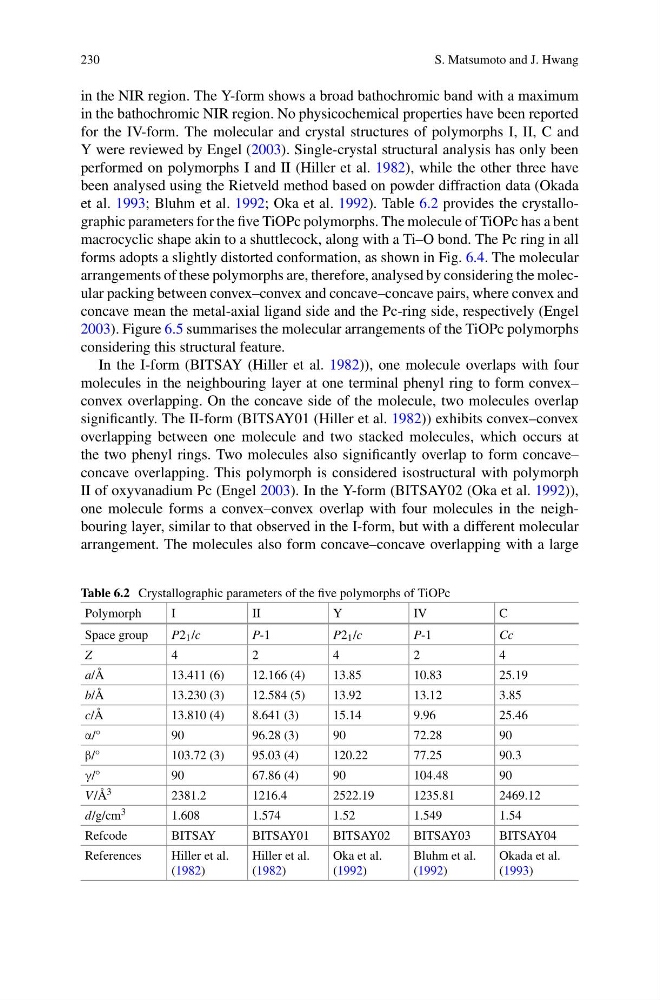
et al. 1993; Bluhm et al. 1992; Oka et al. 1992). Table 6.2 provides the crystallographic parameters for the five TiOPc polymorphs. The molecule of TiOPc has a bent
macrocyclic shape akin to a shuttlecock, along with a Ti–O bond. The Pc ring in all
forms adopts a slightly distorted conformation, as shown in Fig. 6.4. The molecular
arrangements of these polymorphs are, therefore, analysed by considering the molecular packing between convex–convex and concave–concave pairs, where convex and
concave mean the metal-axial ligand side and the Pc-ring side, respectively (Engel
2003). Figure 6.5 summarises the molecular arrangements of the TiOPc polymorphs
considering this structural feature.
In the I-form (BITSAY (Hiller et al. 1982)), one molecule overlaps with four
molecules in the neighbouring layer at one terminal phenyl ring to form convex–
convex overlapping. On the concave side of the molecule, two molecules overlap
significantly. The II-form (BITSAY01 (Hiller et al. 1982)) exhibits convex–convex
overlapping between one molecule and two stacked molecules, which occurs at
the two phenyl rings. Two molecules also significantly overlap to form concave–
concave overlapping. This polymorph is considered isostructural with polymorph
II of oxyvanadium Pc (Engel 2003). In the Y-form (BITSAY02 (Oka et al. 1992)),
one molecule forms a convex–convex overlap with four molecules in the neighbouring layer, similar to that observed in the I-form, but with a different molecular
arrangement. The molecules also form concave–concave overlapping with a large
Table 6.2 Crystallographic parameters of the five polymorphs of TiOPc
Polymorph
I
II
Y
IV
C
Space group
P2 1 /c
P-1
P2 1 /c
P-1
Cc
Z
4
2
4
2
4
a/Å
13.411 (6)
12.166 (4)
13.85
10.83
25.19
b/Å
13.230 (3)
12.584 (5)
13.92
13.12
3.85
c/Å
13.810 (4)
8.641 (3)
15.14
9.96
25.46
α/°
90
96.28 (3)
90
72.28
90
β/°
103.72 (3)
95.03 (4)
120.22
77.25
90.3
γ/°
90
67.86 (4)
90
104.48
90
V /Å 3
2381.2
1216.4
2522.19
1235.81
2469.12
d/g/cm 3
1.608
1.574
1.52
1.549
1.54
Refcode
BITSAY
BITSAY01
BITSAY02
BITSAY03
BITSAY04
References
Hiller et al.
(1982)
Hiller et al.
(1982)
Oka et al.
(1992)
Bluhm et al.
(1992)
Okada et al.
(1993)
S. Matsumoto and J. Hwang
in the NIR region. The Y-form shows a broad bathochromic band with a maximum
in the bathochromic NIR region. No physicochemical properties have been reported
for the IV-form. The molecular and crystal structures of polymorphs I, II, C and
Y were reviewed by Engel (2003). Single-crystal structural analysis has only been
performed on polymorphs I and II (Hiller et al. 1982), while the other three have
been analysed using the Rietveld method based on powder diffraction data (Okada
et al. 1993; Bluhm et al. 1992; Oka et al. 1992). Table 6.2 provides the crystallographic parameters for the five TiOPc polymorphs. The molecule of TiOPc has a bent
macrocyclic shape akin to a shuttlecock, along with a Ti–O bond. The Pc ring in all
forms adopts a slightly distorted conformation, as shown in Fig. 6.4. The molecular
arrangements of these polymorphs are, therefore, analysed by considering the molecular packing between convex–convex and concave–concave pairs, where convex and
concave mean the metal-axial ligand side and the Pc-ring side, respectively (Engel
2003). Figure 6.5 summarises the molecular arrangements of the TiOPc polymorphs
considering this structural feature.
In the I-form (BITSAY (Hiller et al. 1982)), one molecule overlaps with four
molecules in the neighbouring layer at one terminal phenyl ring to form convex–
convex overlapping. On the concave side of the molecule, two molecules overlap
significantly. The II-form (BITSAY01 (Hiller et al. 1982)) exhibits convex–convex
overlapping between one molecule and two stacked molecules, which occurs at
the two phenyl rings. Two molecules also significantly overlap to form concave–
concave overlapping. This polymorph is considered isostructural with polymorph
II of oxyvanadium Pc (Engel 2003). In the Y-form (BITSAY02 (Oka et al. 1992)),
one molecule forms a convex–convex overlap with four molecules in the neighbouring layer, similar to that observed in the I-form, but with a different molecular
arrangement. The molecules also form concave–concave overlapping with a large
Table 6.2 Crystallographic parameters of the five polymorphs of TiOPc
Polymorph
I
II
Y
IV
C
Space group
P2 1 /c
P-1
P2 1 /c
P-1
Cc
Z
4
2
4
2
4
a/Å
13.411 (6)
12.166 (4)
13.85
10.83
25.19
b/Å
13.230 (3)
12.584 (5)
13.92
13.12
3.85
c/Å
13.810 (4)
8.641 (3)
15.14
9.96
25.46
α/°
90
96.28 (3)
90
72.28
90
β/°
103.72 (3)
95.03 (4)
120.22
77.25
90.3
γ/°
90
67.86 (4)
90
104.48
90
V /Å 3
2381.2
1216.4
2522.19
1235.81
2469.12
d/g/cm 3
1.608
1.574
1.52
1.549
1.54
Refcode
BITSAY
BITSAY01
BITSAY02
BITSAY03
BITSAY04
References
Hiller et al.
(1982)
Hiller et al.
(1982)
Oka et al.
(1992)
Bluhm et al.
(1992)
Okada et al.
(1993)