

6 Molecular and Crystal Structures of Polymorphic …
229
(a) α
(b) β
a
a
b
O
c
a
O
c
(c) γ
(d) ε
a
b
O
c
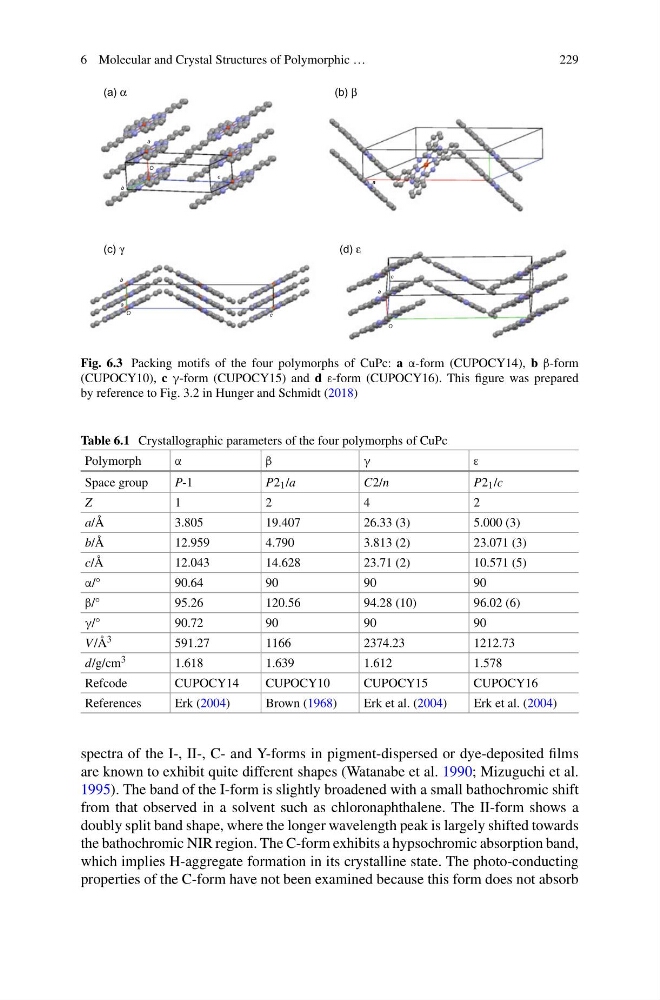
Fig. 6.3 Packing motifs of the four polymorphs of CuPc: a α-form (CUPOCY14), b β-form
(CUPOCY10), c γ-form (CUPOCY15) and d ε-form (CUPOCY16). This figure was prepared
by reference to Fig. 3.2 in Hunger and Schmidt (2018)
Table 6.1 Crystallographic parameters of the four polymorphs of CuPc
Polymorph
α
β
γ
ε
Space group
P-1
P2 1 /a
C2/n
P2 1 /c
Z
1
2
4
2
a/Å
3.805
19.407
26.33 (3)
5.000 (3)
b/Å
12.959
4.790
3.813 (2)
23.071 (3)
c/Å
12.043
14.628
23.71 (2)
10.571 (5)
α/°
90.64
90
90
90
β/°
95.26
120.56
94.28 (10)
96.02 (6)
γ/°
90.72
90
90
90
V /Å 3
591.27
1166
2374.23
1212.73
d/g/cm 3
1.618
1.639
1.612
1.578
Refcode
CUPOCY14
CUPOCY10
CUPOCY15
CUPOCY16
References
Erk (2004)
Brown (1968)
Erk et al. (2004)
Erk et al. (2004)
spectra of the I-, II-, C- and Y-forms in pigment-dispersed or dye-deposited films
are known to exhibit quite different shapes (Watanabe et al. 1990; Mizuguchi et al.
1995). The band of the I-form is slightly broadened with a small bathochromic shift
from that observed in a solvent such as chloronaphthalene. The II-form shows a
doubly split band shape, where the longer wavelength peak is largely shifted towards
the bathochromic NIR region. The C-form exhibits a hypsochromic absorption band,
which implies H-aggregate formation in its crystalline state. The photo-conducting
properties of the C-form have not been examined because this form does not absorb
229
(a) α
(b) β
a
a
b
O
c
a
O
c
(c) γ
(d) ε
a
b
O
c
Fig. 6.3 Packing motifs of the four polymorphs of CuPc: a α-form (CUPOCY14), b β-form
(CUPOCY10), c γ-form (CUPOCY15) and d ε-form (CUPOCY16). This figure was prepared
by reference to Fig. 3.2 in Hunger and Schmidt (2018)
Table 6.1 Crystallographic parameters of the four polymorphs of CuPc
Polymorph
α
β
γ
ε
Space group
P-1
P2 1 /a
C2/n
P2 1 /c
Z
1
2
4
2
a/Å
3.805
19.407
26.33 (3)
5.000 (3)
b/Å
12.959
4.790
3.813 (2)
23.071 (3)
c/Å
12.043
14.628
23.71 (2)
10.571 (5)
α/°
90.64
90
90
90
β/°
95.26
120.56
94.28 (10)
96.02 (6)
γ/°
90.72
90
90
90
V /Å 3
591.27
1166
2374.23
1212.73
d/g/cm 3
1.618
1.639
1.612
1.578
Refcode
CUPOCY14
CUPOCY10
CUPOCY15
CUPOCY16
References
Erk (2004)
Brown (1968)
Erk et al. (2004)
Erk et al. (2004)
spectra of the I-, II-, C- and Y-forms in pigment-dispersed or dye-deposited films
are known to exhibit quite different shapes (Watanabe et al. 1990; Mizuguchi et al.
1995). The band of the I-form is slightly broadened with a small bathochromic shift
from that observed in a solvent such as chloronaphthalene. The II-form shows a
doubly split band shape, where the longer wavelength peak is largely shifted towards
the bathochromic NIR region. The C-form exhibits a hypsochromic absorption band,
which implies H-aggregate formation in its crystalline state. The photo-conducting
properties of the C-form have not been examined because this form does not absorb