

228
S. Matsumoto and J. Hwang
(a) α
(c) γ
(d) ε
(b) β
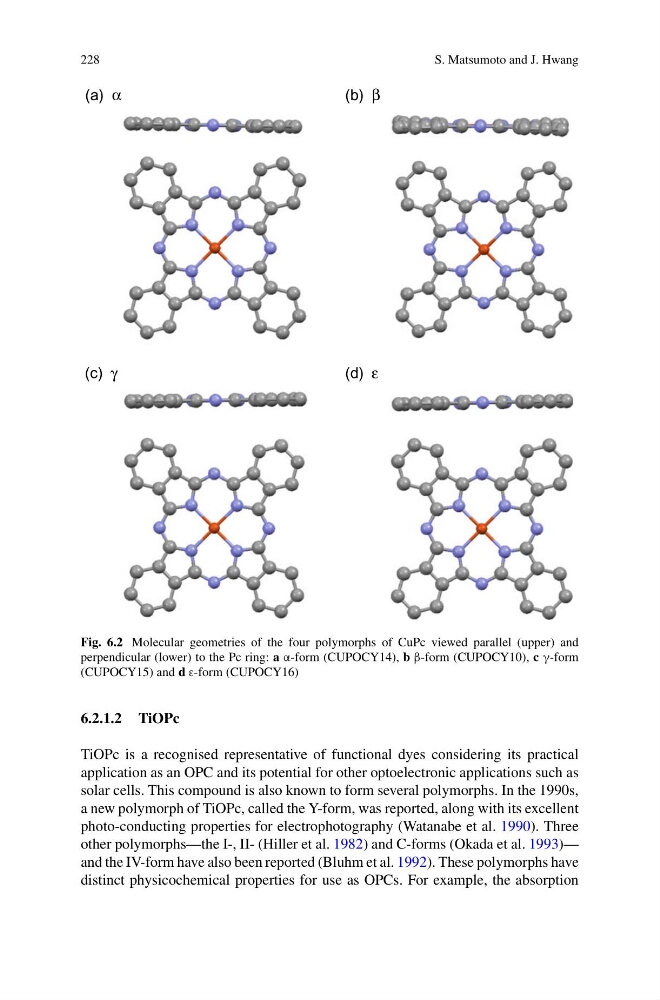
Fig. 6.2 Molecular geometries of the four polymorphs of CuPc viewed parallel (upper) and
perpendicular (lower) to the Pc ring: a α-form (CUPOCY14), b β-form (CUPOCY10), c γ-form
(CUPOCY15) and d ε-form (CUPOCY16)
6.2.1.2 TiOPc
TiOPc is a recognised representative of functional dyes considering its practical
application as an OPC and its potential for other optoelectronic applications such as
solar cells. This compound is also known to form several polymorphs. In the 1990s,
a new polymorph of TiOPc, called the Y-form, was reported, along with its excellent
photo-conducting properties for electrophotography (Watanabe et al. 1990). Three
other polymorphs—the I-, II- (Hiller et al. 1982) and C-forms (Okada et al. 1993)—
and the IV-form have also been reported (Bluhm et al. 1992). These polymorphs have
distinct physicochemical properties for use as OPCs. For example, the absorption
S. Matsumoto and J. Hwang
(a) α
(c) γ
(d) ε
(b) β
Fig. 6.2 Molecular geometries of the four polymorphs of CuPc viewed parallel (upper) and
perpendicular (lower) to the Pc ring: a α-form (CUPOCY14), b β-form (CUPOCY10), c γ-form
(CUPOCY15) and d ε-form (CUPOCY16)
6.2.1.2 TiOPc
TiOPc is a recognised representative of functional dyes considering its practical
application as an OPC and its potential for other optoelectronic applications such as
solar cells. This compound is also known to form several polymorphs. In the 1990s,
a new polymorph of TiOPc, called the Y-form, was reported, along with its excellent
photo-conducting properties for electrophotography (Watanabe et al. 1990). Three
other polymorphs—the I-, II- (Hiller et al. 1982) and C-forms (Okada et al. 1993)—
and the IV-form have also been reported (Bluhm et al. 1992). These polymorphs have
distinct physicochemical properties for use as OPCs. For example, the absorption