

5 BODIPY Dyes and Their Analogues
197
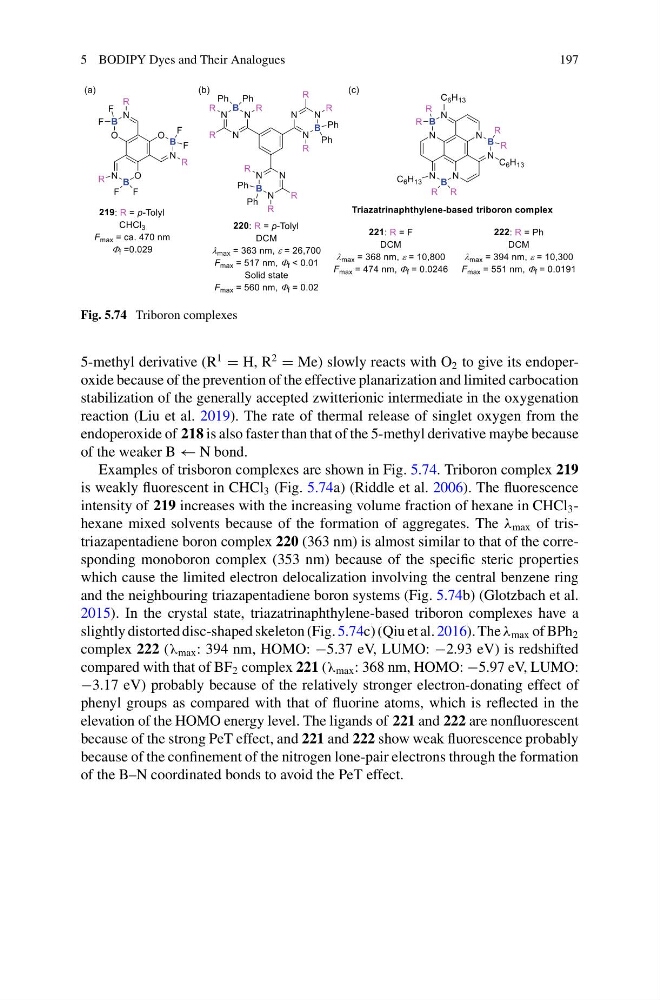
Fig. 5.74 Triboron complexes
5-methyl derivative (R
1
= H, R
2
= Me) slowly reacts with O 2 to give its endoperoxide because of the prevention of the effective planarization and limited carbocation
stabilization of the generally accepted zwitterionic intermediate in the oxygenation
reaction (Liu et al. 2019). The rate of thermal release of singlet oxygen from the
endoperoxide of 218 is also faster than that of the 5-methyl derivative maybe because
of the weaker B ← N bond.
Examples of trisboron complexes are shown in Fig. 5.74. Triboron complex 219
is weakly fluorescent in CHCl 3 (Fig. 5.74a) (Riddle et al. 2006). The fluorescence
intensity of 219 increases with the increasing volume fraction of hexane in CHCl 3 -
hexane mixed solvents because of the formation of aggregates. The λ max of tristriazapentadiene boron complex 220 (363 nm) is almost similar to that of the corresponding monoboron complex (353 nm) because of the specific steric properties
which cause the limited electron delocalization involving the central benzene ring
and the neighbouring triazapentadiene boron systems (Fig. 5.74b) (Glotzbach et al.
2015). In the crystal state, triazatrinaphthylene-based triboron complexes have a
slightly distorted disc-shaped skeleton (Fig. 5.74c) (Qiu et al. 2016). The λ max of BPh 2
complex 222 (λ max : 394 nm, HOMO: −5.37 eV, LUMO: −2.93 eV) is redshifted
compared with that of BF 2 complex 221 (λ max : 368 nm, HOMO: −5.97 eV, LUMO:
−3.17 eV) probably because of the relatively stronger electron-donating effect of
phenyl groups as compared with that of fluorine atoms, which is reflected in the
elevation of the HOMO energy level. The ligands of 221 and 222 are nonfluorescent
because of the strong PeT effect, and 221 and 222 show weak fluorescence probably
because of the confinement of the nitrogen lone-pair electrons through the formation
of the B–N coordinated bonds to avoid the PeT effect.
197
Fig. 5.74 Triboron complexes
5-methyl derivative (R
1
= H, R
2
= Me) slowly reacts with O 2 to give its endoperoxide because of the prevention of the effective planarization and limited carbocation
stabilization of the generally accepted zwitterionic intermediate in the oxygenation
reaction (Liu et al. 2019). The rate of thermal release of singlet oxygen from the
endoperoxide of 218 is also faster than that of the 5-methyl derivative maybe because
of the weaker B ← N bond.
Examples of trisboron complexes are shown in Fig. 5.74. Triboron complex 219
is weakly fluorescent in CHCl 3 (Fig. 5.74a) (Riddle et al. 2006). The fluorescence
intensity of 219 increases with the increasing volume fraction of hexane in CHCl 3 -
hexane mixed solvents because of the formation of aggregates. The λ max of tristriazapentadiene boron complex 220 (363 nm) is almost similar to that of the corresponding monoboron complex (353 nm) because of the specific steric properties
which cause the limited electron delocalization involving the central benzene ring
and the neighbouring triazapentadiene boron systems (Fig. 5.74b) (Glotzbach et al.
2015). In the crystal state, triazatrinaphthylene-based triboron complexes have a
slightly distorted disc-shaped skeleton (Fig. 5.74c) (Qiu et al. 2016). The λ max of BPh 2
complex 222 (λ max : 394 nm, HOMO: −5.37 eV, LUMO: −2.93 eV) is redshifted
compared with that of BF 2 complex 221 (λ max : 368 nm, HOMO: −5.97 eV, LUMO:
−3.17 eV) probably because of the relatively stronger electron-donating effect of
phenyl groups as compared with that of fluorine atoms, which is reflected in the
elevation of the HOMO energy level. The ligands of 221 and 222 are nonfluorescent
because of the strong PeT effect, and 221 and 222 show weak fluorescence probably
because of the confinement of the nitrogen lone-pair electrons through the formation
of the B–N coordinated bonds to avoid the PeT effect.