

198
Y. Kubota
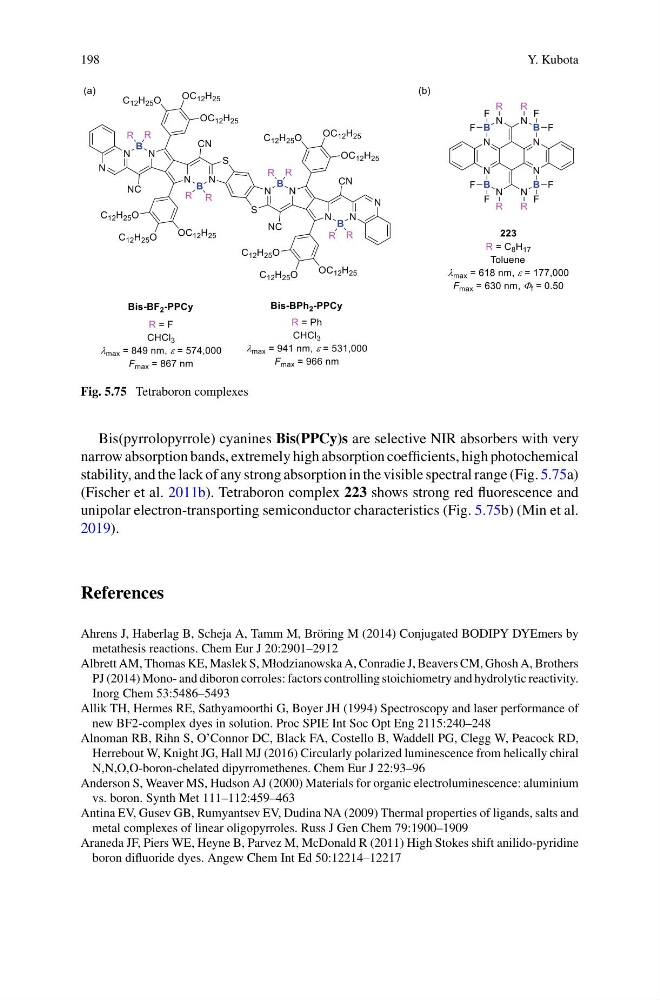
Fig. 5.75 Tetraboron complexes
Bis(pyrrolopyrrole) cyanines Bis(PPCy)s are selective NIR absorbers with very
narrow absorption bands, extremely high absorption coefficients, high photochemical
stability, and the lack of any strong absorption in the visible spectral range (Fig. 5.75a)
(Fischer et al. 2011b). Tetraboron complex 223 shows strong red fluorescence and
unipolar electron-transporting semiconductor characteristics (Fig. 5.75b) (Min et al.
2019).
References
Ahrens J, Haberlag B, Scheja A, Tamm M, Bröring M (2014) Conjugated BODIPY DYEmers by
metathesis reactions. Chem Eur J 20:2901–2912
Albrett AM, Thomas KE, Maslek S, Młodzianowska A, Conradie J, Beavers CM, Ghosh A, Brothers
PJ (2014) Mono- and diboron corroles: factors controlling stoichiometry and hydrolytic reactivity.
Inorg Chem 53:5486–5493
Allik TH, Hermes RE, Sathyamoorthi G, Boyer JH (1994) Spectroscopy and laser performance of
new BF2-complex dyes in solution. Proc SPIE Int Soc Opt Eng 2115:240–248
Alnoman RB, Rihn S, O’Connor DC, Black FA, Costello B, Waddell PG, Clegg W, Peacock RD,
Herrebout W, Knight JG, Hall MJ (2016) Circularly polarized luminescence from helically chiral
N,N,O,O-boron-chelated dipyrromethenes. Chem Eur J 22:93–96
Anderson S, Weaver MS, Hudson AJ (2000) Materials for organic electroluminescence: aluminium
vs. boron. Synth Met 111–112:459–463
Antina EV, Gusev GB, Rumyantsev EV, Dudina NA (2009) Thermal properties of ligands, salts and
metal complexes of linear oligopyrroles. Russ J Gen Chem 79:1900–1909
Araneda JF, Piers WE, Heyne B, Parvez M, McDonald R (2011) High Stokes shift anilido-pyridine
boron difluoride dyes. Angew Chem Int Ed 50:12214–12217
Y. Kubota
Fig. 5.75 Tetraboron complexes
Bis(pyrrolopyrrole) cyanines Bis(PPCy)s are selective NIR absorbers with very
narrow absorption bands, extremely high absorption coefficients, high photochemical
stability, and the lack of any strong absorption in the visible spectral range (Fig. 5.75a)
(Fischer et al. 2011b). Tetraboron complex 223 shows strong red fluorescence and
unipolar electron-transporting semiconductor characteristics (Fig. 5.75b) (Min et al.
2019).
References
Ahrens J, Haberlag B, Scheja A, Tamm M, Bröring M (2014) Conjugated BODIPY DYEmers by
metathesis reactions. Chem Eur J 20:2901–2912
Albrett AM, Thomas KE, Maslek S, Młodzianowska A, Conradie J, Beavers CM, Ghosh A, Brothers
PJ (2014) Mono- and diboron corroles: factors controlling stoichiometry and hydrolytic reactivity.
Inorg Chem 53:5486–5493
Allik TH, Hermes RE, Sathyamoorthi G, Boyer JH (1994) Spectroscopy and laser performance of
new BF2-complex dyes in solution. Proc SPIE Int Soc Opt Eng 2115:240–248
Alnoman RB, Rihn S, O’Connor DC, Black FA, Costello B, Waddell PG, Clegg W, Peacock RD,
Herrebout W, Knight JG, Hall MJ (2016) Circularly polarized luminescence from helically chiral
N,N,O,O-boron-chelated dipyrromethenes. Chem Eur J 22:93–96
Anderson S, Weaver MS, Hudson AJ (2000) Materials for organic electroluminescence: aluminium
vs. boron. Synth Met 111–112:459–463
Antina EV, Gusev GB, Rumyantsev EV, Dudina NA (2009) Thermal properties of ligands, salts and
metal complexes of linear oligopyrroles. Russ J Gen Chem 79:1900–1909
Araneda JF, Piers WE, Heyne B, Parvez M, McDonald R (2011) High Stokes shift anilido-pyridine
boron difluoride dyes. Angew Chem Int Ed 50:12214–12217