

196
Y. Kubota
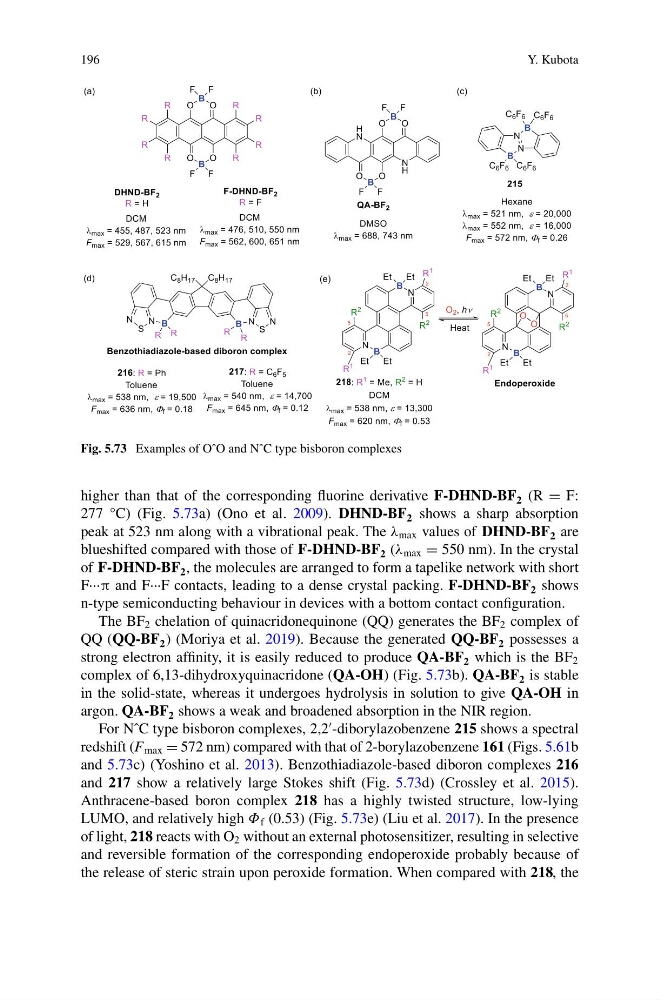
Fig. 5.73 Examples of OˆO and NˆC type bisboron complexes
higher than that of the corresponding fluorine derivative F-DHND-BF 2 (R = F:
277 °C) (Fig. 5.73a) (Ono et al. 2009). DHND-BF 2 shows a sharp absorption
peak at 523 nm along with a vibrational peak. The λ max values of DHND-BF 2 are
blueshifted compared with those of F-DHND-BF 2 (λ max = 550 nm). In the crystal
of F-DHND-BF 2 , the molecules are arranged to form a tapelike network with short
F···π and F···F contacts, leading to a dense crystal packing. F-DHND-BF 2 shows
n-type semiconducting behaviour in devices with a bottom contact configuration.
The BF 2 chelation of quinacridonequinone (QQ) generates the BF 2 complex of
QQ (QQ-BF 2 ) (Moriya et al. 2019). Because the generated QQ-BF 2 possesses a
strong electron affinity, it is easily reduced to produce QA-BF 2 which is the BF 2
complex of 6,13-dihydroxyquinacridone (QA-OH) (Fig. 5.73b). QA-BF 2 is stable
in the solid-state, whereas it undergoes hydrolysis in solution to give QA-OH in
argon. QA-BF 2 shows a weak and broadened absorption in the NIR region.
For NˆC type bisboron complexes, 2,2
-diborylazobenzene 215 shows a spectral
redshift (F max = 572 nm) compared with that of 2-borylazobenzene 161 (Figs. 5.61b
and 5.73c) (Yoshino et al. 2013). Benzothiadiazole-based diboron complexes 216
and 217 show a relatively large Stokes shift (Fig. 5.73d) (Crossley et al. 2015).
Anthracene-based boron complex 218 has a highly twisted structure, low-lying
LUMO, and relatively high Φ f (0.53) (Fig. 5.73e) (Liu et al. 2017). In the presence
of light, 218 reacts with O 2 without an external photosensitizer, resulting in selective
and reversible formation of the corresponding endoperoxide probably because of
the release of steric strain upon peroxide formation. When compared with 218, the
Y. Kubota
Fig. 5.73 Examples of OˆO and NˆC type bisboron complexes
higher than that of the corresponding fluorine derivative F-DHND-BF 2 (R = F:
277 °C) (Fig. 5.73a) (Ono et al. 2009). DHND-BF 2 shows a sharp absorption
peak at 523 nm along with a vibrational peak. The λ max values of DHND-BF 2 are
blueshifted compared with those of F-DHND-BF 2 (λ max = 550 nm). In the crystal
of F-DHND-BF 2 , the molecules are arranged to form a tapelike network with short
F···π and F···F contacts, leading to a dense crystal packing. F-DHND-BF 2 shows
n-type semiconducting behaviour in devices with a bottom contact configuration.
The BF 2 chelation of quinacridonequinone (QQ) generates the BF 2 complex of
QQ (QQ-BF 2 ) (Moriya et al. 2019). Because the generated QQ-BF 2 possesses a
strong electron affinity, it is easily reduced to produce QA-BF 2 which is the BF 2
complex of 6,13-dihydroxyquinacridone (QA-OH) (Fig. 5.73b). QA-BF 2 is stable
in the solid-state, whereas it undergoes hydrolysis in solution to give QA-OH in
argon. QA-BF 2 shows a weak and broadened absorption in the NIR region.
For NˆC type bisboron complexes, 2,2
-diborylazobenzene 215 shows a spectral
redshift (F max = 572 nm) compared with that of 2-borylazobenzene 161 (Figs. 5.61b
and 5.73c) (Yoshino et al. 2013). Benzothiadiazole-based diboron complexes 216
and 217 show a relatively large Stokes shift (Fig. 5.73d) (Crossley et al. 2015).
Anthracene-based boron complex 218 has a highly twisted structure, low-lying
LUMO, and relatively high Φ f (0.53) (Fig. 5.73e) (Liu et al. 2017). In the presence
of light, 218 reacts with O 2 without an external photosensitizer, resulting in selective
and reversible formation of the corresponding endoperoxide probably because of
the release of steric strain upon peroxide formation. When compared with 218, the