

5 BODIPY Dyes and Their Analogues
185
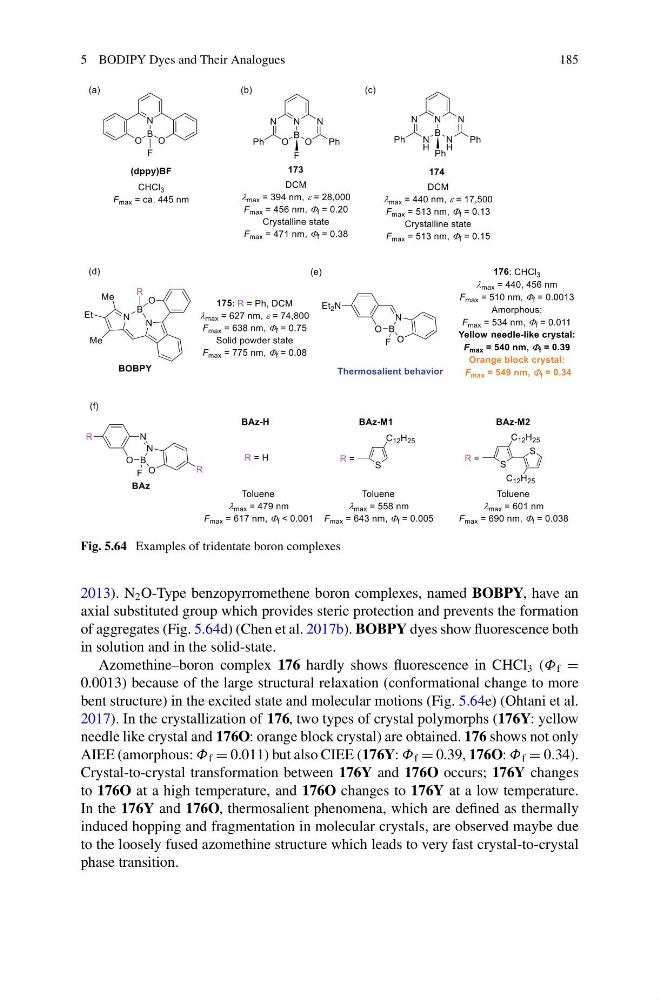
Fig. 5.64 Examples of tridentate boron complexes
2013). N 2 O-Type benzopyrromethene boron complexes, named BOBPY, have an
axial substituted group which provides steric protection and prevents the formation
of aggregates (Fig. 5.64d) (Chen et al. 2017b). BOBPY dyes show fluorescence both
in solution and in the solid-state.
Azomethine–boron complex 176 hardly shows fluorescence in CHCl 3 (Φ f =
0.0013) because of the large structural relaxation (conformational change to more
bent structure) in the excited state and molecular motions (Fig. 5.64e) (Ohtani et al.
2017). In the crystallization of 176, two types of crystal polymorphs (176Y: yellow
needle like crystal and 176O: orange block crystal) are obtained. 176 shows not only
AIEE (amorphous: Φ f = 0.011) but also CIEE (176Y: Φ f = 0.39, 176O: Φ f = 0.34).
Crystal-to-crystal transformation between 176Y and 176O occurs; 176Y changes
to 176O at a high temperature, and 176O changes to 176Y at a low temperature.
In the 176Y and 176O, thermosalient phenomena, which are defined as thermally
induced hopping and fragmentation in molecular crystals, are observed maybe due
to the loosely fused azomethine structure which leads to very fast crystal-to-crystal
phase transition.
185
Fig. 5.64 Examples of tridentate boron complexes
2013). N 2 O-Type benzopyrromethene boron complexes, named BOBPY, have an
axial substituted group which provides steric protection and prevents the formation
of aggregates (Fig. 5.64d) (Chen et al. 2017b). BOBPY dyes show fluorescence both
in solution and in the solid-state.
Azomethine–boron complex 176 hardly shows fluorescence in CHCl 3 (Φ f =
0.0013) because of the large structural relaxation (conformational change to more
bent structure) in the excited state and molecular motions (Fig. 5.64e) (Ohtani et al.
2017). In the crystallization of 176, two types of crystal polymorphs (176Y: yellow
needle like crystal and 176O: orange block crystal) are obtained. 176 shows not only
AIEE (amorphous: Φ f = 0.011) but also CIEE (176Y: Φ f = 0.39, 176O: Φ f = 0.34).
Crystal-to-crystal transformation between 176Y and 176O occurs; 176Y changes
to 176O at a high temperature, and 176O changes to 176Y at a low temperature.
In the 176Y and 176O, thermosalient phenomena, which are defined as thermally
induced hopping and fragmentation in molecular crystals, are observed maybe due
to the loosely fused azomethine structure which leads to very fast crystal-to-crystal
phase transition.