

184
Y. Kubota
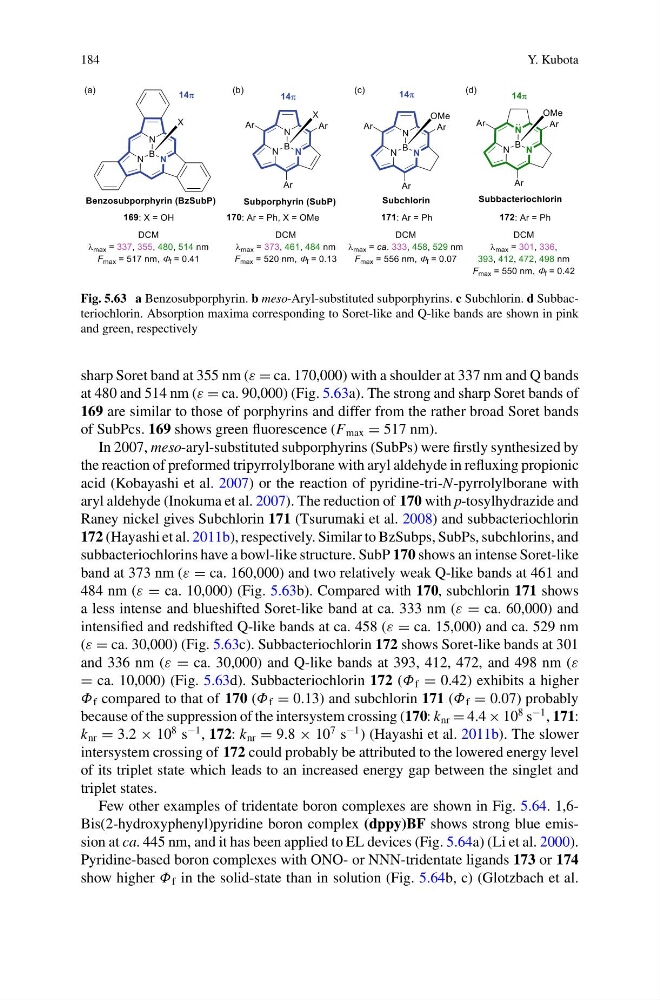
Fig. 5.63 a Benzosubporphyrin. b meso-Aryl-substituted subporphyrins. c Subchlorin. d Subbacteriochlorin. Absorption maxima corresponding to Soret-like and Q-like bands are shown in pink
and green, respectively
sharp Soret band at 355 nm (ε = ca. 170,000) with a shoulder at 337 nm and Q bands
at 480 and 514 nm (ε = ca. 90,000) (Fig. 5.63a). The strong and sharp Soret bands of
169 are similar to those of porphyrins and differ from the rather broad Soret bands
of SubPcs. 169 shows green fluorescence (F max = 517 nm).
In 2007, meso-aryl-substituted subporphyrins (SubPs) were firstly synthesized by
the reaction of preformed tripyrrolylborane with aryl aldehyde in refluxing propionic
acid (Kobayashi et al. 2007) or the reaction of pyridine-tri-N-pyrrolylborane with
aryl aldehyde (Inokuma et al. 2007). The reduction of 170 with p-tosylhydrazide and
Raney nickel gives Subchlorin 171 (Tsurumaki et al. 2008) and subbacteriochlorin
172 (Hayashi et al. 2011b), respectively. Similar to BzSubps, SubPs, subchlorins, and
subbacteriochlorins have a bowl-like structure. SubP 170 shows an intense Soret-like
band at 373 nm (ε = ca. 160,000) and two relatively weak Q-like bands at 461 and
484 nm (ε = ca. 10,000) (Fig. 5.63b). Compared with 170, subchlorin 171 shows
a less intense and blueshifted Soret-like band at ca. 333 nm (ε = ca. 60,000) and
intensified and redshifted Q-like bands at ca. 458 (ε = ca. 15,000) and ca. 529 nm
(ε = ca. 30,000) (Fig. 5.63c). Subbacteriochlorin 172 shows Soret-like bands at 301
and 336 nm (ε = ca. 30,000) and Q-like bands at 393, 412, 472, and 498 nm (ε
= ca. 10,000) (Fig. 5.63d). Subbacteriochlorin 172 (Φ f = 0.42) exhibits a higher
Φ f compared to that of 170 (Φ f = 0.13) and subchlorin 171 (Φ f = 0.07) probably
because of the suppression of the intersystem crossing (170: k nr = 4.4 × 10
8 s
−1 , 171:
k nr = 3.2 × 10
8 s
−1 , 172: k nr = 9.8 × 10
7 s
−1 ) (Hayashi et al. 2011b). The slower
intersystem crossing of 172 could probably be attributed to the lowered energy level
of its triplet state which leads to an increased energy gap between the singlet and
triplet states.
Few other examples of tridentate boron complexes are shown in Fig. 5.64. 1,6Bis(2-hydroxyphenyl)pyridine boron complex (dppy)BF shows strong blue emission at ca. 445 nm, and it has been applied to EL devices (Fig. 5.64a) (Li et al. 2000).
Pyridine-based boron complexes with ONO- or NNN-tridentate ligands 173 or 174
show higher Φ f in the solid-state than in solution (Fig. 5.64b, c) (Glotzbach et al.
Y. Kubota
Fig. 5.63 a Benzosubporphyrin. b meso-Aryl-substituted subporphyrins. c Subchlorin. d Subbacteriochlorin. Absorption maxima corresponding to Soret-like and Q-like bands are shown in pink
and green, respectively
sharp Soret band at 355 nm (ε = ca. 170,000) with a shoulder at 337 nm and Q bands
at 480 and 514 nm (ε = ca. 90,000) (Fig. 5.63a). The strong and sharp Soret bands of
169 are similar to those of porphyrins and differ from the rather broad Soret bands
of SubPcs. 169 shows green fluorescence (F max = 517 nm).
In 2007, meso-aryl-substituted subporphyrins (SubPs) were firstly synthesized by
the reaction of preformed tripyrrolylborane with aryl aldehyde in refluxing propionic
acid (Kobayashi et al. 2007) or the reaction of pyridine-tri-N-pyrrolylborane with
aryl aldehyde (Inokuma et al. 2007). The reduction of 170 with p-tosylhydrazide and
Raney nickel gives Subchlorin 171 (Tsurumaki et al. 2008) and subbacteriochlorin
172 (Hayashi et al. 2011b), respectively. Similar to BzSubps, SubPs, subchlorins, and
subbacteriochlorins have a bowl-like structure. SubP 170 shows an intense Soret-like
band at 373 nm (ε = ca. 160,000) and two relatively weak Q-like bands at 461 and
484 nm (ε = ca. 10,000) (Fig. 5.63b). Compared with 170, subchlorin 171 shows
a less intense and blueshifted Soret-like band at ca. 333 nm (ε = ca. 60,000) and
intensified and redshifted Q-like bands at ca. 458 (ε = ca. 15,000) and ca. 529 nm
(ε = ca. 30,000) (Fig. 5.63c). Subbacteriochlorin 172 shows Soret-like bands at 301
and 336 nm (ε = ca. 30,000) and Q-like bands at 393, 412, 472, and 498 nm (ε
= ca. 10,000) (Fig. 5.63d). Subbacteriochlorin 172 (Φ f = 0.42) exhibits a higher
Φ f compared to that of 170 (Φ f = 0.13) and subchlorin 171 (Φ f = 0.07) probably
because of the suppression of the intersystem crossing (170: k nr = 4.4 × 10
8 s
−1 , 171:
k nr = 3.2 × 10
8 s
−1 , 172: k nr = 9.8 × 10
7 s
−1 ) (Hayashi et al. 2011b). The slower
intersystem crossing of 172 could probably be attributed to the lowered energy level
of its triplet state which leads to an increased energy gap between the singlet and
triplet states.
Few other examples of tridentate boron complexes are shown in Fig. 5.64. 1,6Bis(2-hydroxyphenyl)pyridine boron complex (dppy)BF shows strong blue emission at ca. 445 nm, and it has been applied to EL devices (Fig. 5.64a) (Li et al. 2000).
Pyridine-based boron complexes with ONO- or NNN-tridentate ligands 173 or 174
show higher Φ f in the solid-state than in solution (Fig. 5.64b, c) (Glotzbach et al.