

186
Y. Kubota
The S 0 –S 1 transition of the fused azobenzene–boron complex BAz-H with the
2,2
-dihydroxyazobenzene moiety as a tridentate ligand is a permitted π–π* transition, while that of common azobenzenes is a forbidden n–π* transition (Fig. 5.64f)
(Gon et al. 2018). Despite having a rigid structure and without having movable
substituents which lead to molecular rotations, BAz-H hardly shows fluorescence in
solution (Φ f < 0.001). The nonfluorescent property of BAz-H may be caused by the
structural relaxation of the π-conjugated fluorophore in the excited state. Owing to
the strong electron-accepting property of the BAz-H moiety, the mono (BAz-M1:
λ max = 558 nm) and bithiophene-substituted (BAz-M2: λ max = 601 nm) derivatives
show redshifted λ max compared with that of BAz-H (λ max = 479 nm).
5.4 Multinuclear Boron Complex
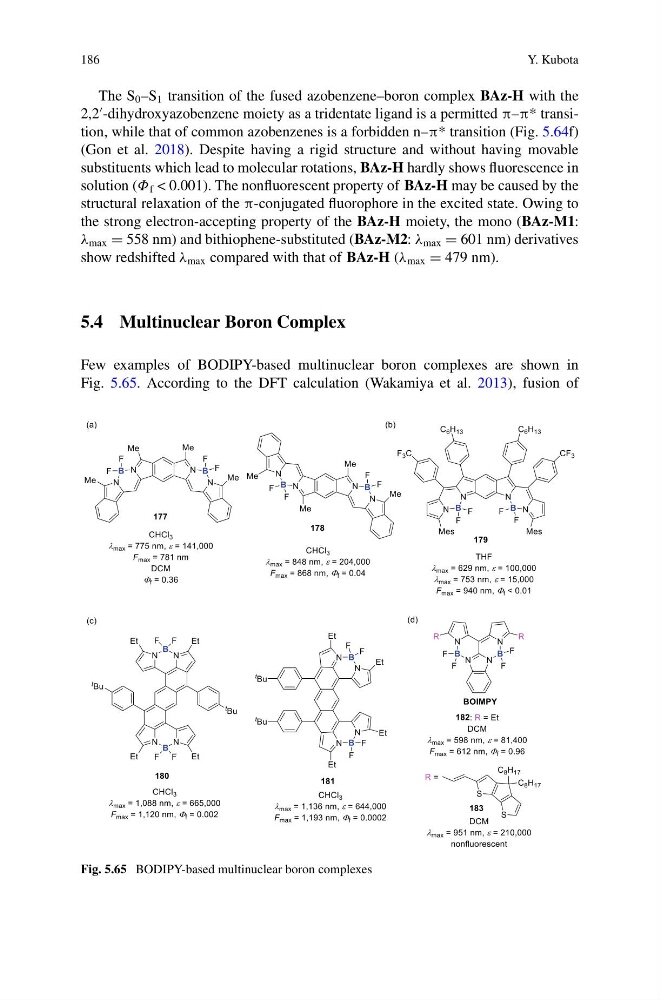
Few examples of BODIPY-based multinuclear boron complexes are shown in
Fig. 5.65. According to the DFT calculation (Wakamiya et al. 2013), fusion of
Fig. 5.65 BODIPY-based multinuclear boron complexes
Y. Kubota
The S 0 –S 1 transition of the fused azobenzene–boron complex BAz-H with the
2,2
-dihydroxyazobenzene moiety as a tridentate ligand is a permitted π–π* transition, while that of common azobenzenes is a forbidden n–π* transition (Fig. 5.64f)
(Gon et al. 2018). Despite having a rigid structure and without having movable
substituents which lead to molecular rotations, BAz-H hardly shows fluorescence in
solution (Φ f < 0.001). The nonfluorescent property of BAz-H may be caused by the
structural relaxation of the π-conjugated fluorophore in the excited state. Owing to
the strong electron-accepting property of the BAz-H moiety, the mono (BAz-M1:
λ max = 558 nm) and bithiophene-substituted (BAz-M2: λ max = 601 nm) derivatives
show redshifted λ max compared with that of BAz-H (λ max = 479 nm).
5.4 Multinuclear Boron Complex
Few examples of BODIPY-based multinuclear boron complexes are shown in
Fig. 5.65. According to the DFT calculation (Wakamiya et al. 2013), fusion of
Fig. 5.65 BODIPY-based multinuclear boron complexes