

5 BODIPY Dyes and Their Analogues
179
5.2.6.2
5 NˆO and
7 NˆO Monoboron Complexes
Few examples of
5 NˆO and
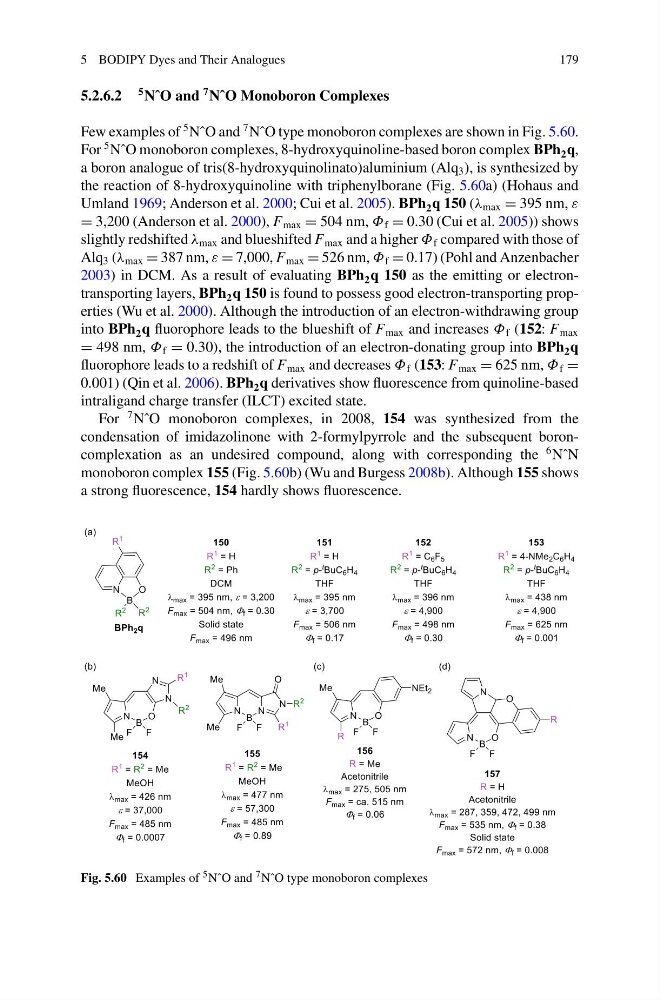
7 NˆO type monoboron complexes are shown in Fig. 5.60.
For
5 NˆO monoboron complexes, 8-hydroxyquinoline-based boron complex BPh 2 q,
a boron analogue of tris(8-hydroxyquinolinato)aluminium (Alq 3 ), is synthesized by
the reaction of 8-hydroxyquinoline with triphenylborane (Fig. 5.60a) (Hohaus and
Umland 1969; Anderson et al. 2000; Cui et al. 2005). BPh 2 q 150 (λ max = 395 nm, ε
= 3,200 (Anderson et al. 2000), F max = 504 nm, Φ f = 0.30 (Cui et al. 2005)) shows
slightly redshifted λ max and blueshifted F max and a higher Φ f compared with those of
Alq 3 (λ max = 387 nm, ε = 7,000, F max = 526 nm, Φ f = 0.17) (Pohl and Anzenbacher
2003) in DCM. As a result of evaluating BPh 2 q 150 as the emitting or electrontransporting layers, BPh 2 q 150 is found to possess good electron-transporting properties (Wu et al. 2000). Although the introduction of an electron-withdrawing group
into BPh 2 q fluorophore leads to the blueshift of F max and increases Φ f (152: F max
= 498 nm, Φ f = 0.30), the introduction of an electron-donating group into BPh 2 q
fluorophore leads to a redshift of F max and decreases Φ f (153: F max = 625 nm, Φ f =
0.001) (Qin et al. 2006). BPh 2 q derivatives show fluorescence from quinoline-based
intraligand charge transfer (ILCT) excited state.
For
7 NˆO monoboron complexes, in 2008, 154 was synthesized from the
condensation of imidazolinone with 2-formylpyrrole and the subsequent boroncomplexation as an undesired compound, along with corresponding the
6 NˆN
monoboron complex 155 (Fig. 5.60b) (Wu and Burgess 2008b). Although 155 shows
a strong fluorescence, 154 hardly shows fluorescence.
Fig. 5.60 Examples of 5 NˆO and 7 NˆO type monoboron complexes
179
5.2.6.2
5 NˆO and
7 NˆO Monoboron Complexes
Few examples of
5 NˆO and
7 NˆO type monoboron complexes are shown in Fig. 5.60.
For
5 NˆO monoboron complexes, 8-hydroxyquinoline-based boron complex BPh 2 q,
a boron analogue of tris(8-hydroxyquinolinato)aluminium (Alq 3 ), is synthesized by
the reaction of 8-hydroxyquinoline with triphenylborane (Fig. 5.60a) (Hohaus and
Umland 1969; Anderson et al. 2000; Cui et al. 2005). BPh 2 q 150 (λ max = 395 nm, ε
= 3,200 (Anderson et al. 2000), F max = 504 nm, Φ f = 0.30 (Cui et al. 2005)) shows
slightly redshifted λ max and blueshifted F max and a higher Φ f compared with those of
Alq 3 (λ max = 387 nm, ε = 7,000, F max = 526 nm, Φ f = 0.17) (Pohl and Anzenbacher
2003) in DCM. As a result of evaluating BPh 2 q 150 as the emitting or electrontransporting layers, BPh 2 q 150 is found to possess good electron-transporting properties (Wu et al. 2000). Although the introduction of an electron-withdrawing group
into BPh 2 q fluorophore leads to the blueshift of F max and increases Φ f (152: F max
= 498 nm, Φ f = 0.30), the introduction of an electron-donating group into BPh 2 q
fluorophore leads to a redshift of F max and decreases Φ f (153: F max = 625 nm, Φ f =
0.001) (Qin et al. 2006). BPh 2 q derivatives show fluorescence from quinoline-based
intraligand charge transfer (ILCT) excited state.
For
7 NˆO monoboron complexes, in 2008, 154 was synthesized from the
condensation of imidazolinone with 2-formylpyrrole and the subsequent boroncomplexation as an undesired compound, along with corresponding the
6 NˆN
monoboron complex 155 (Fig. 5.60b) (Wu and Burgess 2008b). Although 155 shows
a strong fluorescence, 154 hardly shows fluorescence.
Fig. 5.60 Examples of 5 NˆO and 7 NˆO type monoboron complexes