

178
Y. Kubota
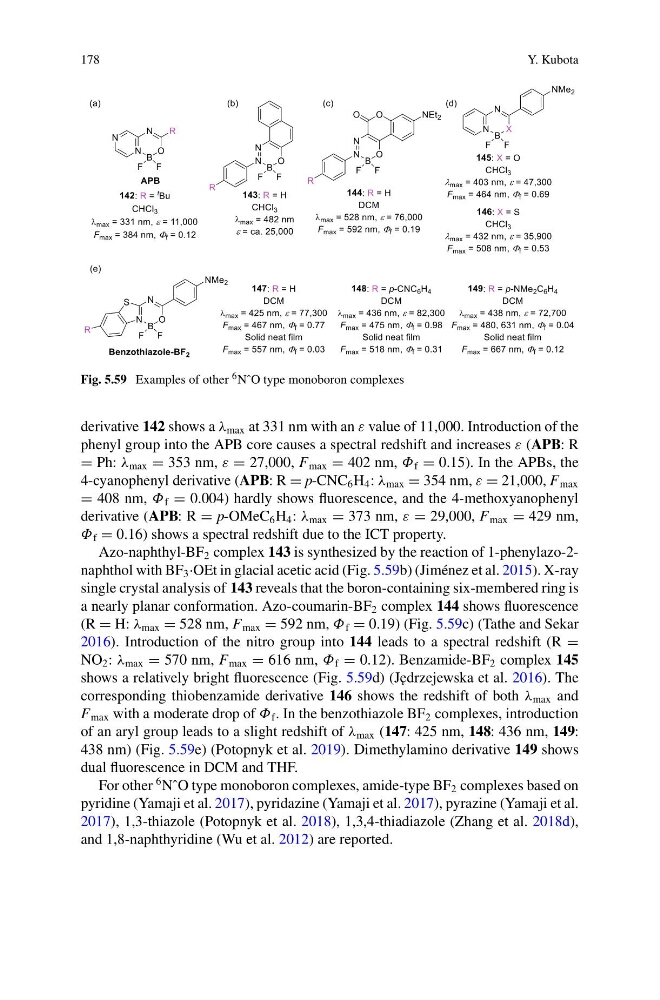
Fig. 5.59 Examples of other 6 NˆO type monoboron complexes
derivative 142 shows a λ max at 331 nm with an ε value of 11,000. Introduction of the
phenyl group into the APB core causes a spectral redshift and increases ε (APB: R
= Ph: λ max = 353 nm, ε = 27,000, F max = 402 nm, Φ f = 0.15). In the APBs, the
4-cyanophenyl derivative (APB: R = p-CNC 6 H 4 : λ max = 354 nm, ε = 21,000, F max
= 408 nm, Φ f = 0.004) hardly shows fluorescence, and the 4-methoxyanophenyl
derivative (APB: R = p-OMeC 6 H 4 : λ max = 373 nm, ε = 29,000, F max = 429 nm,
Φ f = 0.16) shows a spectral redshift due to the ICT property.
Azo-naphthyl-BF 2 complex 143 is synthesized by the reaction of 1-phenylazo-2naphthol with BF 3 ·OEt in glacial acetic acid (Fig. 5.59b) (Jiménez et al. 2015). X-ray
single crystal analysis of 143 reveals that the boron-containing six-membered ring is
a nearly planar conformation. Azo-coumarin-BF 2 complex 144 shows fluorescence
(R = H: λ max = 528 nm, F max = 592 nm, Φ f = 0.19) (Fig. 5.59c) (Tathe and Sekar
2016). Introduction of the nitro group into 144 leads to a spectral redshift (R =
NO 2 : λ max = 570 nm, F max = 616 nm, Φ f = 0.12). Benzamide-BF 2 complex 145
shows a relatively bright fluorescence (Fig. 5.59d) (J˛ edrzejewska et al. 2016). The
corresponding thiobenzamide derivative 146 shows the redshift of both λ max and
F max with a moderate drop of Φ f . In the benzothiazole BF 2 complexes, introduction
of an aryl group leads to a slight redshift of λ max (147: 425 nm, 148: 436 nm, 149:
438 nm) (Fig. 5.59e) (Potopnyk et al. 2019). Dimethylamino derivative 149 shows
dual fluorescence in DCM and THF.
For other
6 NˆO type monoboron complexes, amide-type BF 2 complexes based on
pyridine (Yamaji et al. 2017), pyridazine (Yamaji et al. 2017), pyrazine (Yamaji et al.
2017), 1,3-thiazole (Potopnyk et al. 2018), 1,3,4-thiadiazole (Zhang et al. 2018d),
and 1,8-naphthyridine (Wu et al. 2012) are reported.
Y. Kubota
Fig. 5.59 Examples of other 6 NˆO type monoboron complexes
derivative 142 shows a λ max at 331 nm with an ε value of 11,000. Introduction of the
phenyl group into the APB core causes a spectral redshift and increases ε (APB: R
= Ph: λ max = 353 nm, ε = 27,000, F max = 402 nm, Φ f = 0.15). In the APBs, the
4-cyanophenyl derivative (APB: R = p-CNC 6 H 4 : λ max = 354 nm, ε = 21,000, F max
= 408 nm, Φ f = 0.004) hardly shows fluorescence, and the 4-methoxyanophenyl
derivative (APB: R = p-OMeC 6 H 4 : λ max = 373 nm, ε = 29,000, F max = 429 nm,
Φ f = 0.16) shows a spectral redshift due to the ICT property.
Azo-naphthyl-BF 2 complex 143 is synthesized by the reaction of 1-phenylazo-2naphthol with BF 3 ·OEt in glacial acetic acid (Fig. 5.59b) (Jiménez et al. 2015). X-ray
single crystal analysis of 143 reveals that the boron-containing six-membered ring is
a nearly planar conformation. Azo-coumarin-BF 2 complex 144 shows fluorescence
(R = H: λ max = 528 nm, F max = 592 nm, Φ f = 0.19) (Fig. 5.59c) (Tathe and Sekar
2016). Introduction of the nitro group into 144 leads to a spectral redshift (R =
NO 2 : λ max = 570 nm, F max = 616 nm, Φ f = 0.12). Benzamide-BF 2 complex 145
shows a relatively bright fluorescence (Fig. 5.59d) (J˛ edrzejewska et al. 2016). The
corresponding thiobenzamide derivative 146 shows the redshift of both λ max and
F max with a moderate drop of Φ f . In the benzothiazole BF 2 complexes, introduction
of an aryl group leads to a slight redshift of λ max (147: 425 nm, 148: 436 nm, 149:
438 nm) (Fig. 5.59e) (Potopnyk et al. 2019). Dimethylamino derivative 149 shows
dual fluorescence in DCM and THF.
For other
6 NˆO type monoboron complexes, amide-type BF 2 complexes based on
pyridine (Yamaji et al. 2017), pyridazine (Yamaji et al. 2017), pyrazine (Yamaji et al.
2017), 1,3-thiazole (Potopnyk et al. 2018), 1,3,4-thiadiazole (Zhang et al. 2018d),
and 1,8-naphthyridine (Wu et al. 2012) are reported.