

5 BODIPY Dyes and Their Analogues
177
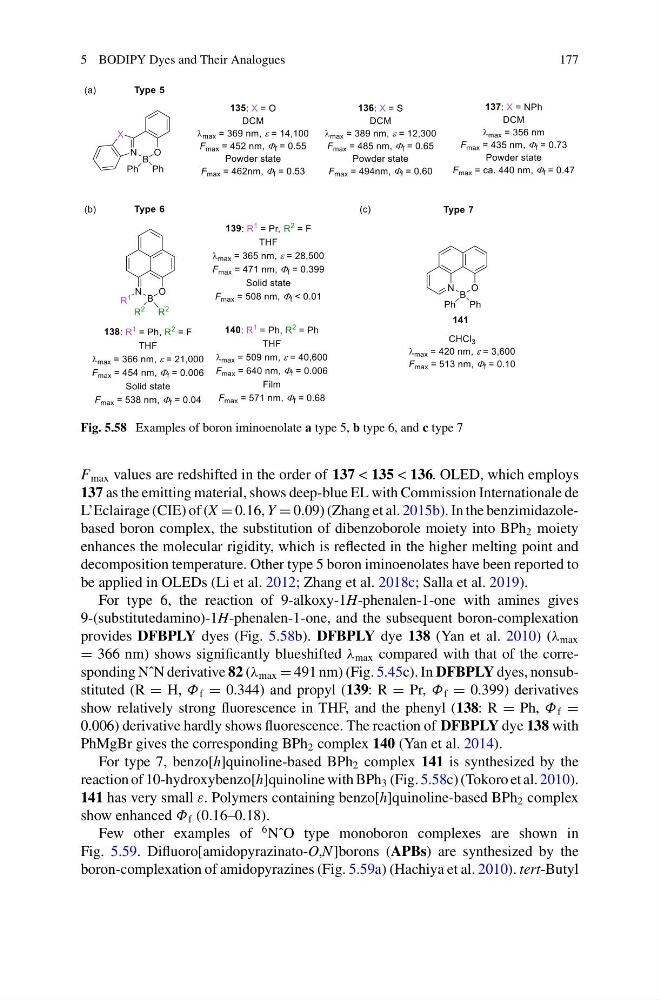
Fig. 5.58 Examples of boron iminoenolate a type 5, b type 6, and c type 7
F max values are redshifted in the order of 137 < 135 < 136. OLED, which employs
137 as the emitting material, shows deep-blue EL with Commission Internationale de
L’Eclairage (CIE) of (X = 0.16, Y = 0.09) (Zhang et al. 2015b). In the benzimidazolebased boron complex, the substitution of dibenzoborole moiety into BPh 2 moiety
enhances the molecular rigidity, which is reflected in the higher melting point and
decomposition temperature. Other type 5 boron iminoenolates have been reported to
be applied in OLEDs (Li et al. 2012; Zhang et al. 2018c; Salla et al. 2019).
For type 6, the reaction of 9-alkoxy-1H-phenalen-1-one with amines gives
9-(substitutedamino)-1H-phenalen-1-one, and the subsequent boron-complexation
provides DFBPLY dyes (Fig. 5.58b). DFBPLY dye 138 (Yan et al. 2010) (λ max
= 366 nm) shows significantly blueshifted λ max compared with that of the corresponding NˆN derivative 82 (λ max = 491 nm) (Fig. 5.45c). In DFBPLY dyes, nonsubstituted (R = H, Φ f = 0.344) and propyl (139: R = Pr, Φ f = 0.399) derivatives
show relatively strong fluorescence in THF, and the phenyl (138: R = Ph, Φ f =
0.006) derivative hardly shows fluorescence. The reaction of DFBPLY dye 138 with
PhMgBr gives the corresponding BPh 2 complex 140 (Yan et al. 2014).
For type 7, benzo[h]quinoline-based BPh 2 complex 141 is synthesized by the
reaction of 10-hydroxybenzo[h]quinoline with BPh 3 (Fig. 5.58c) (Tokoro et al. 2010).
141 has very small ε. Polymers containing benzo[h]quinoline-based BPh 2 complex
show enhanced Φ f (0.16–0.18).
Few other examples of
6 NˆO type monoboron complexes are shown in
Fig. 5.59. Difluoro[amidopyrazinato-O,N]borons (APBs) are synthesized by the
boron-complexation of amidopyrazines (Fig. 5.59a) (Hachiya et al. 2010). tert-Butyl
177
Fig. 5.58 Examples of boron iminoenolate a type 5, b type 6, and c type 7
F max values are redshifted in the order of 137 < 135 < 136. OLED, which employs
137 as the emitting material, shows deep-blue EL with Commission Internationale de
L’Eclairage (CIE) of (X = 0.16, Y = 0.09) (Zhang et al. 2015b). In the benzimidazolebased boron complex, the substitution of dibenzoborole moiety into BPh 2 moiety
enhances the molecular rigidity, which is reflected in the higher melting point and
decomposition temperature. Other type 5 boron iminoenolates have been reported to
be applied in OLEDs (Li et al. 2012; Zhang et al. 2018c; Salla et al. 2019).
For type 6, the reaction of 9-alkoxy-1H-phenalen-1-one with amines gives
9-(substitutedamino)-1H-phenalen-1-one, and the subsequent boron-complexation
provides DFBPLY dyes (Fig. 5.58b). DFBPLY dye 138 (Yan et al. 2010) (λ max
= 366 nm) shows significantly blueshifted λ max compared with that of the corresponding NˆN derivative 82 (λ max = 491 nm) (Fig. 5.45c). In DFBPLY dyes, nonsubstituted (R = H, Φ f = 0.344) and propyl (139: R = Pr, Φ f = 0.399) derivatives
show relatively strong fluorescence in THF, and the phenyl (138: R = Ph, Φ f =
0.006) derivative hardly shows fluorescence. The reaction of DFBPLY dye 138 with
PhMgBr gives the corresponding BPh 2 complex 140 (Yan et al. 2014).
For type 7, benzo[h]quinoline-based BPh 2 complex 141 is synthesized by the
reaction of 10-hydroxybenzo[h]quinoline with BPh 3 (Fig. 5.58c) (Tokoro et al. 2010).
141 has very small ε. Polymers containing benzo[h]quinoline-based BPh 2 complex
show enhanced Φ f (0.16–0.18).
Few other examples of
6 NˆO type monoboron complexes are shown in
Fig. 5.59. Difluoro[amidopyrazinato-O,N]borons (APBs) are synthesized by the
boron-complexation of amidopyrazines (Fig. 5.59a) (Hachiya et al. 2010). tert-Butyl