

176
Y. Kubota
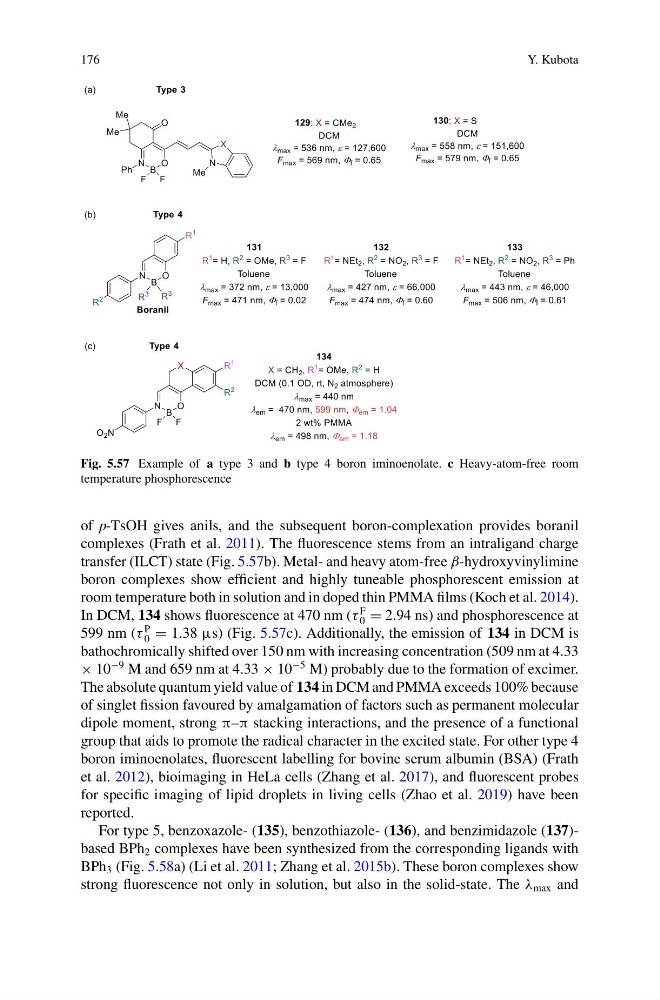
Fig. 5.57 Example of a type 3 and b type 4 boron iminoenolate. c Heavy-atom-free room
temperature phosphorescence
of p-TsOH gives anils, and the subsequent boron-complexation provides boranil
complexes (Frath et al. 2011). The fluorescence stems from an intraligand charge
transfer (ILCT) state (Fig. 5.57b). Metal- and heavy atom-free β-hydroxyvinylimine
boron complexes show efficient and highly tuneable phosphorescent emission at
room temperature both in solution and in doped thin PMMA films (Koch et al. 2014).
In DCM, 134 shows fluorescence at 470 nm (τ
F
0 = 2.94 ns) and phosphorescence at
599 nm (τ
P
0 = 1.38 μs) (Fig. 5.57c). Additionally, the emission of 134 in DCM is
bathochromically shifted over 150 nm with increasing concentration (509 nm at 4.33
× 10
−9 M and 659 nm at 4.33 × 10
−5 M) probably due to the formation of excimer.
The absolute quantum yield value of 134 in DCM and PMMA exceeds 100% because
of singlet fission favoured by amalgamation of factors such as permanent molecular
dipole moment, strong π–π stacking interactions, and the presence of a functional
group that aids to promote the radical character in the excited state. For other type 4
boron iminoenolates, fluorescent labelling for bovine serum albumin (BSA) (Frath
et al. 2012), bioimaging in HeLa cells (Zhang et al. 2017), and fluorescent probes
for specific imaging of lipid droplets in living cells (Zhao et al. 2019) have been
reported.
For type 5, benzoxazole- (135), benzothiazole- (136), and benzimidazole (137)based BPh 2 complexes have been synthesized from the corresponding ligands with
BPh 3 (Fig. 5.58a) (Li et al. 2011; Zhang et al. 2015b). These boron complexes show
strong fluorescence not only in solution, but also in the solid-state. The λ max and
Y. Kubota
Fig. 5.57 Example of a type 3 and b type 4 boron iminoenolate. c Heavy-atom-free room
temperature phosphorescence
of p-TsOH gives anils, and the subsequent boron-complexation provides boranil
complexes (Frath et al. 2011). The fluorescence stems from an intraligand charge
transfer (ILCT) state (Fig. 5.57b). Metal- and heavy atom-free β-hydroxyvinylimine
boron complexes show efficient and highly tuneable phosphorescent emission at
room temperature both in solution and in doped thin PMMA films (Koch et al. 2014).
In DCM, 134 shows fluorescence at 470 nm (τ
F
0 = 2.94 ns) and phosphorescence at
599 nm (τ
P
0 = 1.38 μs) (Fig. 5.57c). Additionally, the emission of 134 in DCM is
bathochromically shifted over 150 nm with increasing concentration (509 nm at 4.33
× 10
−9 M and 659 nm at 4.33 × 10
−5 M) probably due to the formation of excimer.
The absolute quantum yield value of 134 in DCM and PMMA exceeds 100% because
of singlet fission favoured by amalgamation of factors such as permanent molecular
dipole moment, strong π–π stacking interactions, and the presence of a functional
group that aids to promote the radical character in the excited state. For other type 4
boron iminoenolates, fluorescent labelling for bovine serum albumin (BSA) (Frath
et al. 2012), bioimaging in HeLa cells (Zhang et al. 2017), and fluorescent probes
for specific imaging of lipid droplets in living cells (Zhao et al. 2019) have been
reported.
For type 5, benzoxazole- (135), benzothiazole- (136), and benzimidazole (137)based BPh 2 complexes have been synthesized from the corresponding ligands with
BPh 3 (Fig. 5.58a) (Li et al. 2011; Zhang et al. 2015b). These boron complexes show
strong fluorescence not only in solution, but also in the solid-state. The λ max and