

5 BODIPY Dyes and Their Analogues
175
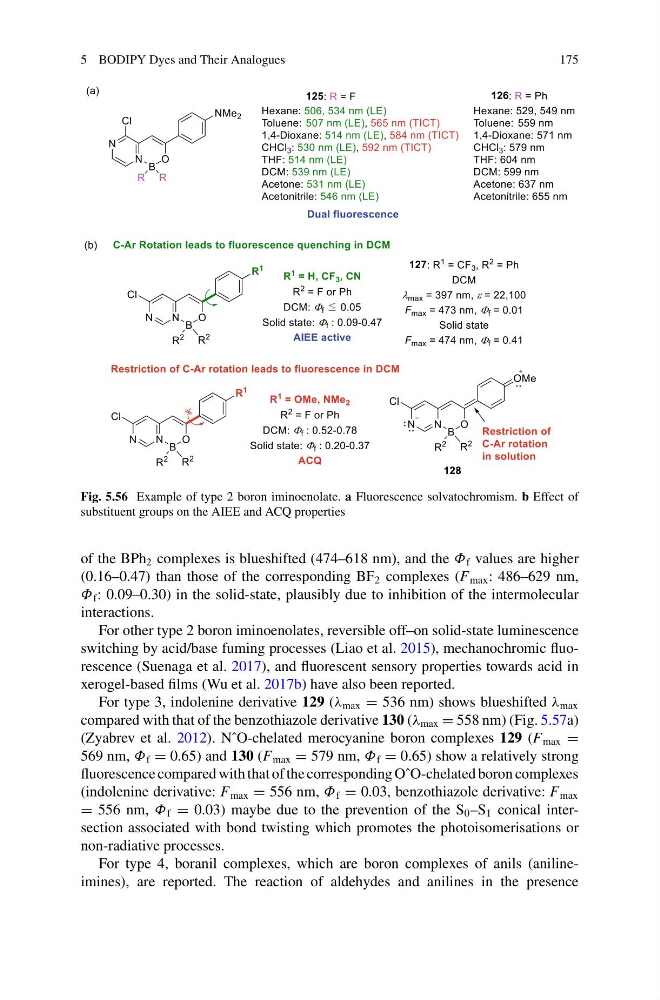
Fig. 5.56 Example of type 2 boron iminoenolate. a Fluorescence solvatochromism. b Effect of
substituent groups on the AIEE and ACQ properties
of the BPh 2 complexes is blueshifted (474–618 nm), and the Φ f values are higher
(0.16–0.47) than those of the corresponding BF 2 complexes (F max : 486–629 nm,
Φ f : 0.09–0.30) in the solid-state, plausibly due to inhibition of the intermolecular
interactions.
For other type 2 boron iminoenolates, reversible off–on solid-state luminescence
switching by acid/base fuming processes (Liao et al. 2015), mechanochromic fluorescence (Suenaga et al. 2017), and fluorescent sensory properties towards acid in
xerogel-based films (Wu et al. 2017b) have also been reported.
For type 3, indolenine derivative 129 (λ max = 536 nm) shows blueshifted λ max
compared with that of the benzothiazole derivative 130 (λ max = 558 nm) (Fig. 5.57a)
(Zyabrev et al. 2012). NˆO-chelated merocyanine boron complexes 129 (F max =
569 nm, Φ f = 0.65) and 130 (F max = 579 nm, Φ f = 0.65) show a relatively strong
fluorescence compared with that of the corresponding OˆO-chelated boron complexes
(indolenine derivative: F max = 556 nm, Φ f = 0.03, benzothiazole derivative: F max
= 556 nm, Φ f = 0.03) maybe due to the prevention of the S 0 –S 1 conical intersection associated with bond twisting which promotes the photoisomerisations or
non-radiative processes.
For type 4, boranil complexes, which are boron complexes of anils (anilineimines), are reported. The reaction of aldehydes and anilines in the presence
175
Fig. 5.56 Example of type 2 boron iminoenolate. a Fluorescence solvatochromism. b Effect of
substituent groups on the AIEE and ACQ properties
of the BPh 2 complexes is blueshifted (474–618 nm), and the Φ f values are higher
(0.16–0.47) than those of the corresponding BF 2 complexes (F max : 486–629 nm,
Φ f : 0.09–0.30) in the solid-state, plausibly due to inhibition of the intermolecular
interactions.
For other type 2 boron iminoenolates, reversible off–on solid-state luminescence
switching by acid/base fuming processes (Liao et al. 2015), mechanochromic fluorescence (Suenaga et al. 2017), and fluorescent sensory properties towards acid in
xerogel-based films (Wu et al. 2017b) have also been reported.
For type 3, indolenine derivative 129 (λ max = 536 nm) shows blueshifted λ max
compared with that of the benzothiazole derivative 130 (λ max = 558 nm) (Fig. 5.57a)
(Zyabrev et al. 2012). NˆO-chelated merocyanine boron complexes 129 (F max =
569 nm, Φ f = 0.65) and 130 (F max = 579 nm, Φ f = 0.65) show a relatively strong
fluorescence compared with that of the corresponding OˆO-chelated boron complexes
(indolenine derivative: F max = 556 nm, Φ f = 0.03, benzothiazole derivative: F max
= 556 nm, Φ f = 0.03) maybe due to the prevention of the S 0 –S 1 conical intersection associated with bond twisting which promotes the photoisomerisations or
non-radiative processes.
For type 4, boranil complexes, which are boron complexes of anils (anilineimines), are reported. The reaction of aldehydes and anilines in the presence