

174
Y. Kubota
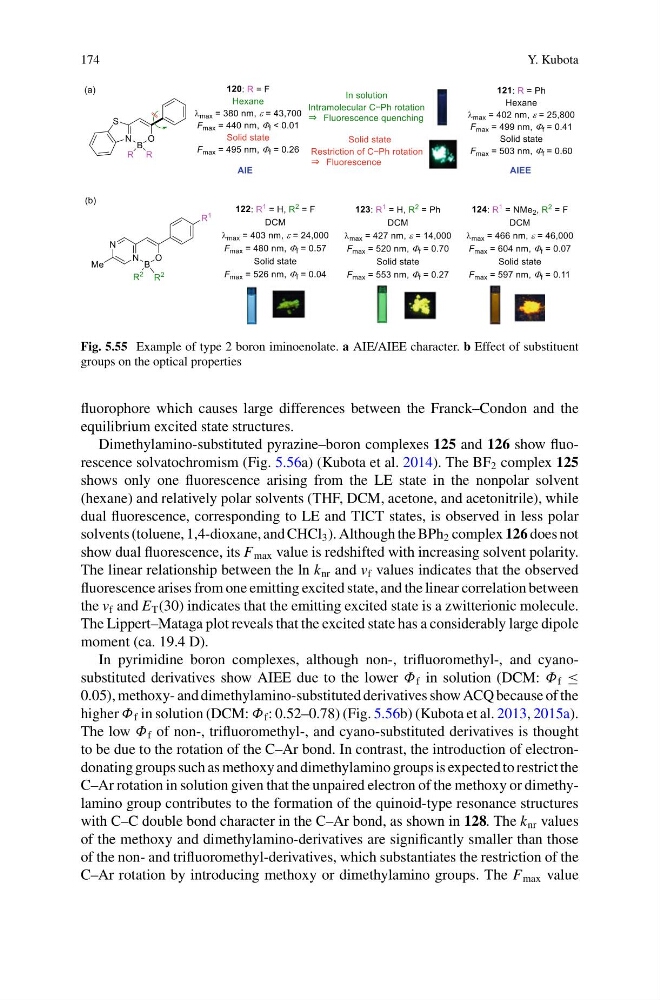
Fig. 5.55 Example of type 2 boron iminoenolate. a AIE/AIEE character. b Effect of substituent
groups on the optical properties
fluorophore which causes large differences between the Franck–Condon and the
equilibrium excited state structures.
Dimethylamino-substituted pyrazine–boron complexes 125 and 126 show fluorescence solvatochromism (Fig. 5.56a) (Kubota et al. 2014). The BF 2 complex 125
shows only one fluorescence arising from the LE state in the nonpolar solvent
(hexane) and relatively polar solvents (THF, DCM, acetone, and acetonitrile), while
dual fluorescence, corresponding to LE and TICT states, is observed in less polar
solvents (toluene, 1,4-dioxane, and CHCl 3 ). Although the BPh 2 complex 126 does not
show dual fluorescence, its F max value is redshifted with increasing solvent polarity.
The linear relationship between the ln k nr and v f values indicates that the observed
fluorescence arises from one emitting excited state, and the linear correlation between
the v f and E T (30) indicates that the emitting excited state is a zwitterionic molecule.
The Lippert–Mataga plot reveals that the excited state has a considerably large dipole
moment (ca. 19.4 D).
In pyrimidine boron complexes, although non-, trifluoromethyl-, and cyanosubstituted derivatives show AIEE due to the lower Φ f in solution (DCM: Φ f ≤
0.05), methoxy- and dimethylamino-substituted derivatives show ACQ because of the
higher Φ f in solution (DCM: Φ f : 0.52–0.78) (Fig. 5.56b) (Kubota et al. 2013, 2015a).
The low Φ f of non-, trifluoromethyl-, and cyano-substituted derivatives is thought
to be due to the rotation of the C–Ar bond. In contrast, the introduction of electrondonating groups such as methoxy and dimethylamino groups is expected to restrict the
C–Ar rotation in solution given that the unpaired electron of the methoxy or dimethylamino group contributes to the formation of the quinoid-type resonance structures
with C–C double bond character in the C–Ar bond, as shown in 128. The k nr values
of the methoxy and dimethylamino-derivatives are significantly smaller than those
of the non- and trifluoromethyl-derivatives, which substantiates the restriction of the
C–Ar rotation by introducing methoxy or dimethylamino groups. The F max value
Y. Kubota
Fig. 5.55 Example of type 2 boron iminoenolate. a AIE/AIEE character. b Effect of substituent
groups on the optical properties
fluorophore which causes large differences between the Franck–Condon and the
equilibrium excited state structures.
Dimethylamino-substituted pyrazine–boron complexes 125 and 126 show fluorescence solvatochromism (Fig. 5.56a) (Kubota et al. 2014). The BF 2 complex 125
shows only one fluorescence arising from the LE state in the nonpolar solvent
(hexane) and relatively polar solvents (THF, DCM, acetone, and acetonitrile), while
dual fluorescence, corresponding to LE and TICT states, is observed in less polar
solvents (toluene, 1,4-dioxane, and CHCl 3 ). Although the BPh 2 complex 126 does not
show dual fluorescence, its F max value is redshifted with increasing solvent polarity.
The linear relationship between the ln k nr and v f values indicates that the observed
fluorescence arises from one emitting excited state, and the linear correlation between
the v f and E T (30) indicates that the emitting excited state is a zwitterionic molecule.
The Lippert–Mataga plot reveals that the excited state has a considerably large dipole
moment (ca. 19.4 D).
In pyrimidine boron complexes, although non-, trifluoromethyl-, and cyanosubstituted derivatives show AIEE due to the lower Φ f in solution (DCM: Φ f ≤
0.05), methoxy- and dimethylamino-substituted derivatives show ACQ because of the
higher Φ f in solution (DCM: Φ f : 0.52–0.78) (Fig. 5.56b) (Kubota et al. 2013, 2015a).
The low Φ f of non-, trifluoromethyl-, and cyano-substituted derivatives is thought
to be due to the rotation of the C–Ar bond. In contrast, the introduction of electrondonating groups such as methoxy and dimethylamino groups is expected to restrict the
C–Ar rotation in solution given that the unpaired electron of the methoxy or dimethylamino group contributes to the formation of the quinoid-type resonance structures
with C–C double bond character in the C–Ar bond, as shown in 128. The k nr values
of the methoxy and dimethylamino-derivatives are significantly smaller than those
of the non- and trifluoromethyl-derivatives, which substantiates the restriction of the
C–Ar rotation by introducing methoxy or dimethylamino groups. The F max value