

5 BODIPY Dyes and Their Analogues
173
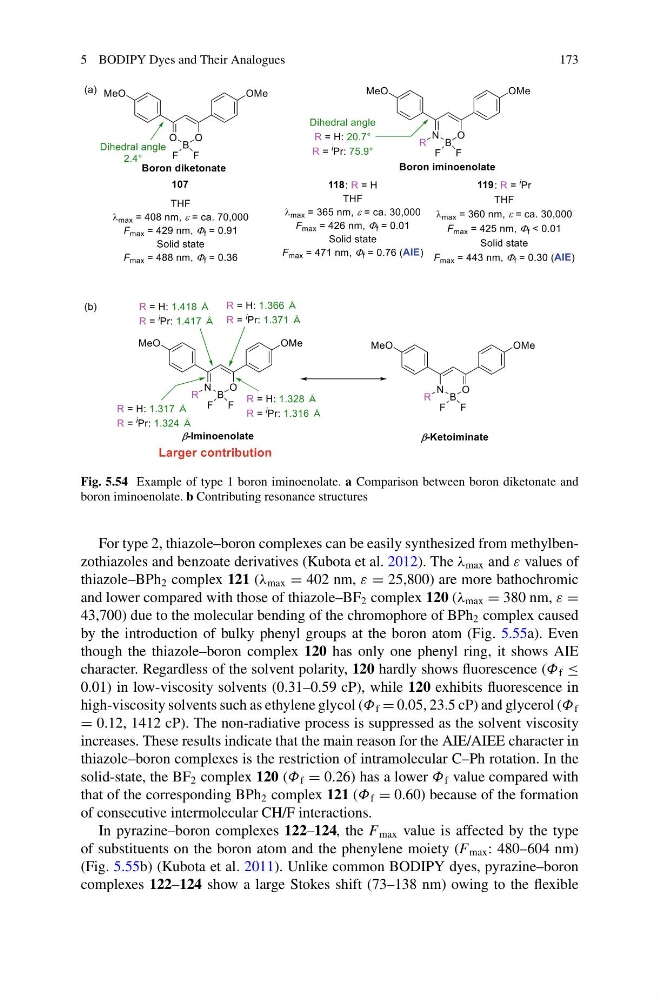
Fig. 5.54 Example of type 1 boron iminoenolate. a Comparison between boron diketonate and
boron iminoenolate. b Contributing resonance structures
For type 2, thiazole–boron complexes can be easily synthesized from methylbenzothiazoles and benzoate derivatives (Kubota et al. 2012). The λ max and ε values of
thiazole–BPh 2 complex 121 (λ max = 402 nm, ε = 25,800) are more bathochromic
and lower compared with those of thiazole–BF 2 complex 120 (λ max = 380 nm, ε =
43,700) due to the molecular bending of the chromophore of BPh 2 complex caused
by the introduction of bulky phenyl groups at the boron atom (Fig. 5.55a). Even
though the thiazole–boron complex 120 has only one phenyl ring, it shows AIE
character. Regardless of the solvent polarity, 120 hardly shows fluorescence (Φ f ≤
0.01) in low-viscosity solvents (0.31–0.59 cP), while 120 exhibits fluorescence in
high-viscosity solvents such as ethylene glycol (Φ f = 0.05, 23.5 cP) and glycerol (Φ f
= 0.12, 1412 cP). The non-radiative process is suppressed as the solvent viscosity
increases. These results indicate that the main reason for the AIE/AIEE character in
thiazole–boron complexes is the restriction of intramolecular C–Ph rotation. In the
solid-state, the BF 2 complex 120 (Φ f = 0.26) has a lower Φ f value compared with
that of the corresponding BPh 2 complex 121 (Φ f = 0.60) because of the formation
of consecutive intermolecular CH/F interactions.
In pyrazine–boron complexes 122–124, the F max value is affected by the type
of substituents on the boron atom and the phenylene moiety (F max : 480–604 nm)
(Fig. 5.55b) (Kubota et al. 2011). Unlike common BODIPY dyes, pyrazine–boron
complexes 122–124 show a large Stokes shift (73–138 nm) owing to the flexible
173
Fig. 5.54 Example of type 1 boron iminoenolate. a Comparison between boron diketonate and
boron iminoenolate. b Contributing resonance structures
For type 2, thiazole–boron complexes can be easily synthesized from methylbenzothiazoles and benzoate derivatives (Kubota et al. 2012). The λ max and ε values of
thiazole–BPh 2 complex 121 (λ max = 402 nm, ε = 25,800) are more bathochromic
and lower compared with those of thiazole–BF 2 complex 120 (λ max = 380 nm, ε =
43,700) due to the molecular bending of the chromophore of BPh 2 complex caused
by the introduction of bulky phenyl groups at the boron atom (Fig. 5.55a). Even
though the thiazole–boron complex 120 has only one phenyl ring, it shows AIE
character. Regardless of the solvent polarity, 120 hardly shows fluorescence (Φ f ≤
0.01) in low-viscosity solvents (0.31–0.59 cP), while 120 exhibits fluorescence in
high-viscosity solvents such as ethylene glycol (Φ f = 0.05, 23.5 cP) and glycerol (Φ f
= 0.12, 1412 cP). The non-radiative process is suppressed as the solvent viscosity
increases. These results indicate that the main reason for the AIE/AIEE character in
thiazole–boron complexes is the restriction of intramolecular C–Ph rotation. In the
solid-state, the BF 2 complex 120 (Φ f = 0.26) has a lower Φ f value compared with
that of the corresponding BPh 2 complex 121 (Φ f = 0.60) because of the formation
of consecutive intermolecular CH/F interactions.
In pyrazine–boron complexes 122–124, the F max value is affected by the type
of substituents on the boron atom and the phenylene moiety (F max : 480–604 nm)
(Fig. 5.55b) (Kubota et al. 2011). Unlike common BODIPY dyes, pyrazine–boron
complexes 122–124 show a large Stokes shift (73–138 nm) owing to the flexible