

172
Y. Kubota
Heavy-atom-free BF 2 dbm with high triplet activity is more attractive because
generally, a halogen atom is photochemically unstable, toxic, and unfriendly to the
environment (Huang et al. 2019). Chen et al. reported the triplet activity of heavyatom-free BF 2 dbm is boosted via sp
3 oxygen-bridged electron donors (Fig. 5.52b)
(Huang et al. 2019). Methoxy- and phenoxy-substituted derivatives 115 (F max =
420 nm, Φ PL = 0.97) and 116 (F max = 414 nm, Φ PL = 0.81) show intense fluorescence in 2-methyl-tetrahydrofuran (2Me-THF) at room temperature, while 4methoxyphenoxy-substituted derivative 117 (F max = 415 nm, Φ PL < 0.001) exhibits
extremely attenuated fluorescence. In contrast, in 2Me-THF at 77 K, 117 (λ P =
539 nm, Φ P = 0.16) shows relatively intense phosphorescence because of the charge
transfer mediated ISC process.
5.2.6 NˆO Type Organoboron Complex
5.2.6.1
6 NˆO Monoboron Complexes
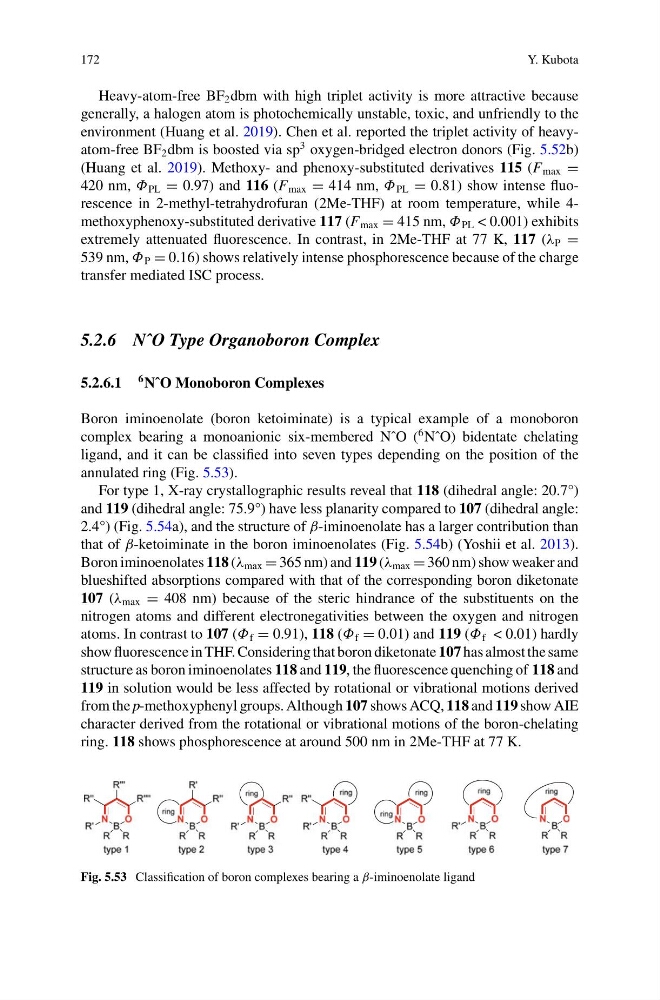
Boron iminoenolate (boron ketoiminate) is a typical example of a monoboron
complex bearing a monoanionic six-membered NˆO (
6 NˆO) bidentate chelating
ligand, and it can be classified into seven types depending on the position of the
annulated ring (Fig. 5.53).
For type 1, X-ray crystallographic results reveal that 118 (dihedral angle: 20.7°)
and 119 (dihedral angle: 75.9°) have less planarity compared to 107 (dihedral angle:
2.4°) (Fig. 5.54a), and the structure of β-iminoenolate has a larger contribution than
that of β-ketoiminate in the boron iminoenolates (Fig. 5.54b) (Yoshii et al. 2013).
Boron iminoenolates 118 (λ max = 365 nm) and 119 (λ max = 360 nm) show weaker and
blueshifted absorptions compared with that of the corresponding boron diketonate
107 (λ max = 408 nm) because of the steric hindrance of the substituents on the
nitrogen atoms and different electronegativities between the oxygen and nitrogen
atoms. In contrast to 107 (Φ f = 0.91), 118 (Φ f = 0.01) and 119 (Φ f < 0.01) hardly
show fluorescence in THF. Considering that boron diketonate 107 has almost the same
structure as boron iminoenolates 118 and 119, the fluorescence quenching of 118 and
119 in solution would be less affected by rotational or vibrational motions derived
from the p-methoxyphenyl groups. Although 107 shows ACQ, 118 and 119 show AIE
character derived from the rotational or vibrational motions of the boron-chelating
ring. 118 shows phosphorescence at around 500 nm in 2Me-THF at 77 K.
Fig. 5.53 Classification of boron complexes bearing a β-iminoenolate ligand
Y. Kubota
Heavy-atom-free BF 2 dbm with high triplet activity is more attractive because
generally, a halogen atom is photochemically unstable, toxic, and unfriendly to the
environment (Huang et al. 2019). Chen et al. reported the triplet activity of heavyatom-free BF 2 dbm is boosted via sp
3 oxygen-bridged electron donors (Fig. 5.52b)
(Huang et al. 2019). Methoxy- and phenoxy-substituted derivatives 115 (F max =
420 nm, Φ PL = 0.97) and 116 (F max = 414 nm, Φ PL = 0.81) show intense fluorescence in 2-methyl-tetrahydrofuran (2Me-THF) at room temperature, while 4methoxyphenoxy-substituted derivative 117 (F max = 415 nm, Φ PL < 0.001) exhibits
extremely attenuated fluorescence. In contrast, in 2Me-THF at 77 K, 117 (λ P =
539 nm, Φ P = 0.16) shows relatively intense phosphorescence because of the charge
transfer mediated ISC process.
5.2.6 NˆO Type Organoboron Complex
5.2.6.1
6 NˆO Monoboron Complexes
Boron iminoenolate (boron ketoiminate) is a typical example of a monoboron
complex bearing a monoanionic six-membered NˆO (
6 NˆO) bidentate chelating
ligand, and it can be classified into seven types depending on the position of the
annulated ring (Fig. 5.53).
For type 1, X-ray crystallographic results reveal that 118 (dihedral angle: 20.7°)
and 119 (dihedral angle: 75.9°) have less planarity compared to 107 (dihedral angle:
2.4°) (Fig. 5.54a), and the structure of β-iminoenolate has a larger contribution than
that of β-ketoiminate in the boron iminoenolates (Fig. 5.54b) (Yoshii et al. 2013).
Boron iminoenolates 118 (λ max = 365 nm) and 119 (λ max = 360 nm) show weaker and
blueshifted absorptions compared with that of the corresponding boron diketonate
107 (λ max = 408 nm) because of the steric hindrance of the substituents on the
nitrogen atoms and different electronegativities between the oxygen and nitrogen
atoms. In contrast to 107 (Φ f = 0.91), 118 (Φ f = 0.01) and 119 (Φ f < 0.01) hardly
show fluorescence in THF. Considering that boron diketonate 107 has almost the same
structure as boron iminoenolates 118 and 119, the fluorescence quenching of 118 and
119 in solution would be less affected by rotational or vibrational motions derived
from the p-methoxyphenyl groups. Although 107 shows ACQ, 118 and 119 show AIE
character derived from the rotational or vibrational motions of the boron-chelating
ring. 118 shows phosphorescence at around 500 nm in 2Me-THF at 77 K.
Fig. 5.53 Classification of boron complexes bearing a β-iminoenolate ligand