

5 BODIPY Dyes and Their Analogues
171
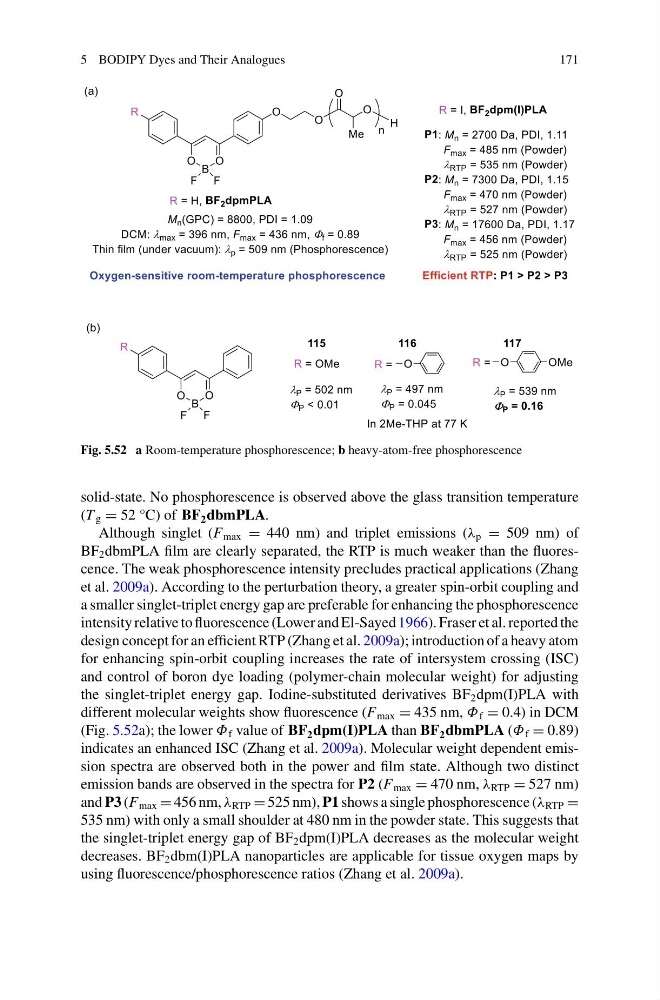
Fig. 5.52 a Room-temperature phosphorescence; b heavy-atom-free phosphorescence
solid-state. No phosphorescence is observed above the glass transition temperature
(T g = 52 °C) of BF 2 dbmPLA.
Although singlet (F max = 440 nm) and triplet emissions (λ p = 509 nm) of
BF 2 dbmPLA film are clearly separated, the RTP is much weaker than the fluorescence. The weak phosphorescence intensity precludes practical applications (Zhang
et al. 2009a). According to the perturbation theory, a greater spin-orbit coupling and
a smaller singlet-triplet energy gap are preferable for enhancing the phosphorescence
intensity relative to fluorescence (Lower and El-Sayed 1966). Fraser et al. reported the
design concept for an efficient RTP (Zhang et al. 2009a); introduction of a heavy atom
for enhancing spin-orbit coupling increases the rate of intersystem crossing (ISC)
and control of boron dye loading (polymer-chain molecular weight) for adjusting
the singlet-triplet energy gap. Iodine-substituted derivatives BF 2 dpm(I)PLA with
different molecular weights show fluorescence (F max = 435 nm, Φ f = 0.4) in DCM
(Fig. 5.52a); the lower Φ f value of BF 2 dpm(I)PLA than BF 2 dbmPLA (Φ f = 0.89)
indicates an enhanced ISC (Zhang et al. 2009a). Molecular weight dependent emission spectra are observed both in the power and film state. Although two distinct
emission bands are observed in the spectra for P2 (F max = 470 nm, λ RTP = 527 nm)
and P3 (F max = 456 nm, λ RTP = 525 nm), P1 shows a single phosphorescence (λ RTP =
535 nm) with only a small shoulder at 480 nm in the powder state. This suggests that
the singlet-triplet energy gap of BF 2 dpm(I)PLA decreases as the molecular weight
decreases. BF 2 dbm(I)PLA nanoparticles are applicable for tissue oxygen maps by
using fluorescence/phosphorescence ratios (Zhang et al. 2009a).
171
Fig. 5.52 a Room-temperature phosphorescence; b heavy-atom-free phosphorescence
solid-state. No phosphorescence is observed above the glass transition temperature
(T g = 52 °C) of BF 2 dbmPLA.
Although singlet (F max = 440 nm) and triplet emissions (λ p = 509 nm) of
BF 2 dbmPLA film are clearly separated, the RTP is much weaker than the fluorescence. The weak phosphorescence intensity precludes practical applications (Zhang
et al. 2009a). According to the perturbation theory, a greater spin-orbit coupling and
a smaller singlet-triplet energy gap are preferable for enhancing the phosphorescence
intensity relative to fluorescence (Lower and El-Sayed 1966). Fraser et al. reported the
design concept for an efficient RTP (Zhang et al. 2009a); introduction of a heavy atom
for enhancing spin-orbit coupling increases the rate of intersystem crossing (ISC)
and control of boron dye loading (polymer-chain molecular weight) for adjusting
the singlet-triplet energy gap. Iodine-substituted derivatives BF 2 dpm(I)PLA with
different molecular weights show fluorescence (F max = 435 nm, Φ f = 0.4) in DCM
(Fig. 5.52a); the lower Φ f value of BF 2 dpm(I)PLA than BF 2 dbmPLA (Φ f = 0.89)
indicates an enhanced ISC (Zhang et al. 2009a). Molecular weight dependent emission spectra are observed both in the power and film state. Although two distinct
emission bands are observed in the spectra for P2 (F max = 470 nm, λ RTP = 527 nm)
and P3 (F max = 456 nm, λ RTP = 525 nm), P1 shows a single phosphorescence (λ RTP =
535 nm) with only a small shoulder at 480 nm in the powder state. This suggests that
the singlet-triplet energy gap of BF 2 dpm(I)PLA decreases as the molecular weight
decreases. BF 2 dbm(I)PLA nanoparticles are applicable for tissue oxygen maps by
using fluorescence/phosphorescence ratios (Zhang et al. 2009a).