

170
Y. Kubota
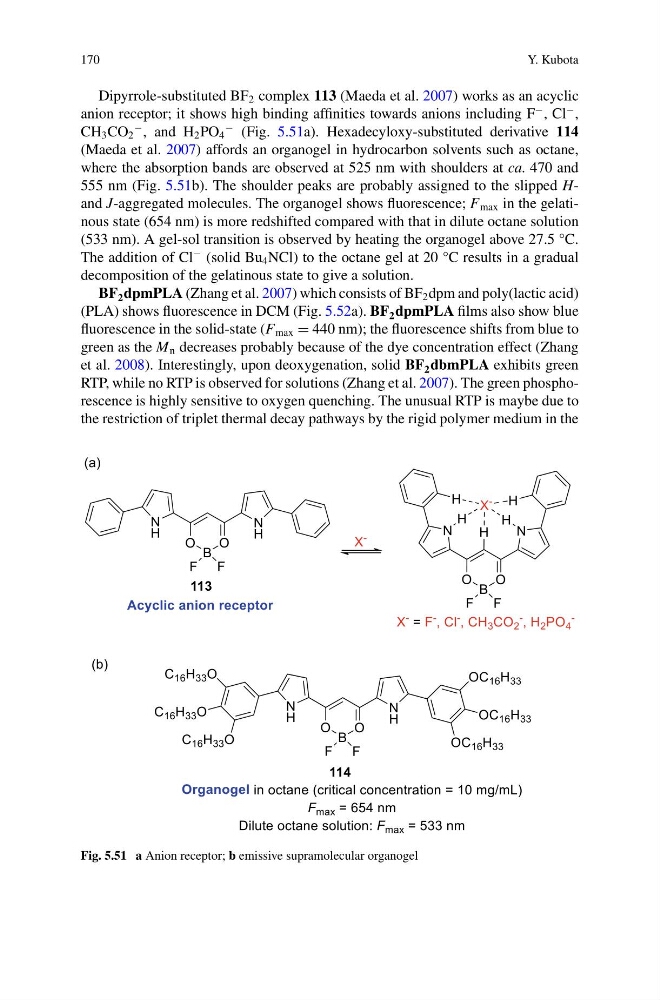
Dipyrrole-substituted BF 2 complex 113 (Maeda et al. 2007) works as an acyclic
anion receptor; it shows high binding affinities towards anions including F
− , Cl
− ,
CH 3 CO 2
− , and H 2 PO 4
− (Fig. 5.51a). Hexadecyloxy-substituted derivative 114
(Maeda et al. 2007) affords an organogel in hydrocarbon solvents such as octane,
where the absorption bands are observed at 525 nm with shoulders at ca. 470 and
555 nm (Fig. 5.51b). The shoulder peaks are probably assigned to the slipped Hand J-aggregated molecules. The organogel shows fluorescence; F max in the gelatinous state (654 nm) is more redshifted compared with that in dilute octane solution
(533 nm). A gel-sol transition is observed by heating the organogel above 27.5 °C.
The addition of Cl
− (solid Bu 4 NCl) to the octane gel at 20 °C results in a gradual
decomposition of the gelatinous state to give a solution.
BF 2 dpmPLA (Zhang et al. 2007) which consists of BF 2 dpm and poly(lactic acid)
(PLA) shows fluorescence in DCM (Fig. 5.52a). BF 2 dpmPLA films also show blue
fluorescence in the solid-state (F max = 440 nm); the fluorescence shifts from blue to
green as the M n decreases probably because of the dye concentration effect (Zhang
et al. 2008). Interestingly, upon deoxygenation, solid BF 2 dbmPLA exhibits green
RTP, while no RTP is observed for solutions (Zhang et al. 2007). The green phosphorescence is highly sensitive to oxygen quenching. The unusual RTP is maybe due to
the restriction of triplet thermal decay pathways by the rigid polymer medium in the
Fig. 5.51 a Anion receptor; b emissive supramolecular organogel
Y. Kubota
Dipyrrole-substituted BF 2 complex 113 (Maeda et al. 2007) works as an acyclic
anion receptor; it shows high binding affinities towards anions including F
− , Cl
− ,
CH 3 CO 2
− , and H 2 PO 4
− (Fig. 5.51a). Hexadecyloxy-substituted derivative 114
(Maeda et al. 2007) affords an organogel in hydrocarbon solvents such as octane,
where the absorption bands are observed at 525 nm with shoulders at ca. 470 and
555 nm (Fig. 5.51b). The shoulder peaks are probably assigned to the slipped Hand J-aggregated molecules. The organogel shows fluorescence; F max in the gelatinous state (654 nm) is more redshifted compared with that in dilute octane solution
(533 nm). A gel-sol transition is observed by heating the organogel above 27.5 °C.
The addition of Cl
− (solid Bu 4 NCl) to the octane gel at 20 °C results in a gradual
decomposition of the gelatinous state to give a solution.
BF 2 dpmPLA (Zhang et al. 2007) which consists of BF 2 dpm and poly(lactic acid)
(PLA) shows fluorescence in DCM (Fig. 5.52a). BF 2 dpmPLA films also show blue
fluorescence in the solid-state (F max = 440 nm); the fluorescence shifts from blue to
green as the M n decreases probably because of the dye concentration effect (Zhang
et al. 2008). Interestingly, upon deoxygenation, solid BF 2 dbmPLA exhibits green
RTP, while no RTP is observed for solutions (Zhang et al. 2007). The green phosphorescence is highly sensitive to oxygen quenching. The unusual RTP is maybe due to
the restriction of triplet thermal decay pathways by the rigid polymer medium in the
Fig. 5.51 a Anion receptor; b emissive supramolecular organogel