

5 BODIPY Dyes and Their Analogues
169
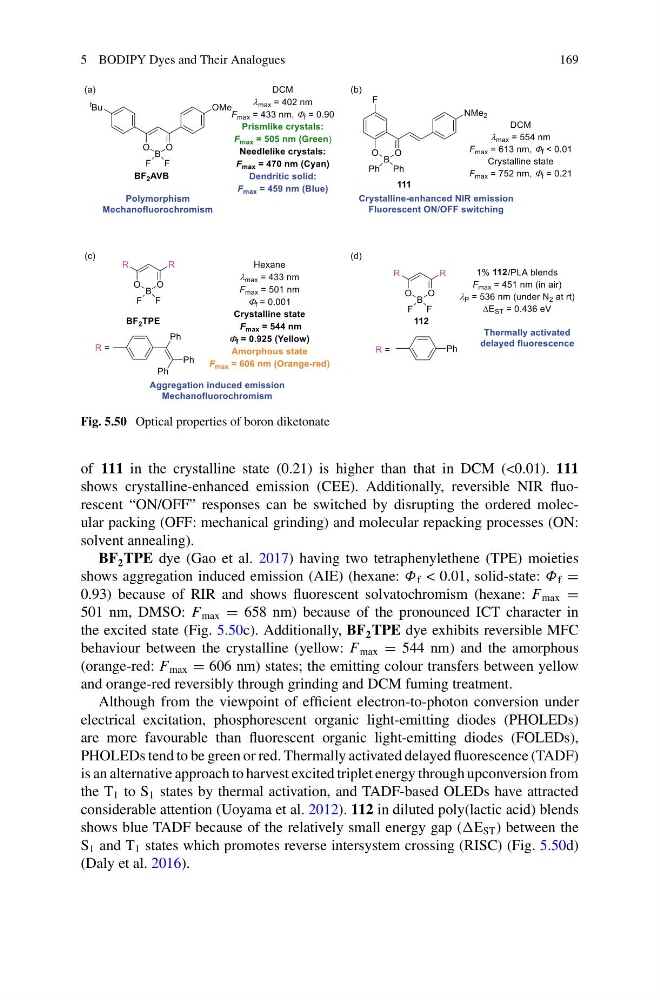
Fig. 5.50 Optical properties of boron diketonate
of 111 in the crystalline state (0.21) is higher than that in DCM (<0.01). 111
shows crystalline-enhanced emission (CEE). Additionally, reversible NIR fluorescent “ON/OFF” responses can be switched by disrupting the ordered molecular packing (OFF: mechanical grinding) and molecular repacking processes (ON:
solvent annealing).
BF 2 TPE dye (Gao et al. 2017) having two tetraphenylethene (TPE) moieties
shows aggregation induced emission (AIE) (hexane: Φ f < 0.01, solid-state: Φ f =
0.93) because of RIR and shows fluorescent solvatochromism (hexane: F max =
501 nm, DMSO: F max = 658 nm) because of the pronounced ICT character in
the excited state (Fig. 5.50c). Additionally, BF 2 TPE dye exhibits reversible MFC
behaviour between the crystalline (yellow: F max = 544 nm) and the amorphous
(orange-red: F max = 606 nm) states; the emitting colour transfers between yellow
and orange-red reversibly through grinding and DCM fuming treatment.
Although from the viewpoint of efficient electron-to-photon conversion under
electrical excitation, phosphorescent organic light-emitting diodes (PHOLEDs)
are more favourable than fluorescent organic light-emitting diodes (FOLEDs),
PHOLEDs tend to be green or red. Thermally activated delayed fluorescence (TADF)
is an alternative approach to harvest excited triplet energy through upconversion from
the T 1 to S 1 states by thermal activation, and TADF-based OLEDs have attracted
considerable attention (Uoyama et al. 2012). 112 in diluted poly(lactic acid) blends
shows blue TADF because of the relatively small energy gap ( ST ) between the
S 1 and T 1 states which promotes reverse intersystem crossing (RISC) (Fig. 5.50d)
(Daly et al. 2016).
169
Fig. 5.50 Optical properties of boron diketonate
of 111 in the crystalline state (0.21) is higher than that in DCM (<0.01). 111
shows crystalline-enhanced emission (CEE). Additionally, reversible NIR fluorescent “ON/OFF” responses can be switched by disrupting the ordered molecular packing (OFF: mechanical grinding) and molecular repacking processes (ON:
solvent annealing).
BF 2 TPE dye (Gao et al. 2017) having two tetraphenylethene (TPE) moieties
shows aggregation induced emission (AIE) (hexane: Φ f < 0.01, solid-state: Φ f =
0.93) because of RIR and shows fluorescent solvatochromism (hexane: F max =
501 nm, DMSO: F max = 658 nm) because of the pronounced ICT character in
the excited state (Fig. 5.50c). Additionally, BF 2 TPE dye exhibits reversible MFC
behaviour between the crystalline (yellow: F max = 544 nm) and the amorphous
(orange-red: F max = 606 nm) states; the emitting colour transfers between yellow
and orange-red reversibly through grinding and DCM fuming treatment.
Although from the viewpoint of efficient electron-to-photon conversion under
electrical excitation, phosphorescent organic light-emitting diodes (PHOLEDs)
are more favourable than fluorescent organic light-emitting diodes (FOLEDs),
PHOLEDs tend to be green or red. Thermally activated delayed fluorescence (TADF)
is an alternative approach to harvest excited triplet energy through upconversion from
the T 1 to S 1 states by thermal activation, and TADF-based OLEDs have attracted
considerable attention (Uoyama et al. 2012). 112 in diluted poly(lactic acid) blends
shows blue TADF because of the relatively small energy gap ( ST ) between the
S 1 and T 1 states which promotes reverse intersystem crossing (RISC) (Fig. 5.50d)
(Daly et al. 2016).