

168
Y. Kubota
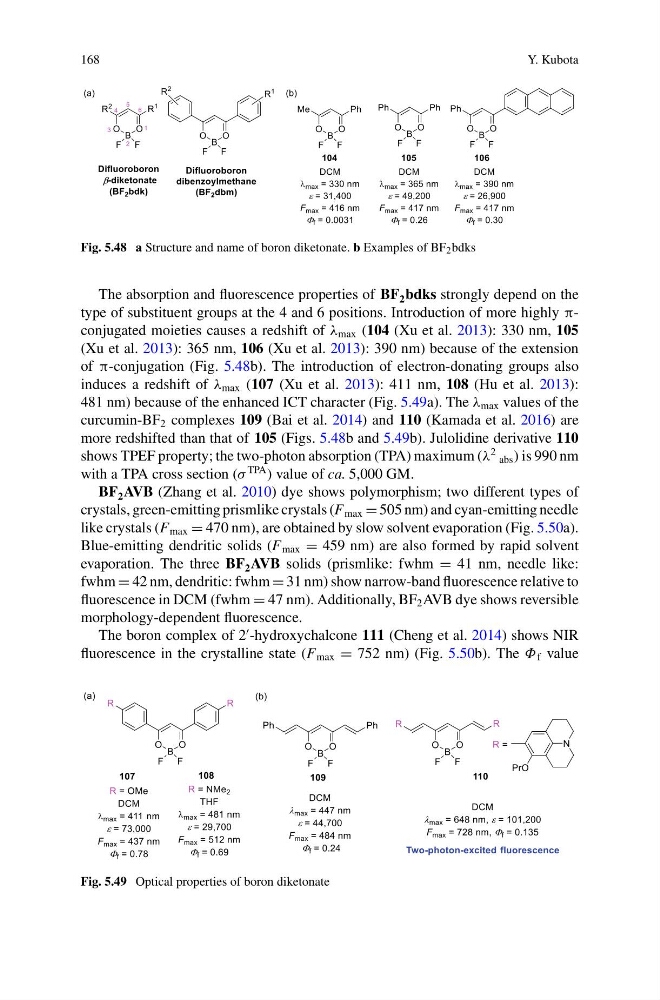
Fig. 5.48 a Structure and name of boron diketonate. b Examples of BF 2 bdks
The absorption and fluorescence properties of BF 2 bdks strongly depend on the
type of substituent groups at the 4 and 6 positions. Introduction of more highly πconjugated moieties causes a redshift of λ max (104 (Xu et al. 2013): 330 nm, 105
(Xu et al. 2013): 365 nm, 106 (Xu et al. 2013): 390 nm) because of the extension
of π-conjugation (Fig. 5.48b). The introduction of electron-donating groups also
induces a redshift of λ max (107 (Xu et al. 2013): 411 nm, 108 (Hu et al. 2013):
481 nm) because of the enhanced ICT character (Fig. 5.49a). The λ max values of the
curcumin-BF 2 complexes 109 (Bai et al. 2014) and 110 (Kamada et al. 2016) are
more redshifted than that of 105 (Figs. 5.48b and 5.49b). Julolidine derivative 110
shows TPEF property; the two-photon absorption (TPA) maximum (λ
2
abs ) is 990 nm
with a TPA cross section (σ
TPA ) value of ca. 5,000 GM.
BF 2 AVB (Zhang et al. 2010) dye shows polymorphism; two different types of
crystals, green-emitting prismlike crystals (F max = 505 nm) and cyan-emitting needle
like crystals (F max = 470 nm), are obtained by slow solvent evaporation (Fig. 5.50a).
Blue-emitting dendritic solids (F max = 459 nm) are also formed by rapid solvent
evaporation. The three BF 2 AVB solids (prismlike: fwhm = 41 nm, needle like:
fwhm = 42 nm, dendritic: fwhm = 31 nm) show narrow-band fluorescence relative to
fluorescence in DCM (fwhm = 47 nm). Additionally, BF 2 AVB dye shows reversible
morphology-dependent fluorescence.
The boron complex of 2
-hydroxychalcone 111 (Cheng et al. 2014) shows NIR
fluorescence in the crystalline state (F max = 752 nm) (Fig. 5.50b). The Φ f value
Fig. 5.49 Optical properties of boron diketonate
Y. Kubota
Fig. 5.48 a Structure and name of boron diketonate. b Examples of BF 2 bdks
The absorption and fluorescence properties of BF 2 bdks strongly depend on the
type of substituent groups at the 4 and 6 positions. Introduction of more highly πconjugated moieties causes a redshift of λ max (104 (Xu et al. 2013): 330 nm, 105
(Xu et al. 2013): 365 nm, 106 (Xu et al. 2013): 390 nm) because of the extension
of π-conjugation (Fig. 5.48b). The introduction of electron-donating groups also
induces a redshift of λ max (107 (Xu et al. 2013): 411 nm, 108 (Hu et al. 2013):
481 nm) because of the enhanced ICT character (Fig. 5.49a). The λ max values of the
curcumin-BF 2 complexes 109 (Bai et al. 2014) and 110 (Kamada et al. 2016) are
more redshifted than that of 105 (Figs. 5.48b and 5.49b). Julolidine derivative 110
shows TPEF property; the two-photon absorption (TPA) maximum (λ
2
abs ) is 990 nm
with a TPA cross section (σ
TPA ) value of ca. 5,000 GM.
BF 2 AVB (Zhang et al. 2010) dye shows polymorphism; two different types of
crystals, green-emitting prismlike crystals (F max = 505 nm) and cyan-emitting needle
like crystals (F max = 470 nm), are obtained by slow solvent evaporation (Fig. 5.50a).
Blue-emitting dendritic solids (F max = 459 nm) are also formed by rapid solvent
evaporation. The three BF 2 AVB solids (prismlike: fwhm = 41 nm, needle like:
fwhm = 42 nm, dendritic: fwhm = 31 nm) show narrow-band fluorescence relative to
fluorescence in DCM (fwhm = 47 nm). Additionally, BF 2 AVB dye shows reversible
morphology-dependent fluorescence.
The boron complex of 2
-hydroxychalcone 111 (Cheng et al. 2014) shows NIR
fluorescence in the crystalline state (F max = 752 nm) (Fig. 5.50b). The Φ f value
Fig. 5.49 Optical properties of boron diketonate