

180
Y. Kubota
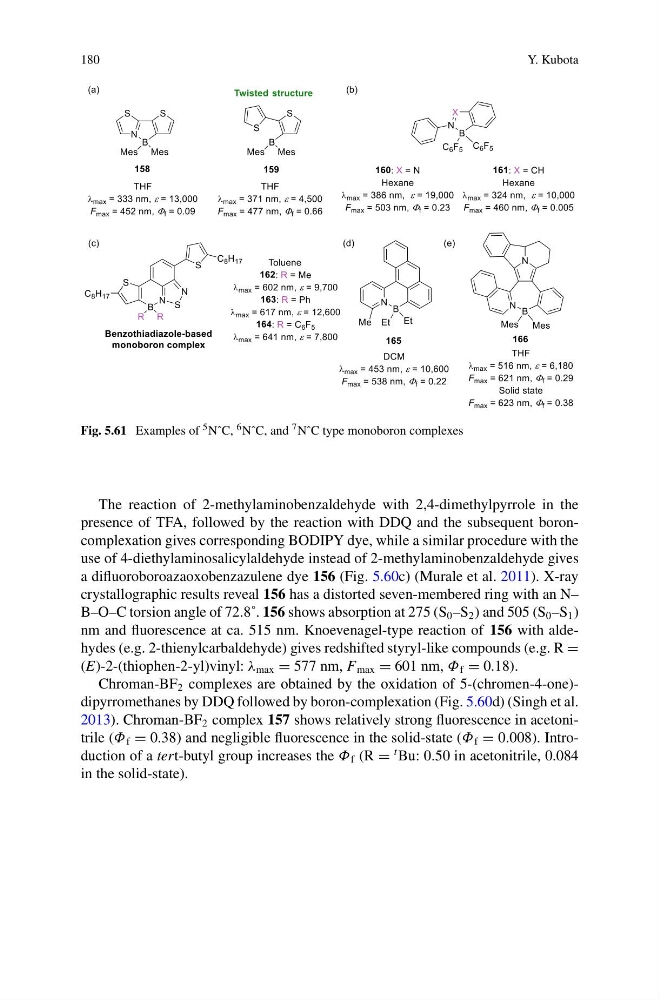
Fig. 5.61 Examples of 5 NˆC, 6 NˆC, and 7 NˆC type monoboron complexes
The reaction of 2-methylaminobenzaldehyde with 2,4-dimethylpyrrole in the
presence of TFA, followed by the reaction with DDQ and the subsequent boroncomplexation gives corresponding BODIPY dye, while a similar procedure with the
use of 4-diethylaminosalicylaldehyde instead of 2-methylaminobenzaldehyde gives
a difluoroboroazaoxobenzazulene dye 156 (Fig. 5.60c) (Murale et al. 2011). X-ray
crystallographic results reveal 156 has a distorted seven-membered ring with an N–
B–O–C torsion angle of 72.8˚. 156 shows absorption at 275 (S 0 –S 2 ) and 505 (S 0 –S 1 )
nm and fluorescence at ca. 515 nm. Knoevenagel-type reaction of 156 with aldehydes (e.g. 2-thienylcarbaldehyde) gives redshifted styryl-like compounds (e.g. R =
(E)-2-(thiophen-2-yl)vinyl: λ max = 577 nm, F max = 601 nm, Φ f = 0.18).
Chroman-BF 2 complexes are obtained by the oxidation of 5-(chromen-4-one)dipyrromethanes by DDQ followed by boron-complexation (Fig. 5.60d) (Singh et al.
2013). Chroman-BF 2 complex 157 shows relatively strong fluorescence in acetonitrile (Φ f = 0.38) and negligible fluorescence in the solid-state (Φ f = 0.008). Introduction of a tert-butyl group increases the Φ f (R =
t Bu: 0.50 in acetonitrile, 0.084
in the solid-state).
Y. Kubota
Fig. 5.61 Examples of 5 NˆC, 6 NˆC, and 7 NˆC type monoboron complexes
The reaction of 2-methylaminobenzaldehyde with 2,4-dimethylpyrrole in the
presence of TFA, followed by the reaction with DDQ and the subsequent boroncomplexation gives corresponding BODIPY dye, while a similar procedure with the
use of 4-diethylaminosalicylaldehyde instead of 2-methylaminobenzaldehyde gives
a difluoroboroazaoxobenzazulene dye 156 (Fig. 5.60c) (Murale et al. 2011). X-ray
crystallographic results reveal 156 has a distorted seven-membered ring with an N–
B–O–C torsion angle of 72.8˚. 156 shows absorption at 275 (S 0 –S 2 ) and 505 (S 0 –S 1 )
nm and fluorescence at ca. 515 nm. Knoevenagel-type reaction of 156 with aldehydes (e.g. 2-thienylcarbaldehyde) gives redshifted styryl-like compounds (e.g. R =
(E)-2-(thiophen-2-yl)vinyl: λ max = 577 nm, F max = 601 nm, Φ f = 0.18).
Chroman-BF 2 complexes are obtained by the oxidation of 5-(chromen-4-one)dipyrromethanes by DDQ followed by boron-complexation (Fig. 5.60d) (Singh et al.
2013). Chroman-BF 2 complex 157 shows relatively strong fluorescence in acetonitrile (Φ f = 0.38) and negligible fluorescence in the solid-state (Φ f = 0.008). Introduction of a tert-butyl group increases the Φ f (R =
t Bu: 0.50 in acetonitrile, 0.084
in the solid-state).