

160
Y. Kubota
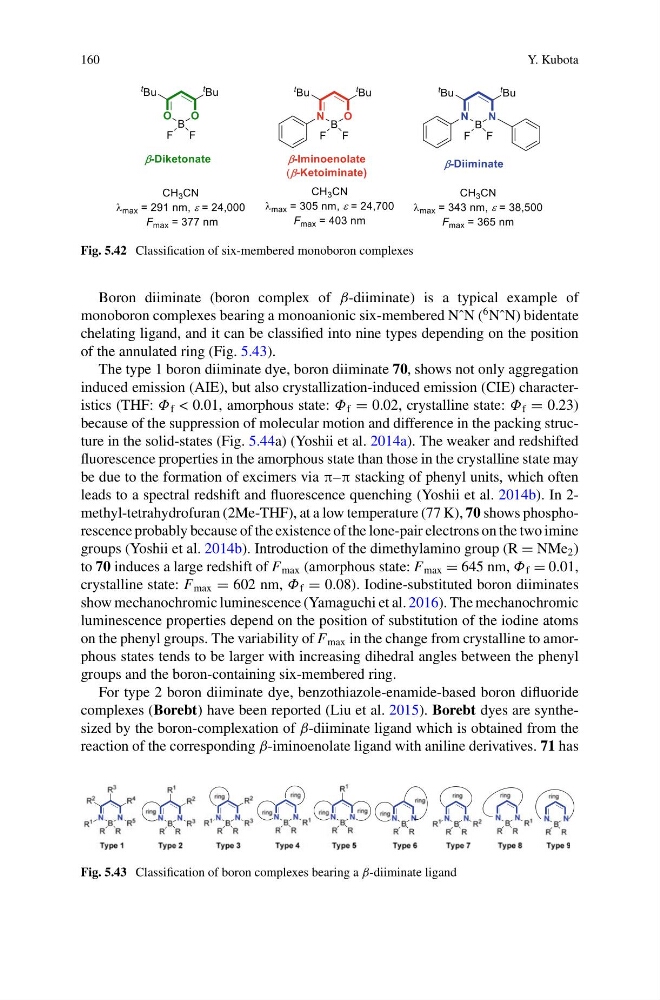
Fig. 5.42 Classification of six-membered monoboron complexes
Boron diiminate (boron complex of β-diiminate) is a typical example of
monoboron complexes bearing a monoanionic six-membered NˆN (
6 NˆN) bidentate
chelating ligand, and it can be classified into nine types depending on the position
of the annulated ring (Fig. 5.43).
The type 1 boron diiminate dye, boron diiminate 70, shows not only aggregation
induced emission (AIE), but also crystallization-induced emission (CIE) characteristics (THF: Φ f < 0.01, amorphous state: Φ f = 0.02, crystalline state: Φ f = 0.23)
because of the suppression of molecular motion and difference in the packing structure in the solid-states (Fig. 5.44a) (Yoshii et al. 2014a). The weaker and redshifted
fluorescence properties in the amorphous state than those in the crystalline state may
be due to the formation of excimers via π–π stacking of phenyl units, which often
leads to a spectral redshift and fluorescence quenching (Yoshii et al. 2014b). In 2methyl-tetrahydrofuran (2Me-THF), at a low temperature (77 K), 70 shows phosphorescence probably because of the existence of the lone-pair electrons on the two imine
groups (Yoshii et al. 2014b). Introduction of the dimethylamino group (R = NMe 2 )
to 70 induces a large redshift of F max (amorphous state: F max = 645 nm, Φ f = 0.01,
crystalline state: F max = 602 nm, Φ f = 0.08). Iodine-substituted boron diiminates
show mechanochromic luminescence (Yamaguchi et al. 2016). The mechanochromic
luminescence properties depend on the position of substitution of the iodine atoms
on the phenyl groups. The variability of F max in the change from crystalline to amorphous states tends to be larger with increasing dihedral angles between the phenyl
groups and the boron-containing six-membered ring.
For type 2 boron diiminate dye, benzothiazole-enamide-based boron difluoride
complexes (Borebt) have been reported (Liu et al. 2015). Borebt dyes are synthesized by the boron-complexation of β-diiminate ligand which is obtained from the
reaction of the corresponding β-iminoenolate ligand with aniline derivatives. 71 has
Fig. 5.43 Classification of boron complexes bearing a β-diiminate ligand
Y. Kubota
Fig. 5.42 Classification of six-membered monoboron complexes
Boron diiminate (boron complex of β-diiminate) is a typical example of
monoboron complexes bearing a monoanionic six-membered NˆN (
6 NˆN) bidentate
chelating ligand, and it can be classified into nine types depending on the position
of the annulated ring (Fig. 5.43).
The type 1 boron diiminate dye, boron diiminate 70, shows not only aggregation
induced emission (AIE), but also crystallization-induced emission (CIE) characteristics (THF: Φ f < 0.01, amorphous state: Φ f = 0.02, crystalline state: Φ f = 0.23)
because of the suppression of molecular motion and difference in the packing structure in the solid-states (Fig. 5.44a) (Yoshii et al. 2014a). The weaker and redshifted
fluorescence properties in the amorphous state than those in the crystalline state may
be due to the formation of excimers via π–π stacking of phenyl units, which often
leads to a spectral redshift and fluorescence quenching (Yoshii et al. 2014b). In 2methyl-tetrahydrofuran (2Me-THF), at a low temperature (77 K), 70 shows phosphorescence probably because of the existence of the lone-pair electrons on the two imine
groups (Yoshii et al. 2014b). Introduction of the dimethylamino group (R = NMe 2 )
to 70 induces a large redshift of F max (amorphous state: F max = 645 nm, Φ f = 0.01,
crystalline state: F max = 602 nm, Φ f = 0.08). Iodine-substituted boron diiminates
show mechanochromic luminescence (Yamaguchi et al. 2016). The mechanochromic
luminescence properties depend on the position of substitution of the iodine atoms
on the phenyl groups. The variability of F max in the change from crystalline to amorphous states tends to be larger with increasing dihedral angles between the phenyl
groups and the boron-containing six-membered ring.
For type 2 boron diiminate dye, benzothiazole-enamide-based boron difluoride
complexes (Borebt) have been reported (Liu et al. 2015). Borebt dyes are synthesized by the boron-complexation of β-diiminate ligand which is obtained from the
reaction of the corresponding β-iminoenolate ligand with aniline derivatives. 71 has
Fig. 5.43 Classification of boron complexes bearing a β-diiminate ligand