

5 BODIPY Dyes and Their Analogues
151
[b]-Fused BODIPY
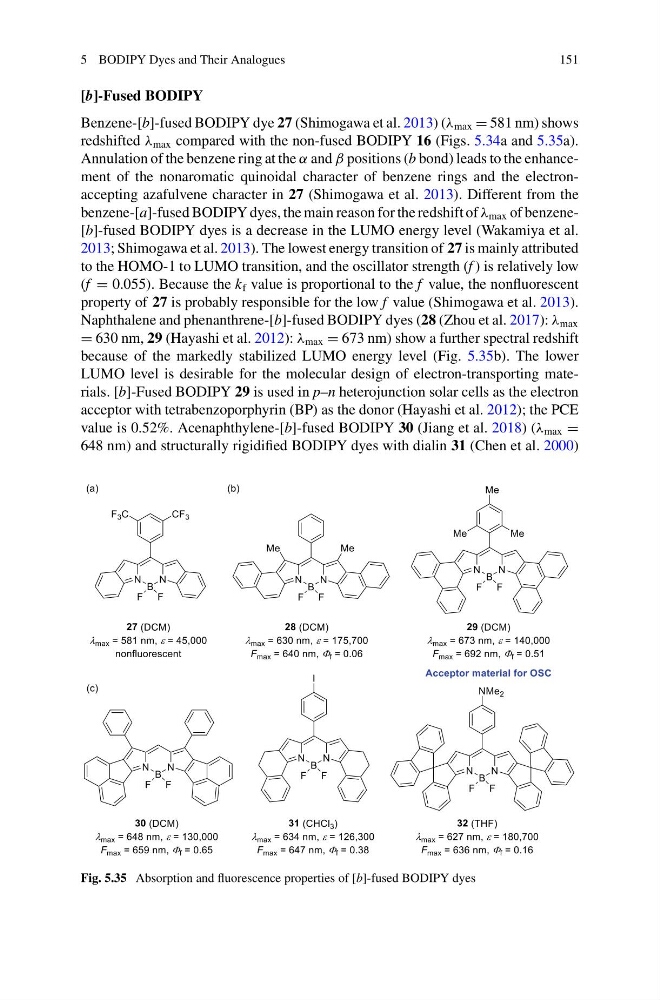
Benzene-[b]-fused BODIPY dye 27 (Shimogawa et al. 2013) (λ max = 581 nm) shows
redshifted λ max compared with the non-fused BODIPY 16 (Figs. 5.34a and 5.35a).
Annulation of the benzene ring at the α and β positions (b bond) leads to the enhancement of the nonaromatic quinoidal character of benzene rings and the electronaccepting azafulvene character in 27 (Shimogawa et al. 2013). Different from the
benzene-[a]-fused BODIPY dyes, the main reason for the redshift of λ max of benzene[b]-fused BODIPY dyes is a decrease in the LUMO energy level (Wakamiya et al.
2013; Shimogawa et al. 2013). The lowest energy transition of 27 is mainly attributed
to the HOMO-1 to LUMO transition, and the oscillator strength (f ) is relatively low
(f = 0.055). Because the k f value is proportional to the f value, the nonfluorescent
property of 27 is probably responsible for the low f value (Shimogawa et al. 2013).
Naphthalene and phenanthrene-[b]-fused BODIPY dyes (28 (Zhou et al. 2017): λ max
= 630 nm, 29 (Hayashi et al. 2012): λ max = 673 nm) show a further spectral redshift
because of the markedly stabilized LUMO energy level (Fig. 5.35b). The lower
LUMO level is desirable for the molecular design of electron-transporting materials. [b]-Fused BODIPY 29 is used in p–n heterojunction solar cells as the electron
acceptor with tetrabenzoporphyrin (BP) as the donor (Hayashi et al. 2012); the PCE
value is 0.52%. Acenaphthylene-[b]-fused BODIPY 30 (Jiang et al. 2018) (λ max =
648 nm) and structurally rigidified BODIPY dyes with dialin 31 (Chen et al. 2000)
Fig. 5.35 Absorption and fluorescence properties of [b]-fused BODIPY dyes
151
[b]-Fused BODIPY
Benzene-[b]-fused BODIPY dye 27 (Shimogawa et al. 2013) (λ max = 581 nm) shows
redshifted λ max compared with the non-fused BODIPY 16 (Figs. 5.34a and 5.35a).
Annulation of the benzene ring at the α and β positions (b bond) leads to the enhancement of the nonaromatic quinoidal character of benzene rings and the electronaccepting azafulvene character in 27 (Shimogawa et al. 2013). Different from the
benzene-[a]-fused BODIPY dyes, the main reason for the redshift of λ max of benzene[b]-fused BODIPY dyes is a decrease in the LUMO energy level (Wakamiya et al.
2013; Shimogawa et al. 2013). The lowest energy transition of 27 is mainly attributed
to the HOMO-1 to LUMO transition, and the oscillator strength (f ) is relatively low
(f = 0.055). Because the k f value is proportional to the f value, the nonfluorescent
property of 27 is probably responsible for the low f value (Shimogawa et al. 2013).
Naphthalene and phenanthrene-[b]-fused BODIPY dyes (28 (Zhou et al. 2017): λ max
= 630 nm, 29 (Hayashi et al. 2012): λ max = 673 nm) show a further spectral redshift
because of the markedly stabilized LUMO energy level (Fig. 5.35b). The lower
LUMO level is desirable for the molecular design of electron-transporting materials. [b]-Fused BODIPY 29 is used in p–n heterojunction solar cells as the electron
acceptor with tetrabenzoporphyrin (BP) as the donor (Hayashi et al. 2012); the PCE
value is 0.52%. Acenaphthylene-[b]-fused BODIPY 30 (Jiang et al. 2018) (λ max =
648 nm) and structurally rigidified BODIPY dyes with dialin 31 (Chen et al. 2000)
Fig. 5.35 Absorption and fluorescence properties of [b]-fused BODIPY dyes