

150
Y. Kubota
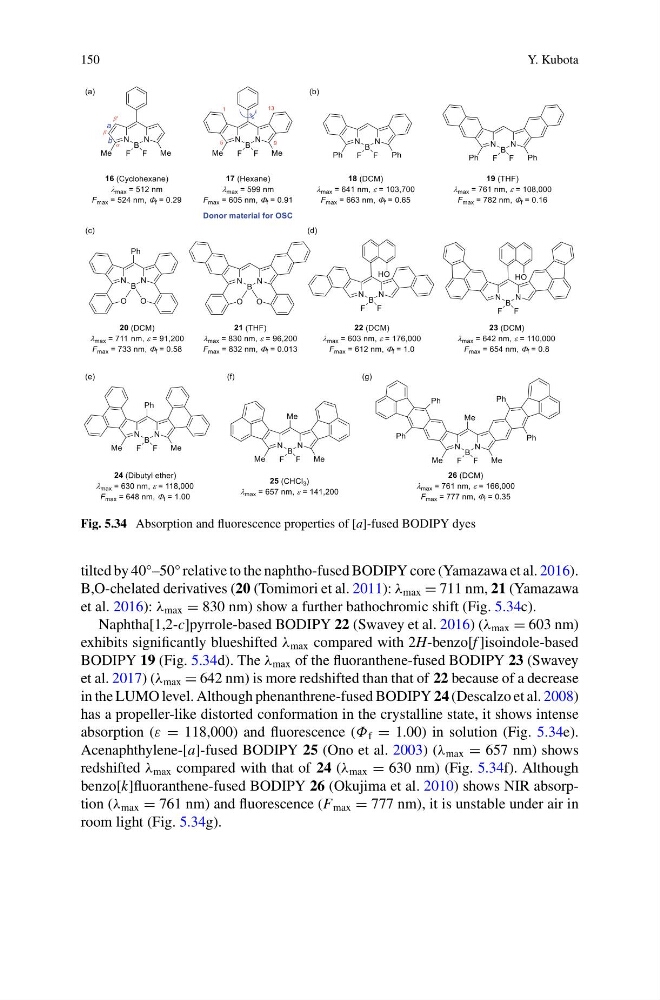
Fig. 5.34 Absorption and fluorescence properties of [a]-fused BODIPY dyes
tilted by 40°–50° relative to the naphtho-fused BODIPY core (Yamazawa et al. 2016).
B,O-chelated derivatives (20 (Tomimori et al. 2011): λ max = 711 nm, 21 (Yamazawa
et al. 2016): λ max = 830 nm) show a further bathochromic shift (Fig. 5.34c).
Naphtha[1,2-c]pyrrole-based BODIPY 22 (Swavey et al. 2016) (λ max = 603 nm)
exhibits significantly blueshifted λ max compared with 2H-benzo[f ]isoindole-based
BODIPY 19 (Fig. 5.34d). The λ max of the fluoranthene-fused BODIPY 23 (Swavey
et al. 2017) (λ max = 642 nm) is more redshifted than that of 22 because of a decrease
in the LUMO level. Although phenanthrene-fused BODIPY 24 (Descalzo et al. 2008)
has a propeller-like distorted conformation in the crystalline state, it shows intense
absorption (ε = 118,000) and fluorescence (Φ f = 1.00) in solution (Fig. 5.34e).
Acenaphthylene-[a]-fused BODIPY 25 (Ono et al. 2003) (λ max = 657 nm) shows
redshifted λ max compared with that of 24 (λ max = 630 nm) (Fig. 5.34f). Although
benzo[k]fluoranthene-fused BODIPY 26 (Okujima et al. 2010) shows NIR absorption (λ max = 761 nm) and fluorescence (F max = 777 nm), it is unstable under air in
room light (Fig. 5.34g).
Y. Kubota
Fig. 5.34 Absorption and fluorescence properties of [a]-fused BODIPY dyes
tilted by 40°–50° relative to the naphtho-fused BODIPY core (Yamazawa et al. 2016).
B,O-chelated derivatives (20 (Tomimori et al. 2011): λ max = 711 nm, 21 (Yamazawa
et al. 2016): λ max = 830 nm) show a further bathochromic shift (Fig. 5.34c).
Naphtha[1,2-c]pyrrole-based BODIPY 22 (Swavey et al. 2016) (λ max = 603 nm)
exhibits significantly blueshifted λ max compared with 2H-benzo[f ]isoindole-based
BODIPY 19 (Fig. 5.34d). The λ max of the fluoranthene-fused BODIPY 23 (Swavey
et al. 2017) (λ max = 642 nm) is more redshifted than that of 22 because of a decrease
in the LUMO level. Although phenanthrene-fused BODIPY 24 (Descalzo et al. 2008)
has a propeller-like distorted conformation in the crystalline state, it shows intense
absorption (ε = 118,000) and fluorescence (Φ f = 1.00) in solution (Fig. 5.34e).
Acenaphthylene-[a]-fused BODIPY 25 (Ono et al. 2003) (λ max = 657 nm) shows
redshifted λ max compared with that of 24 (λ max = 630 nm) (Fig. 5.34f). Although
benzo[k]fluoranthene-fused BODIPY 26 (Okujima et al. 2010) shows NIR absorption (λ max = 761 nm) and fluorescence (F max = 777 nm), it is unstable under air in
room light (Fig. 5.34g).