

5 BODIPY Dyes and Their Analogues
149
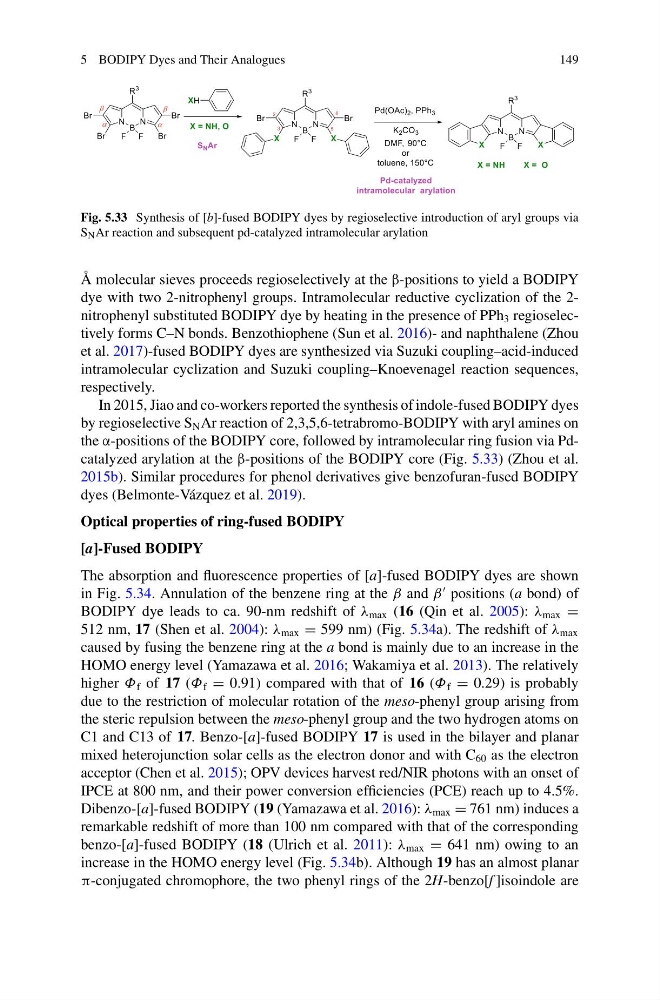
Fig. 5.33 Synthesis of [b]-fused BODIPY dyes by regioselective introduction of aryl groups via
S N Ar reaction and subsequent pd-catalyzed intramolecular arylation
Å molecular sieves proceeds regioselectively at the β-positions to yield a BODIPY
dye with two 2-nitrophenyl groups. Intramolecular reductive cyclization of the 2nitrophenyl substituted BODIPY dye by heating in the presence of PPh 3 regioselectively forms C–N bonds. Benzothiophene (Sun et al. 2016)- and naphthalene (Zhou
et al. 2017)-fused BODIPY dyes are synthesized via Suzuki coupling–acid-induced
intramolecular cyclization and Suzuki coupling–Knoevenagel reaction sequences,
respectively.
In 2015, Jiao and co-workers reported the synthesis of indole-fused BODIPY dyes
by regioselective S N Ar reaction of 2,3,5,6-tetrabromo-BODIPY with aryl amines on
the α-positions of the BODIPY core, followed by intramolecular ring fusion via Pdcatalyzed arylation at the β-positions of the BODIPY core (Fig. 5.33) (Zhou et al.
2015b). Similar procedures for phenol derivatives give benzofuran-fused BODIPY
dyes (Belmonte-Vázquez et al. 2019).
Optical properties of ring-fused BODIPY
[a]-Fused BODIPY
The absorption and fluorescence properties of [a]-fused BODIPY dyes are shown
in Fig. 5.34. Annulation of the benzene ring at the β and β
positions (a bond) of
BODIPY dye leads to ca. 90-nm redshift of λ max (16 (Qin et al. 2005): λ max =
512 nm, 17 (Shen et al. 2004): λ max = 599 nm) (Fig. 5.34a). The redshift of λ max
caused by fusing the benzene ring at the a bond is mainly due to an increase in the
HOMO energy level (Yamazawa et al. 2016; Wakamiya et al. 2013). The relatively
higher Φ f of 17 (Φ f = 0.91) compared with that of 16 (Φ f = 0.29) is probably
due to the restriction of molecular rotation of the meso-phenyl group arising from
the steric repulsion between the meso-phenyl group and the two hydrogen atoms on
C1 and C13 of 17. Benzo-[a]-fused BODIPY 17 is used in the bilayer and planar
mixed heterojunction solar cells as the electron donor and with C 60 as the electron
acceptor (Chen et al. 2015); OPV devices harvest red/NIR photons with an onset of
IPCE at 800 nm, and their power conversion efficiencies (PCE) reach up to 4.5%.
Dibenzo-[a]-fused BODIPY (19 (Yamazawa et al. 2016): λ max = 761 nm) induces a
remarkable redshift of more than 100 nm compared with that of the corresponding
benzo-[a]-fused BODIPY (18 (Ulrich et al. 2011): λ max = 641 nm) owing to an
increase in the HOMO energy level (Fig. 5.34b). Although 19 has an almost planar
π-conjugated chromophore, the two phenyl rings of the 2H-benzo[f ]isoindole are
149
Fig. 5.33 Synthesis of [b]-fused BODIPY dyes by regioselective introduction of aryl groups via
S N Ar reaction and subsequent pd-catalyzed intramolecular arylation
Å molecular sieves proceeds regioselectively at the β-positions to yield a BODIPY
dye with two 2-nitrophenyl groups. Intramolecular reductive cyclization of the 2nitrophenyl substituted BODIPY dye by heating in the presence of PPh 3 regioselectively forms C–N bonds. Benzothiophene (Sun et al. 2016)- and naphthalene (Zhou
et al. 2017)-fused BODIPY dyes are synthesized via Suzuki coupling–acid-induced
intramolecular cyclization and Suzuki coupling–Knoevenagel reaction sequences,
respectively.
In 2015, Jiao and co-workers reported the synthesis of indole-fused BODIPY dyes
by regioselective S N Ar reaction of 2,3,5,6-tetrabromo-BODIPY with aryl amines on
the α-positions of the BODIPY core, followed by intramolecular ring fusion via Pdcatalyzed arylation at the β-positions of the BODIPY core (Fig. 5.33) (Zhou et al.
2015b). Similar procedures for phenol derivatives give benzofuran-fused BODIPY
dyes (Belmonte-Vázquez et al. 2019).
Optical properties of ring-fused BODIPY
[a]-Fused BODIPY
The absorption and fluorescence properties of [a]-fused BODIPY dyes are shown
in Fig. 5.34. Annulation of the benzene ring at the β and β
positions (a bond) of
BODIPY dye leads to ca. 90-nm redshift of λ max (16 (Qin et al. 2005): λ max =
512 nm, 17 (Shen et al. 2004): λ max = 599 nm) (Fig. 5.34a). The redshift of λ max
caused by fusing the benzene ring at the a bond is mainly due to an increase in the
HOMO energy level (Yamazawa et al. 2016; Wakamiya et al. 2013). The relatively
higher Φ f of 17 (Φ f = 0.91) compared with that of 16 (Φ f = 0.29) is probably
due to the restriction of molecular rotation of the meso-phenyl group arising from
the steric repulsion between the meso-phenyl group and the two hydrogen atoms on
C1 and C13 of 17. Benzo-[a]-fused BODIPY 17 is used in the bilayer and planar
mixed heterojunction solar cells as the electron donor and with C 60 as the electron
acceptor (Chen et al. 2015); OPV devices harvest red/NIR photons with an onset of
IPCE at 800 nm, and their power conversion efficiencies (PCE) reach up to 4.5%.
Dibenzo-[a]-fused BODIPY (19 (Yamazawa et al. 2016): λ max = 761 nm) induces a
remarkable redshift of more than 100 nm compared with that of the corresponding
benzo-[a]-fused BODIPY (18 (Ulrich et al. 2011): λ max = 641 nm) owing to an
increase in the HOMO energy level (Fig. 5.34b). Although 19 has an almost planar
π-conjugated chromophore, the two phenyl rings of the 2H-benzo[f ]isoindole are