

152
Y. Kubota
(λ max = 634 nm) and spirofluorene 32 (Kowada et al. 2010) (λ max = 627 nm) moieties
have also been reported (Fig. 5.35c). In the spirofluorene derivative 32, although the
λ max and F max values are not changed by varying the solvent, the Φ f value becomes
lower with increasing solvent polarity (benzene: Φ f = 0.78, CHCl 3 : Φ f = 0.73, THF:
Φ f = 0.16, DMF: Φ f = 0.06); the feasibility of electron transfer from the electron
donor (dimethylaminophenyl group) to the electron acceptor (BODIPY core) is estimated by the Rehm–Weller equation, which suggests that fluorescence quenching
with increasing solvent polarity arises from photoinduced electron transfer (PeT)
process (Kowada et al. 2010).
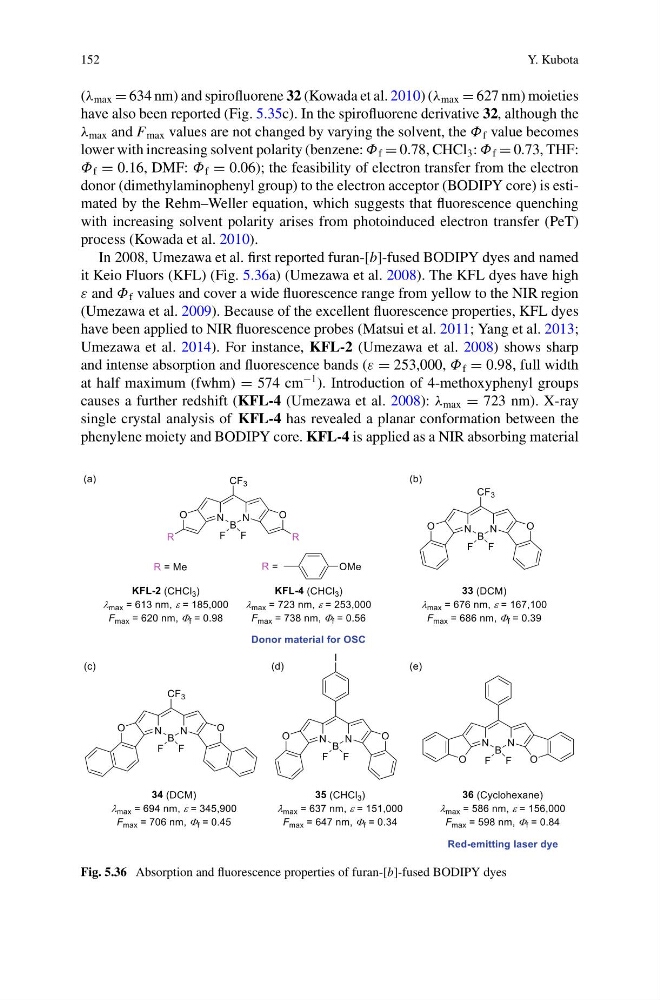
In 2008, Umezawa et al. first reported furan-[b]-fused BODIPY dyes and named
it Keio Fluors (KFL) (Fig. 5.36a) (Umezawa et al. 2008). The KFL dyes have high
ε and Φ f values and cover a wide fluorescence range from yellow to the NIR region
(Umezawa et al. 2009). Because of the excellent fluorescence properties, KFL dyes
have been applied to NIR fluorescence probes (Matsui et al. 2011; Yang et al. 2013;
Umezawa et al. 2014). For instance, KFL-2 (Umezawa et al. 2008) shows sharp
and intense absorption and fluorescence bands (ε = 253,000, Φ f = 0.98, full width
at half maximum (fwhm) = 574 cm
−1 ). Introduction of 4-methoxyphenyl groups
causes a further redshift (KFL-4 (Umezawa et al. 2008): λ max = 723 nm). X-ray
single crystal analysis of KFL-4 has revealed a planar conformation between the
phenylene moiety and BODIPY core. KFL-4 is applied as a NIR absorbing material
Fig. 5.36 Absorption and fluorescence properties of furan-[b]-fused BODIPY dyes
Y. Kubota
(λ max = 634 nm) and spirofluorene 32 (Kowada et al. 2010) (λ max = 627 nm) moieties
have also been reported (Fig. 5.35c). In the spirofluorene derivative 32, although the
λ max and F max values are not changed by varying the solvent, the Φ f value becomes
lower with increasing solvent polarity (benzene: Φ f = 0.78, CHCl 3 : Φ f = 0.73, THF:
Φ f = 0.16, DMF: Φ f = 0.06); the feasibility of electron transfer from the electron
donor (dimethylaminophenyl group) to the electron acceptor (BODIPY core) is estimated by the Rehm–Weller equation, which suggests that fluorescence quenching
with increasing solvent polarity arises from photoinduced electron transfer (PeT)
process (Kowada et al. 2010).
In 2008, Umezawa et al. first reported furan-[b]-fused BODIPY dyes and named
it Keio Fluors (KFL) (Fig. 5.36a) (Umezawa et al. 2008). The KFL dyes have high
ε and Φ f values and cover a wide fluorescence range from yellow to the NIR region
(Umezawa et al. 2009). Because of the excellent fluorescence properties, KFL dyes
have been applied to NIR fluorescence probes (Matsui et al. 2011; Yang et al. 2013;
Umezawa et al. 2014). For instance, KFL-2 (Umezawa et al. 2008) shows sharp
and intense absorption and fluorescence bands (ε = 253,000, Φ f = 0.98, full width
at half maximum (fwhm) = 574 cm
−1 ). Introduction of 4-methoxyphenyl groups
causes a further redshift (KFL-4 (Umezawa et al. 2008): λ max = 723 nm). X-ray
single crystal analysis of KFL-4 has revealed a planar conformation between the
phenylene moiety and BODIPY core. KFL-4 is applied as a NIR absorbing material
Fig. 5.36 Absorption and fluorescence properties of furan-[b]-fused BODIPY dyes