

144
Y. Kubota
5.2.3.8 Ring-Fused BODIPY
Type of ring-fused BODIPY
Annulation of aromatic rings to the BODIPY core is an efficient strategy to achieve
the extension of π-conjugation, which results in redshift of the absorption and fluorescence maxima. The π-extension of the BODIPY chromophore through the introduction of substituents sometimes leads to the promotion of non-radiative processes via
molecular rotations of newly introduced substituents. On the other hand, annulation
of aromatic rings to the BODIPY core forms a π-extended and rigidified BODIPY
chromophore without induction of molecular rotation. Ring-fused BODIPY dyes are
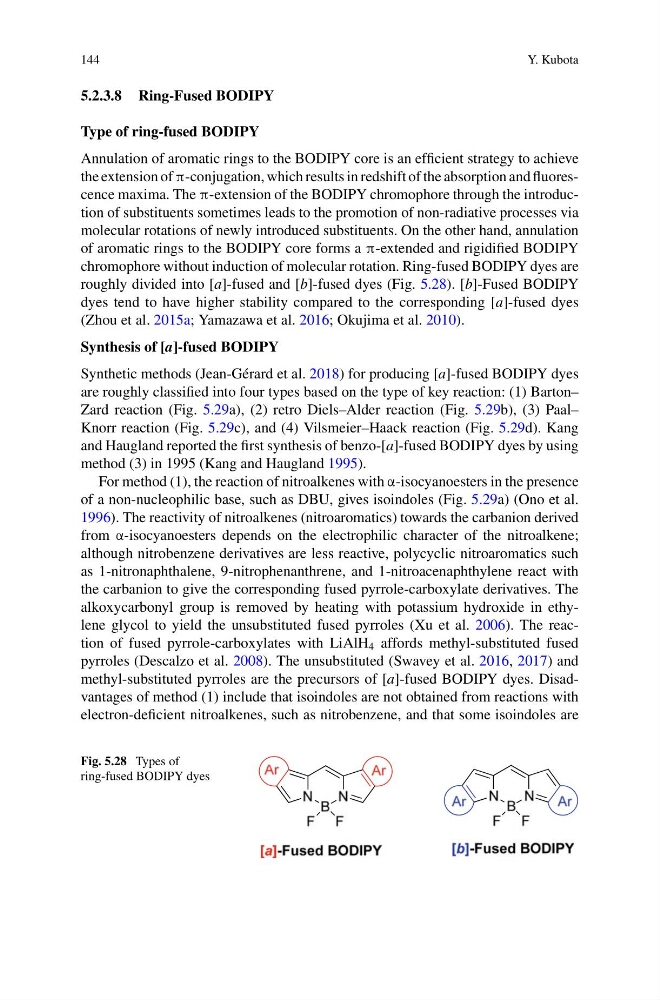
roughly divided into [a]-fused and [b]-fused dyes (Fig. 5.28). [b]-Fused BODIPY
dyes tend to have higher stability compared to the corresponding [a]-fused dyes
(Zhou et al. 2015a; Yamazawa et al. 2016; Okujima et al. 2010).
Synthesis of [a]-fused BODIPY
Synthetic methods (Jean-Gérard et al. 2018) for producing [a]-fused BODIPY dyes
are roughly classified into four types based on the type of key reaction: (1) Barton–
Zard reaction (Fig. 5.29a), (2) retro Diels–Alder reaction (Fig. 5.29b), (3) Paal–
Knorr reaction (Fig. 5.29c), and (4) Vilsmeier–Haack reaction (Fig. 5.29d). Kang
and Haugland reported the first synthesis of benzo-[a]-fused BODIPY dyes by using
method (3) in 1995 (Kang and Haugland 1995).
For method (1), the reaction of nitroalkenes with α-isocyanoesters in the presence
of a non-nucleophilic base, such as DBU, gives isoindoles (Fig. 5.29a) (Ono et al.
1996). The reactivity of nitroalkenes (nitroaromatics) towards the carbanion derived
from α-isocyanoesters depends on the electrophilic character of the nitroalkene;
although nitrobenzene derivatives are less reactive, polycyclic nitroaromatics such
as 1-nitronaphthalene, 9-nitrophenanthrene, and 1-nitroacenaphthylene react with
the carbanion to give the corresponding fused pyrrole-carboxylate derivatives. The
alkoxycarbonyl group is removed by heating with potassium hydroxide in ethylene glycol to yield the unsubstituted fused pyrroles (Xu et al. 2006). The reaction of fused pyrrole-carboxylates with LiAlH 4 affords methyl-substituted fused
pyrroles (Descalzo et al. 2008). The unsubstituted (Swavey et al. 2016, 2017) and
methyl-substituted pyrroles are the precursors of [a]-fused BODIPY dyes. Disadvantages of method (1) include that isoindoles are not obtained from reactions with
electron-deficient nitroalkenes, such as nitrobenzene, and that some isoindoles are
Fig. 5.28 Types of
ring-fused BODIPY dyes
Y. Kubota
5.2.3.8 Ring-Fused BODIPY
Type of ring-fused BODIPY
Annulation of aromatic rings to the BODIPY core is an efficient strategy to achieve
the extension of π-conjugation, which results in redshift of the absorption and fluorescence maxima. The π-extension of the BODIPY chromophore through the introduction of substituents sometimes leads to the promotion of non-radiative processes via
molecular rotations of newly introduced substituents. On the other hand, annulation
of aromatic rings to the BODIPY core forms a π-extended and rigidified BODIPY
chromophore without induction of molecular rotation. Ring-fused BODIPY dyes are
roughly divided into [a]-fused and [b]-fused dyes (Fig. 5.28). [b]-Fused BODIPY
dyes tend to have higher stability compared to the corresponding [a]-fused dyes
(Zhou et al. 2015a; Yamazawa et al. 2016; Okujima et al. 2010).
Synthesis of [a]-fused BODIPY
Synthetic methods (Jean-Gérard et al. 2018) for producing [a]-fused BODIPY dyes
are roughly classified into four types based on the type of key reaction: (1) Barton–
Zard reaction (Fig. 5.29a), (2) retro Diels–Alder reaction (Fig. 5.29b), (3) Paal–
Knorr reaction (Fig. 5.29c), and (4) Vilsmeier–Haack reaction (Fig. 5.29d). Kang
and Haugland reported the first synthesis of benzo-[a]-fused BODIPY dyes by using
method (3) in 1995 (Kang and Haugland 1995).
For method (1), the reaction of nitroalkenes with α-isocyanoesters in the presence
of a non-nucleophilic base, such as DBU, gives isoindoles (Fig. 5.29a) (Ono et al.
1996). The reactivity of nitroalkenes (nitroaromatics) towards the carbanion derived
from α-isocyanoesters depends on the electrophilic character of the nitroalkene;
although nitrobenzene derivatives are less reactive, polycyclic nitroaromatics such
as 1-nitronaphthalene, 9-nitrophenanthrene, and 1-nitroacenaphthylene react with
the carbanion to give the corresponding fused pyrrole-carboxylate derivatives. The
alkoxycarbonyl group is removed by heating with potassium hydroxide in ethylene glycol to yield the unsubstituted fused pyrroles (Xu et al. 2006). The reaction of fused pyrrole-carboxylates with LiAlH 4 affords methyl-substituted fused
pyrroles (Descalzo et al. 2008). The unsubstituted (Swavey et al. 2016, 2017) and
methyl-substituted pyrroles are the precursors of [a]-fused BODIPY dyes. Disadvantages of method (1) include that isoindoles are not obtained from reactions with
electron-deficient nitroalkenes, such as nitrobenzene, and that some isoindoles are
Fig. 5.28 Types of
ring-fused BODIPY dyes