

5 BODIPY Dyes and Their Analogues
145
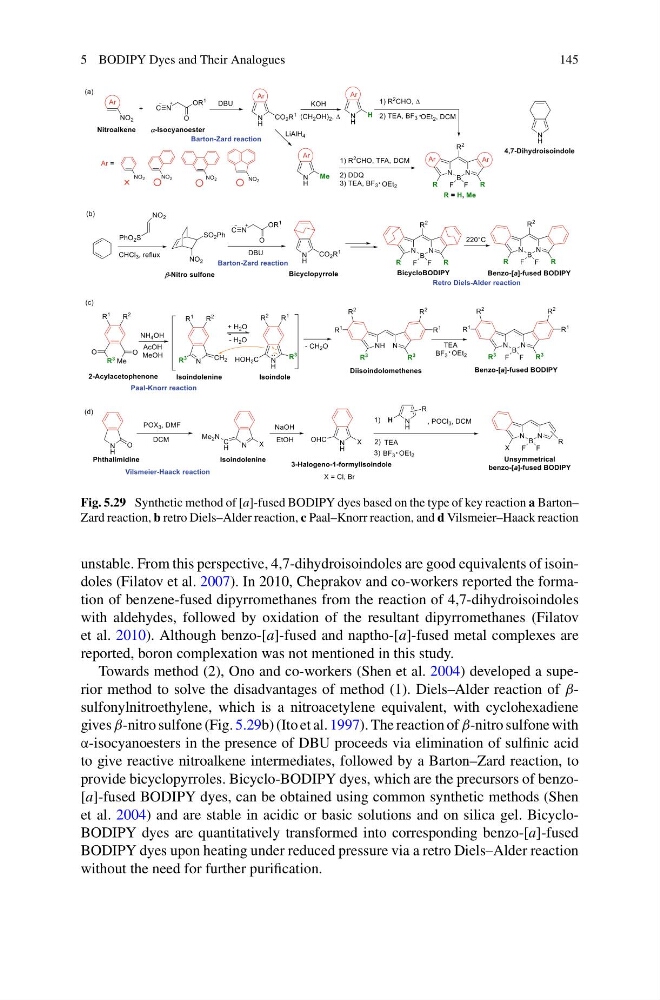
Fig. 5.29 Synthetic method of [a]-fused BODIPY dyes based on the type of key reaction a Barton–
Zard reaction, b retro Diels–Alder reaction, c Paal–Knorr reaction, and d Vilsmeier–Haack reaction
unstable. From this perspective, 4,7-dihydroisoindoles are good equivalents of isoindoles (Filatov et al. 2007). In 2010, Cheprakov and co-workers reported the formation of benzene-fused dipyrromethanes from the reaction of 4,7-dihydroisoindoles
with aldehydes, followed by oxidation of the resultant dipyrromethanes (Filatov
et al. 2010). Although benzo-[a]-fused and naptho-[a]-fused metal complexes are
reported, boron complexation was not mentioned in this study.
Towards method (2), Ono and co-workers (Shen et al. 2004) developed a superior method to solve the disadvantages of method (1). Diels–Alder reaction of βsulfonylnitroethylene, which is a nitroacetylene equivalent, with cyclohexadiene
gives β-nitro sulfone (Fig. 5.29b) (Ito et al. 1997). The reaction of β-nitro sulfone with
α-isocyanoesters in the presence of DBU proceeds via elimination of sulfinic acid
to give reactive nitroalkene intermediates, followed by a Barton–Zard reaction, to
provide bicyclopyrroles. Bicyclo-BODIPY dyes, which are the precursors of benzo[a]-fused BODIPY dyes, can be obtained using common synthetic methods (Shen
et al. 2004) and are stable in acidic or basic solutions and on silica gel. BicycloBODIPY dyes are quantitatively transformed into corresponding benzo-[a]-fused
BODIPY dyes upon heating under reduced pressure via a retro Diels–Alder reaction
without the need for further purification.
145
Fig. 5.29 Synthetic method of [a]-fused BODIPY dyes based on the type of key reaction a Barton–
Zard reaction, b retro Diels–Alder reaction, c Paal–Knorr reaction, and d Vilsmeier–Haack reaction
unstable. From this perspective, 4,7-dihydroisoindoles are good equivalents of isoindoles (Filatov et al. 2007). In 2010, Cheprakov and co-workers reported the formation of benzene-fused dipyrromethanes from the reaction of 4,7-dihydroisoindoles
with aldehydes, followed by oxidation of the resultant dipyrromethanes (Filatov
et al. 2010). Although benzo-[a]-fused and naptho-[a]-fused metal complexes are
reported, boron complexation was not mentioned in this study.
Towards method (2), Ono and co-workers (Shen et al. 2004) developed a superior method to solve the disadvantages of method (1). Diels–Alder reaction of βsulfonylnitroethylene, which is a nitroacetylene equivalent, with cyclohexadiene
gives β-nitro sulfone (Fig. 5.29b) (Ito et al. 1997). The reaction of β-nitro sulfone with
α-isocyanoesters in the presence of DBU proceeds via elimination of sulfinic acid
to give reactive nitroalkene intermediates, followed by a Barton–Zard reaction, to
provide bicyclopyrroles. Bicyclo-BODIPY dyes, which are the precursors of benzo[a]-fused BODIPY dyes, can be obtained using common synthetic methods (Shen
et al. 2004) and are stable in acidic or basic solutions and on silica gel. BicycloBODIPY dyes are quantitatively transformed into corresponding benzo-[a]-fused
BODIPY dyes upon heating under reduced pressure via a retro Diels–Alder reaction
without the need for further purification.