

5 BODIPY Dyes and Their Analogues
143
BODIPY dyes generate less
1 O 2 , are less reactive to
1 O 2 , and are highly resistant
to photobleaching (Komatsu et al. 2011). On the other hand, for the mechanism of
photobleaching, the single-electron transfer (SET) from the S 1 state of BODIPY dyes
to
3
oxygen is also reported (Hinkeldey et al. 2008).
5.2.3.7 Aza-BODIPY
Aza-BODIPY (4,4
-difluoro-4-bora-3a,4a,8-triaza-s-indacene) dyes are BF 2
complexes of azadipyrromethenes ((Z)-N-(2H-pyrrol-2-ylidene)-1H-pyrrole-2amines) (Ge and O’Shea 2016; Loudet et al. 2008). Although azadipyrromethene
was first published in 1943 by Rogers (1943), aza-BODIPY dye was not reported
until 1994 (Allik et al. 1994) and it has begun to attract much attention since the
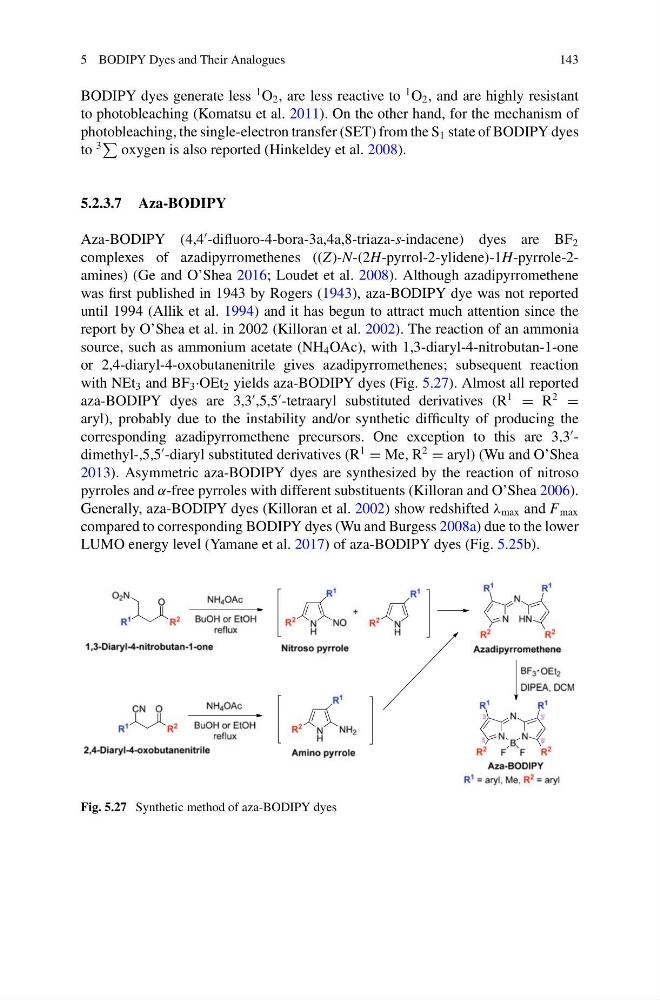
report by O’Shea et al. in 2002 (Killoran et al. 2002). The reaction of an ammonia
source, such as ammonium acetate (NH 4 OAc), with 1,3-diaryl-4-nitrobutan-1-one
or 2,4-diaryl-4-oxobutanenitrile gives azadipyrromethenes; subsequent reaction
with NEt 3 and BF 3 ·OEt 2 yields aza-BODIPY dyes (Fig. 5.27). Almost all reported
aza-BODIPY dyes are 3,3
,5,5
-tetraaryl substituted derivatives (R
1
= R
2
=
aryl), probably due to the instability and/or synthetic difficulty of producing the
corresponding azadipyrromethene precursors. One exception to this are 3,3
-
dimethyl-,5,5
-diaryl substituted derivatives (R
1
= Me, R
2
= aryl) (Wu and O’Shea
2013). Asymmetric aza-BODIPY dyes are synthesized by the reaction of nitroso
pyrroles and α-free pyrroles with different substituents (Killoran and O’Shea 2006).
Generally, aza-BODIPY dyes (Killoran et al. 2002) show redshifted λ max and F max
compared to corresponding BODIPY dyes (Wu and Burgess 2008a) due to the lower
LUMO energy level (Yamane et al. 2017) of aza-BODIPY dyes (Fig. 5.25b).
Fig. 5.27 Synthetic method of aza-BODIPY dyes
143
BODIPY dyes generate less
1 O 2 , are less reactive to
1 O 2 , and are highly resistant
to photobleaching (Komatsu et al. 2011). On the other hand, for the mechanism of
photobleaching, the single-electron transfer (SET) from the S 1 state of BODIPY dyes
to
3
oxygen is also reported (Hinkeldey et al. 2008).
5.2.3.7 Aza-BODIPY
Aza-BODIPY (4,4
-difluoro-4-bora-3a,4a,8-triaza-s-indacene) dyes are BF 2
complexes of azadipyrromethenes ((Z)-N-(2H-pyrrol-2-ylidene)-1H-pyrrole-2amines) (Ge and O’Shea 2016; Loudet et al. 2008). Although azadipyrromethene
was first published in 1943 by Rogers (1943), aza-BODIPY dye was not reported
until 1994 (Allik et al. 1994) and it has begun to attract much attention since the
report by O’Shea et al. in 2002 (Killoran et al. 2002). The reaction of an ammonia
source, such as ammonium acetate (NH 4 OAc), with 1,3-diaryl-4-nitrobutan-1-one
or 2,4-diaryl-4-oxobutanenitrile gives azadipyrromethenes; subsequent reaction
with NEt 3 and BF 3 ·OEt 2 yields aza-BODIPY dyes (Fig. 5.27). Almost all reported
aza-BODIPY dyes are 3,3
,5,5
-tetraaryl substituted derivatives (R
1
= R
2
=
aryl), probably due to the instability and/or synthetic difficulty of producing the
corresponding azadipyrromethene precursors. One exception to this are 3,3
-
dimethyl-,5,5
-diaryl substituted derivatives (R
1
= Me, R
2
= aryl) (Wu and O’Shea
2013). Asymmetric aza-BODIPY dyes are synthesized by the reaction of nitroso
pyrroles and α-free pyrroles with different substituents (Killoran and O’Shea 2006).
Generally, aza-BODIPY dyes (Killoran et al. 2002) show redshifted λ max and F max
compared to corresponding BODIPY dyes (Wu and Burgess 2008a) due to the lower
LUMO energy level (Yamane et al. 2017) of aza-BODIPY dyes (Fig. 5.25b).
Fig. 5.27 Synthetic method of aza-BODIPY dyes