

142
Y. Kubota
Photostability
In the photochemistry of BODIPY dyes, the grand-state triplet oxygen (
3 O 2 ) induces
intersystem crossing (ISC) of the excited singlet (S 1 ) state of BODIPY dye to generate
the excited triplet (T 1 ) state of BODIPY dye (Jones et al. 2003). In the ISC process,
the S 1 state of BODIPY dye and
3 O 2 forms the exciplex and then it dissociates to give
the T 1 state of BODIPY dye and
3 O 2 . The T 1 state of BODIPY dye further undergoes
energy transfer with
3 O 2 to give the singlet oxygen (
1 O 2 ). The formed
1 O 2 reacts
primarily at the C7
–C8 double bond of the ground singlet (S 0 ) state of BODIPY dye
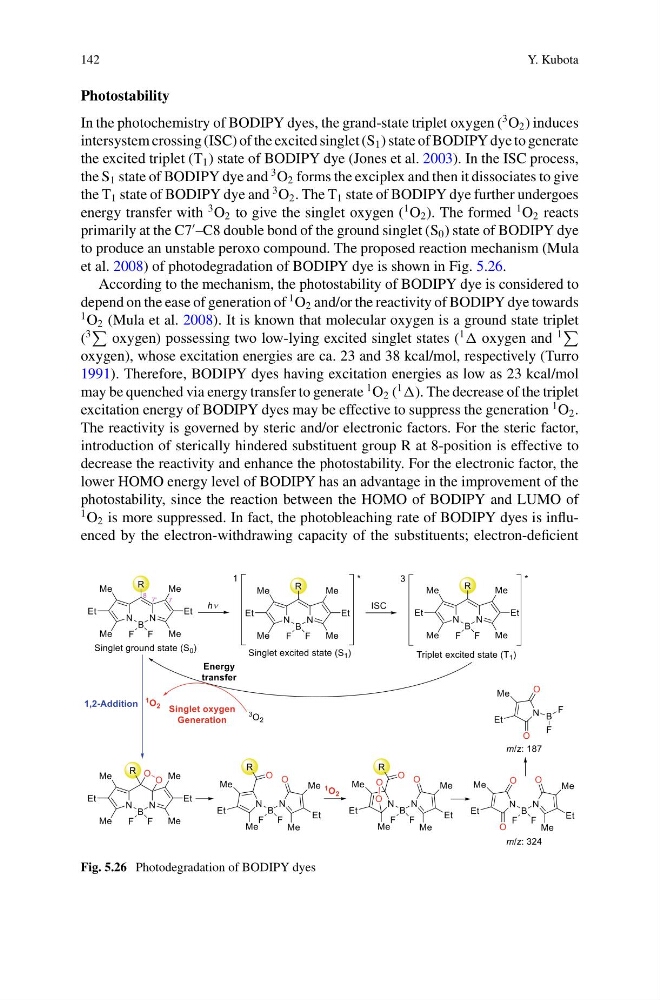
to produce an unstable peroxo compound. The proposed reaction mechanism (Mula
et al. 2008) of photodegradation of BODIPY dye is shown in Fig. 5.26.
According to the mechanism, the photostability of BODIPY dye is considered to
depend on the ease of generation of
1 O 2 and/or the reactivity of BODIPY dye towards
1 O 2 (Mula et al. 2008). It is known that molecular oxygen is a ground state triplet
(
3
oxygen) possessing two low-lying excited singlet states (
1
oxygen and
1
oxygen), whose excitation energies are ca. 23 and 38 kcal/mol, respectively (Turro
1991). Therefore, BODIPY dyes having excitation energies as low as 23 kcal/mol
may be quenched via energy transfer to generate
1 O 2 (
1
). The decrease of the triplet
excitation energy of BODIPY dyes may be effective to suppress the generation
1 O 2 .
The reactivity is governed by steric and/or electronic factors. For the steric factor,
introduction of sterically hindered substituent group R at 8-position is effective to
decrease the reactivity and enhance the photostability. For the electronic factor, the
lower HOMO energy level of BODIPY has an advantage in the improvement of the
photostability, since the reaction between the HOMO of BODIPY and LUMO of
1 O 2 is more suppressed. In fact, the photobleaching rate of BODIPY dyes is influenced by the electron-withdrawing capacity of the substituents; electron-deficient
Fig. 5.26 Photodegradation of BODIPY dyes
Y. Kubota
Photostability
In the photochemistry of BODIPY dyes, the grand-state triplet oxygen (
3 O 2 ) induces
intersystem crossing (ISC) of the excited singlet (S 1 ) state of BODIPY dye to generate
the excited triplet (T 1 ) state of BODIPY dye (Jones et al. 2003). In the ISC process,
the S 1 state of BODIPY dye and
3 O 2 forms the exciplex and then it dissociates to give
the T 1 state of BODIPY dye and
3 O 2 . The T 1 state of BODIPY dye further undergoes
energy transfer with
3 O 2 to give the singlet oxygen (
1 O 2 ). The formed
1 O 2 reacts
primarily at the C7
–C8 double bond of the ground singlet (S 0 ) state of BODIPY dye
to produce an unstable peroxo compound. The proposed reaction mechanism (Mula
et al. 2008) of photodegradation of BODIPY dye is shown in Fig. 5.26.
According to the mechanism, the photostability of BODIPY dye is considered to
depend on the ease of generation of
1 O 2 and/or the reactivity of BODIPY dye towards
1 O 2 (Mula et al. 2008). It is known that molecular oxygen is a ground state triplet
(
3
oxygen) possessing two low-lying excited singlet states (
1
oxygen and
1
oxygen), whose excitation energies are ca. 23 and 38 kcal/mol, respectively (Turro
1991). Therefore, BODIPY dyes having excitation energies as low as 23 kcal/mol
may be quenched via energy transfer to generate
1 O 2 (
1
). The decrease of the triplet
excitation energy of BODIPY dyes may be effective to suppress the generation
1 O 2 .
The reactivity is governed by steric and/or electronic factors. For the steric factor,
introduction of sterically hindered substituent group R at 8-position is effective to
decrease the reactivity and enhance the photostability. For the electronic factor, the
lower HOMO energy level of BODIPY has an advantage in the improvement of the
photostability, since the reaction between the HOMO of BODIPY and LUMO of
1 O 2 is more suppressed. In fact, the photobleaching rate of BODIPY dyes is influenced by the electron-withdrawing capacity of the substituents; electron-deficient
Fig. 5.26 Photodegradation of BODIPY dyes