

5 BODIPY Dyes and Their Analogues
141
Thermal stability
When considering practical applications of BODIPY dyes, thermal stability is
important. The destruction beginning temperature in an argon atmosphere (T Ar ) for
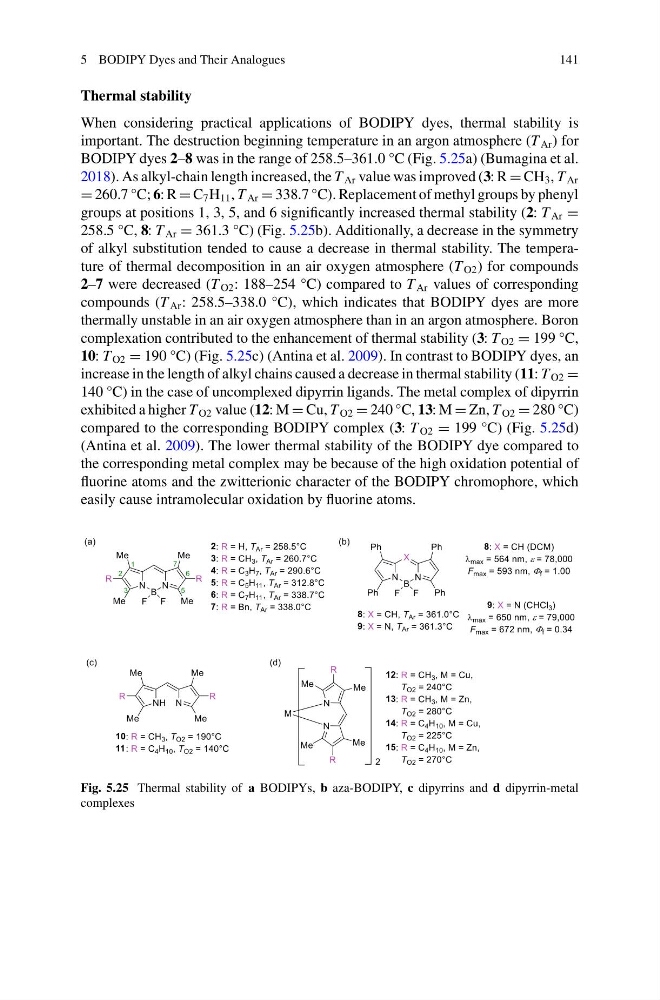
BODIPY dyes 2–8 was in the range of 258.5–361.0 °C (Fig. 5.25a) (Bumagina et al.
2018). As alkyl-chain length increased, the T Ar value was improved (3: R = CH 3 , T Ar
= 260.7 °C; 6: R = C 7 H 11 , T Ar = 338.7 °C). Replacement of methyl groups by phenyl
groups at positions 1, 3, 5, and 6 significantly increased thermal stability (2: T Ar =
258.5 °C, 8: T Ar = 361.3 °C) (Fig. 5.25b). Additionally, a decrease in the symmetry
of alkyl substitution tended to cause a decrease in thermal stability. The temperature of thermal decomposition in an air oxygen atmosphere (T O2 ) for compounds
2–7 were decreased (T O2 : 188–254 °C) compared to T Ar values of corresponding
compounds (T Ar : 258.5–338.0 °C), which indicates that BODIPY dyes are more
thermally unstable in an air oxygen atmosphere than in an argon atmosphere. Boron
complexation contributed to the enhancement of thermal stability (3: T O2 = 199 °C,
10: T O2 = 190 °C) (Fig. 5.25c) (Antina et al. 2009). In contrast to BODIPY dyes, an
increase in the length of alkyl chains caused a decrease in thermal stability (11: T O2 =
140 °C) in the case of uncomplexed dipyrrin ligands. The metal complex of dipyrrin
exhibited a higher T O2 value (12: M = Cu, T O2 = 240 °C, 13: M = Zn, T O2 = 280 °C)
compared to the corresponding BODIPY complex (3: T O2 = 199 °C) (Fig. 5.25d)
(Antina et al. 2009). The lower thermal stability of the BODIPY dye compared to
the corresponding metal complex may be because of the high oxidation potential of
fluorine atoms and the zwitterionic character of the BODIPY chromophore, which
easily cause intramolecular oxidation by fluorine atoms.
Fig. 5.25 Thermal stability of a BODIPYs, b aza-BODIPY, c dipyrrins and d dipyrrin-metal
complexes
141
Thermal stability
When considering practical applications of BODIPY dyes, thermal stability is
important. The destruction beginning temperature in an argon atmosphere (T Ar ) for
BODIPY dyes 2–8 was in the range of 258.5–361.0 °C (Fig. 5.25a) (Bumagina et al.
2018). As alkyl-chain length increased, the T Ar value was improved (3: R = CH 3 , T Ar
= 260.7 °C; 6: R = C 7 H 11 , T Ar = 338.7 °C). Replacement of methyl groups by phenyl
groups at positions 1, 3, 5, and 6 significantly increased thermal stability (2: T Ar =
258.5 °C, 8: T Ar = 361.3 °C) (Fig. 5.25b). Additionally, a decrease in the symmetry
of alkyl substitution tended to cause a decrease in thermal stability. The temperature of thermal decomposition in an air oxygen atmosphere (T O2 ) for compounds
2–7 were decreased (T O2 : 188–254 °C) compared to T Ar values of corresponding
compounds (T Ar : 258.5–338.0 °C), which indicates that BODIPY dyes are more
thermally unstable in an air oxygen atmosphere than in an argon atmosphere. Boron
complexation contributed to the enhancement of thermal stability (3: T O2 = 199 °C,
10: T O2 = 190 °C) (Fig. 5.25c) (Antina et al. 2009). In contrast to BODIPY dyes, an
increase in the length of alkyl chains caused a decrease in thermal stability (11: T O2 =
140 °C) in the case of uncomplexed dipyrrin ligands. The metal complex of dipyrrin
exhibited a higher T O2 value (12: M = Cu, T O2 = 240 °C, 13: M = Zn, T O2 = 280 °C)
compared to the corresponding BODIPY complex (3: T O2 = 199 °C) (Fig. 5.25d)
(Antina et al. 2009). The lower thermal stability of the BODIPY dye compared to
the corresponding metal complex may be because of the high oxidation potential of
fluorine atoms and the zwitterionic character of the BODIPY chromophore, which
easily cause intramolecular oxidation by fluorine atoms.
Fig. 5.25 Thermal stability of a BODIPYs, b aza-BODIPY, c dipyrrins and d dipyrrin-metal
complexes