

140
Y. Kubota
In strategy (3), asymmetric anthracene-fused BODIPY dye shows a large Stokes
shift (hexane: 54 nm, DCM: 55 nm) probably due to the improved ICT properties
(Fig. 5.22d) (Yang et al. 2016). Although ICT causes broadening of the fluorescence spectrum, the asymmetric anthracene-fused BODIPY dye retained a sharp
fluorescence spectrum with full width at half maximum measurements (FWHM) of
934 cm
−1 in hexane and 1107 cm
−1 in DCM.
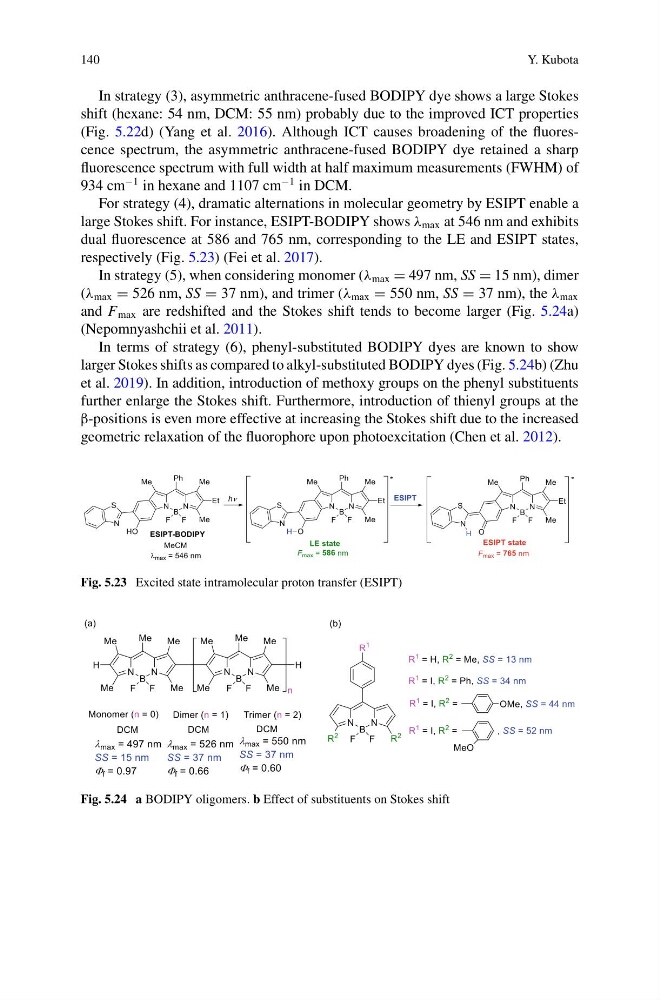
For strategy (4), dramatic alternations in molecular geometry by ESIPT enable a
large Stokes shift. For instance, ESIPT-BODIPY shows λ max at 546 nm and exhibits
dual fluorescence at 586 and 765 nm, corresponding to the LE and ESIPT states,
respectively (Fig. 5.23) (Fei et al. 2017).
In strategy (5), when considering monomer (λ max = 497 nm, SS = 15 nm), dimer
(λ max = 526 nm, SS = 37 nm), and trimer (λ max = 550 nm, SS = 37 nm), the λ max
and F max are redshifted and the Stokes shift tends to become larger (Fig. 5.24a)
(Nepomnyashchii et al. 2011).
In terms of strategy (6), phenyl-substituted BODIPY dyes are known to show
larger Stokes shifts as compared to alkyl-substituted BODIPY dyes (Fig. 5.24b) (Zhu
et al. 2019). In addition, introduction of methoxy groups on the phenyl substituents
further enlarge the Stokes shift. Furthermore, introduction of thienyl groups at the
β-positions is even more effective at increasing the Stokes shift due to the increased
geometric relaxation of the fluorophore upon photoexcitation (Chen et al. 2012).
Fig. 5.23 Excited state intramolecular proton transfer (ESIPT)
Fig. 5.24 a BODIPY oligomers. b Effect of substituents on Stokes shift
Y. Kubota
In strategy (3), asymmetric anthracene-fused BODIPY dye shows a large Stokes
shift (hexane: 54 nm, DCM: 55 nm) probably due to the improved ICT properties
(Fig. 5.22d) (Yang et al. 2016). Although ICT causes broadening of the fluorescence spectrum, the asymmetric anthracene-fused BODIPY dye retained a sharp
fluorescence spectrum with full width at half maximum measurements (FWHM) of
934 cm
−1 in hexane and 1107 cm
−1 in DCM.
For strategy (4), dramatic alternations in molecular geometry by ESIPT enable a
large Stokes shift. For instance, ESIPT-BODIPY shows λ max at 546 nm and exhibits
dual fluorescence at 586 and 765 nm, corresponding to the LE and ESIPT states,
respectively (Fig. 5.23) (Fei et al. 2017).
In strategy (5), when considering monomer (λ max = 497 nm, SS = 15 nm), dimer
(λ max = 526 nm, SS = 37 nm), and trimer (λ max = 550 nm, SS = 37 nm), the λ max
and F max are redshifted and the Stokes shift tends to become larger (Fig. 5.24a)
(Nepomnyashchii et al. 2011).
In terms of strategy (6), phenyl-substituted BODIPY dyes are known to show
larger Stokes shifts as compared to alkyl-substituted BODIPY dyes (Fig. 5.24b) (Zhu
et al. 2019). In addition, introduction of methoxy groups on the phenyl substituents
further enlarge the Stokes shift. Furthermore, introduction of thienyl groups at the
β-positions is even more effective at increasing the Stokes shift due to the increased
geometric relaxation of the fluorophore upon photoexcitation (Chen et al. 2012).
Fig. 5.23 Excited state intramolecular proton transfer (ESIPT)
Fig. 5.24 a BODIPY oligomers. b Effect of substituents on Stokes shift