

5 BODIPY Dyes and Their Analogues
139
system, they are linked through a conjugated spacer in the TBET system. In the case of
FRET, significant spectral overlap between the donor emission and acceptor absorption spectra is required; the efficiency of FRET depends on the degree of the spectral
overlap. On the other hand, in the case of TBET, such spectral overlap between donor
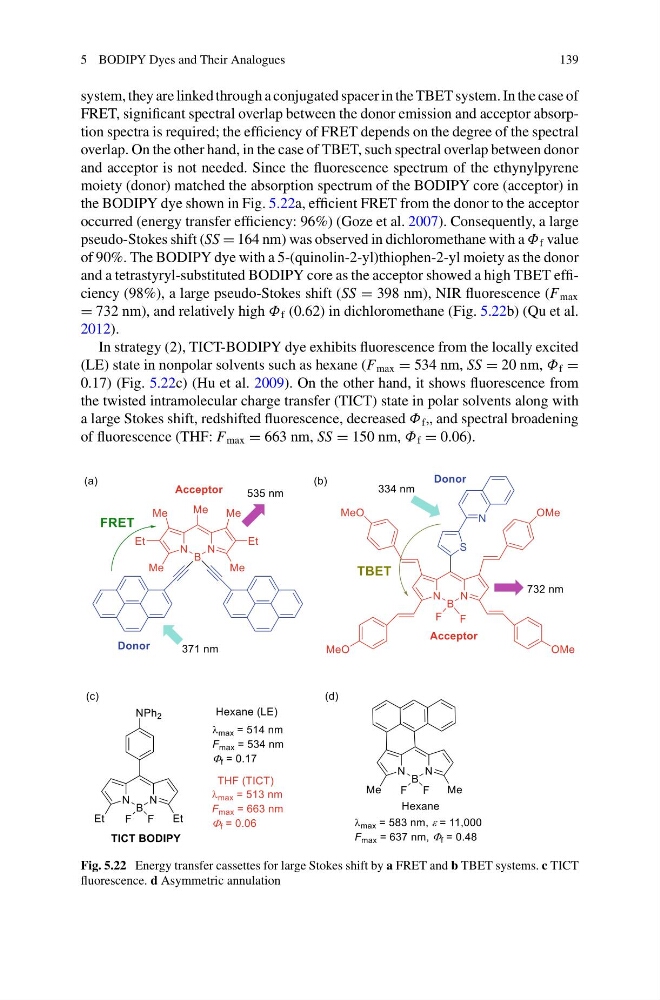
and acceptor is not needed. Since the fluorescence spectrum of the ethynylpyrene
moiety (donor) matched the absorption spectrum of the BODIPY core (acceptor) in
the BODIPY dye shown in Fig. 5.22a, efficient FRET from the donor to the acceptor
occurred (energy transfer efficiency: 96%) (Goze et al. 2007). Consequently, a large
pseudo-Stokes shift (SS = 164 nm) was observed in dichloromethane with a Φ f value
of 90%. The BODIPY dye with a 5-(quinolin-2-yl)thiophen-2-yl moiety as the donor
and a tetrastyryl-substituted BODIPY core as the acceptor showed a high TBET efficiency (98%), a large pseudo-Stokes shift (SS = 398 nm), NIR fluorescence (F max
= 732 nm), and relatively high Φ f (0.62) in dichloromethane (Fig. 5.22b) (Qu et al.
2012).
In strategy (2), TICT-BODIPY dye exhibits fluorescence from the locally excited
(LE) state in nonpolar solvents such as hexane (F max = 534 nm, SS = 20 nm, Φ f =
0.17) (Fig. 5.22c) (Hu et al. 2009). On the other hand, it shows fluorescence from
the twisted intramolecular charge transfer (TICT) state in polar solvents along with
a large Stokes shift, redshifted fluorescence, decreased Φ f „ and spectral broadening
of fluorescence (THF: F max = 663 nm, SS = 150 nm, Φ f = 0.06).
Fig. 5.22 Energy transfer cassettes for large Stokes shift by a FRET and b TBET systems. c TICT
fluorescence. d Asymmetric annulation
139
system, they are linked through a conjugated spacer in the TBET system. In the case of
FRET, significant spectral overlap between the donor emission and acceptor absorption spectra is required; the efficiency of FRET depends on the degree of the spectral
overlap. On the other hand, in the case of TBET, such spectral overlap between donor
and acceptor is not needed. Since the fluorescence spectrum of the ethynylpyrene
moiety (donor) matched the absorption spectrum of the BODIPY core (acceptor) in
the BODIPY dye shown in Fig. 5.22a, efficient FRET from the donor to the acceptor
occurred (energy transfer efficiency: 96%) (Goze et al. 2007). Consequently, a large
pseudo-Stokes shift (SS = 164 nm) was observed in dichloromethane with a Φ f value
of 90%. The BODIPY dye with a 5-(quinolin-2-yl)thiophen-2-yl moiety as the donor
and a tetrastyryl-substituted BODIPY core as the acceptor showed a high TBET efficiency (98%), a large pseudo-Stokes shift (SS = 398 nm), NIR fluorescence (F max
= 732 nm), and relatively high Φ f (0.62) in dichloromethane (Fig. 5.22b) (Qu et al.
2012).
In strategy (2), TICT-BODIPY dye exhibits fluorescence from the locally excited
(LE) state in nonpolar solvents such as hexane (F max = 534 nm, SS = 20 nm, Φ f =
0.17) (Fig. 5.22c) (Hu et al. 2009). On the other hand, it shows fluorescence from
the twisted intramolecular charge transfer (TICT) state in polar solvents along with
a large Stokes shift, redshifted fluorescence, decreased Φ f „ and spectral broadening
of fluorescence (THF: F max = 663 nm, SS = 150 nm, Φ f = 0.06).
Fig. 5.22 Energy transfer cassettes for large Stokes shift by a FRET and b TBET systems. c TICT
fluorescence. d Asymmetric annulation