

5 BODIPY Dyes and Their Analogues
131
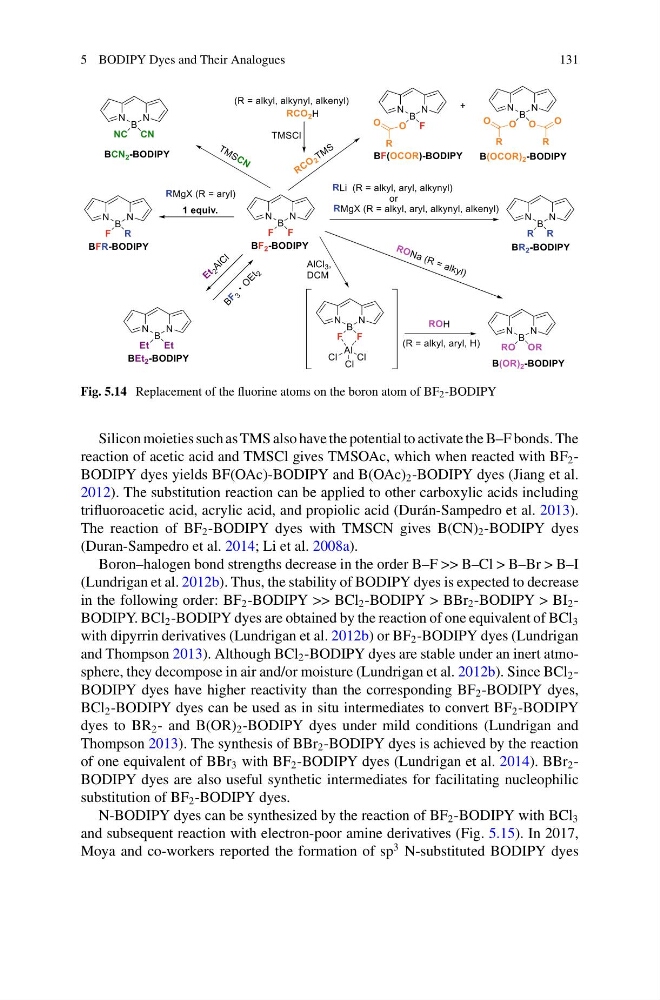
Fig. 5.14 Replacement of the fluorine atoms on the boron atom of BF 2 -BODIPY
Silicon moieties such as TMS also have the potential to activate the B–F bonds. The
reaction of acetic acid and TMSCl gives TMSOAc, which when reacted with BF 2 -
BODIPY dyes yields BF(OAc)-BODIPY and B(OAc) 2 -BODIPY dyes (Jiang et al.
2012). The substitution reaction can be applied to other carboxylic acids including
trifluoroacetic acid, acrylic acid, and propiolic acid (Durán-Sampedro et al. 2013).
The reaction of BF 2 -BODIPY dyes with TMSCN gives B(CN) 2 -BODIPY dyes
(Duran-Sampedro et al. 2014; Li et al. 2008a).
Boron–halogen bond strengths decrease in the order B–F >> B–Cl > B–Br > B–I
(Lundrigan et al. 2012b). Thus, the stability of BODIPY dyes is expected to decrease
in the following order: BF 2 -BODIPY >> BCl 2 -BODIPY > BBr 2 -BODIPY > BI 2 -
BODIPY. BCl 2 -BODIPY dyes are obtained by the reaction of one equivalent of BCl 3
with dipyrrin derivatives (Lundrigan et al. 2012b) or BF 2 -BODIPY dyes (Lundrigan
and Thompson 2013). Although BCl 2 -BODIPY dyes are stable under an inert atmosphere, they decompose in air and/or moisture (Lundrigan et al. 2012b). Since BCl 2 -
BODIPY dyes have higher reactivity than the corresponding BF 2 -BODIPY dyes,
BCl 2 -BODIPY dyes can be used as in situ intermediates to convert BF 2 -BODIPY
dyes to BR 2 - and B(OR) 2 -BODIPY dyes under mild conditions (Lundrigan and
Thompson 2013). The synthesis of BBr 2 -BODIPY dyes is achieved by the reaction
of one equivalent of BBr 3 with BF 2 -BODIPY dyes (Lundrigan et al. 2014). BBr 2 -
BODIPY dyes are also useful synthetic intermediates for facilitating nucleophilic
substitution of BF 2 -BODIPY dyes.
N-BODIPY dyes can be synthesized by the reaction of BF 2 -BODIPY with BCl 3
and subsequent reaction with electron-poor amine derivatives (Fig. 5.15). In 2017,
Moya and co-workers reported the formation of sp
3 N-substituted BODIPY dyes
131
Fig. 5.14 Replacement of the fluorine atoms on the boron atom of BF 2 -BODIPY
Silicon moieties such as TMS also have the potential to activate the B–F bonds. The
reaction of acetic acid and TMSCl gives TMSOAc, which when reacted with BF 2 -
BODIPY dyes yields BF(OAc)-BODIPY and B(OAc) 2 -BODIPY dyes (Jiang et al.
2012). The substitution reaction can be applied to other carboxylic acids including
trifluoroacetic acid, acrylic acid, and propiolic acid (Durán-Sampedro et al. 2013).
The reaction of BF 2 -BODIPY dyes with TMSCN gives B(CN) 2 -BODIPY dyes
(Duran-Sampedro et al. 2014; Li et al. 2008a).
Boron–halogen bond strengths decrease in the order B–F >> B–Cl > B–Br > B–I
(Lundrigan et al. 2012b). Thus, the stability of BODIPY dyes is expected to decrease
in the following order: BF 2 -BODIPY >> BCl 2 -BODIPY > BBr 2 -BODIPY > BI 2 -
BODIPY. BCl 2 -BODIPY dyes are obtained by the reaction of one equivalent of BCl 3
with dipyrrin derivatives (Lundrigan et al. 2012b) or BF 2 -BODIPY dyes (Lundrigan
and Thompson 2013). Although BCl 2 -BODIPY dyes are stable under an inert atmosphere, they decompose in air and/or moisture (Lundrigan et al. 2012b). Since BCl 2 -
BODIPY dyes have higher reactivity than the corresponding BF 2 -BODIPY dyes,
BCl 2 -BODIPY dyes can be used as in situ intermediates to convert BF 2 -BODIPY
dyes to BR 2 - and B(OR) 2 -BODIPY dyes under mild conditions (Lundrigan and
Thompson 2013). The synthesis of BBr 2 -BODIPY dyes is achieved by the reaction
of one equivalent of BBr 3 with BF 2 -BODIPY dyes (Lundrigan et al. 2014). BBr 2 -
BODIPY dyes are also useful synthetic intermediates for facilitating nucleophilic
substitution of BF 2 -BODIPY dyes.
N-BODIPY dyes can be synthesized by the reaction of BF 2 -BODIPY with BCl 3
and subsequent reaction with electron-poor amine derivatives (Fig. 5.15). In 2017,
Moya and co-workers reported the formation of sp
3 N-substituted BODIPY dyes