

132
Y. Kubota
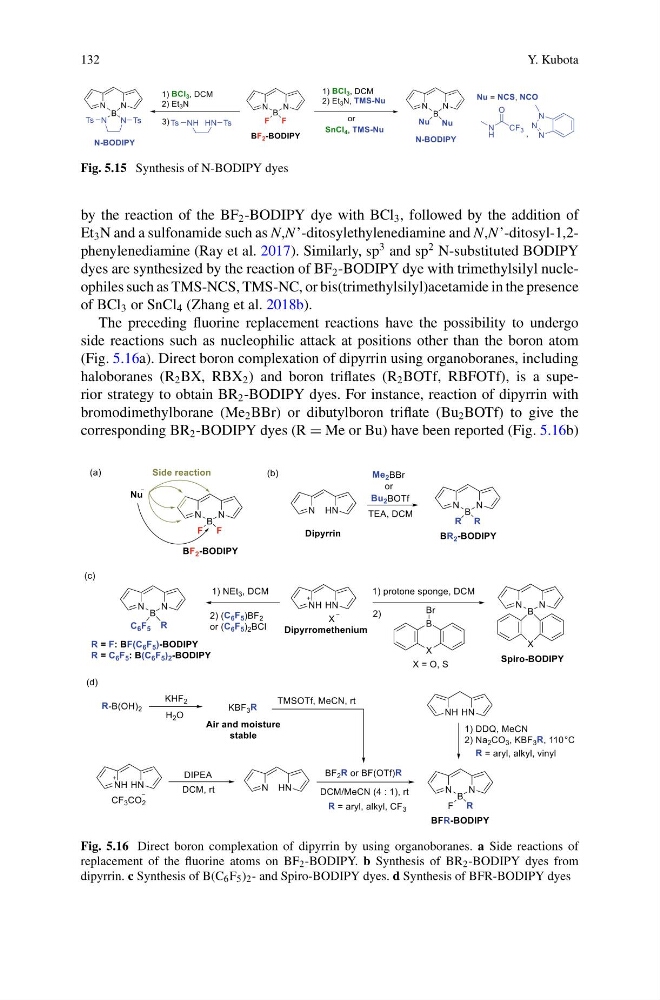
Fig. 5.15 Synthesis of N-BODIPY dyes
by the reaction of the BF 2 -BODIPY dye with BCl 3 , followed by the addition of
Et 3 N and a sulfonamide such as N,N’-ditosylethylenediamine and N,N’-ditosyl-1,2phenylenediamine (Ray et al. 2017). Similarly, sp
3 and sp
2 N-substituted BODIPY
dyes are synthesized by the reaction of BF 2 -BODIPY dye with trimethylsilyl nucleophiles such as TMS-NCS, TMS-NC, or bis(trimethylsilyl)acetamide in the presence
of BCl 3 or SnCl 4 (Zhang et al. 2018b).
The preceding fluorine replacement reactions have the possibility to undergo
side reactions such as nucleophilic attack at positions other than the boron atom
(Fig. 5.16a). Direct boron complexation of dipyrrin using organoboranes, including
haloboranes (R 2 BX, RBX 2 ) and boron triflates (R 2 BOTf, RBFOTf), is a superior strategy to obtain BR 2 -BODIPY dyes. For instance, reaction of dipyrrin with
bromodimethylborane (Me 2 BBr) or dibutylboron triflate (Bu 2 BOTf) to give the
corresponding BR 2 -BODIPY dyes (R = Me or Bu) have been reported (Fig. 5.16b)
Fig. 5.16 Direct boron complexation of dipyrrin by using organoboranes. a Side reactions of
replacement of the fluorine atoms on BF 2 -BODIPY. b Synthesis of BR 2 -BODIPY dyes from
dipyrrin. c Synthesis of B(C 6 F 5 ) 2 - and Spiro-BODIPY dyes. d Synthesis of BFR-BODIPY dyes
Y. Kubota
Fig. 5.15 Synthesis of N-BODIPY dyes
by the reaction of the BF 2 -BODIPY dye with BCl 3 , followed by the addition of
Et 3 N and a sulfonamide such as N,N’-ditosylethylenediamine and N,N’-ditosyl-1,2phenylenediamine (Ray et al. 2017). Similarly, sp
3 and sp
2 N-substituted BODIPY
dyes are synthesized by the reaction of BF 2 -BODIPY dye with trimethylsilyl nucleophiles such as TMS-NCS, TMS-NC, or bis(trimethylsilyl)acetamide in the presence
of BCl 3 or SnCl 4 (Zhang et al. 2018b).
The preceding fluorine replacement reactions have the possibility to undergo
side reactions such as nucleophilic attack at positions other than the boron atom
(Fig. 5.16a). Direct boron complexation of dipyrrin using organoboranes, including
haloboranes (R 2 BX, RBX 2 ) and boron triflates (R 2 BOTf, RBFOTf), is a superior strategy to obtain BR 2 -BODIPY dyes. For instance, reaction of dipyrrin with
bromodimethylborane (Me 2 BBr) or dibutylboron triflate (Bu 2 BOTf) to give the
corresponding BR 2 -BODIPY dyes (R = Me or Bu) have been reported (Fig. 5.16b)
Fig. 5.16 Direct boron complexation of dipyrrin by using organoboranes. a Side reactions of
replacement of the fluorine atoms on BF 2 -BODIPY. b Synthesis of BR 2 -BODIPY dyes from
dipyrrin. c Synthesis of B(C 6 F 5 ) 2 - and Spiro-BODIPY dyes. d Synthesis of BFR-BODIPY dyes