

4 Phthalocyanine and Related Analogues
101
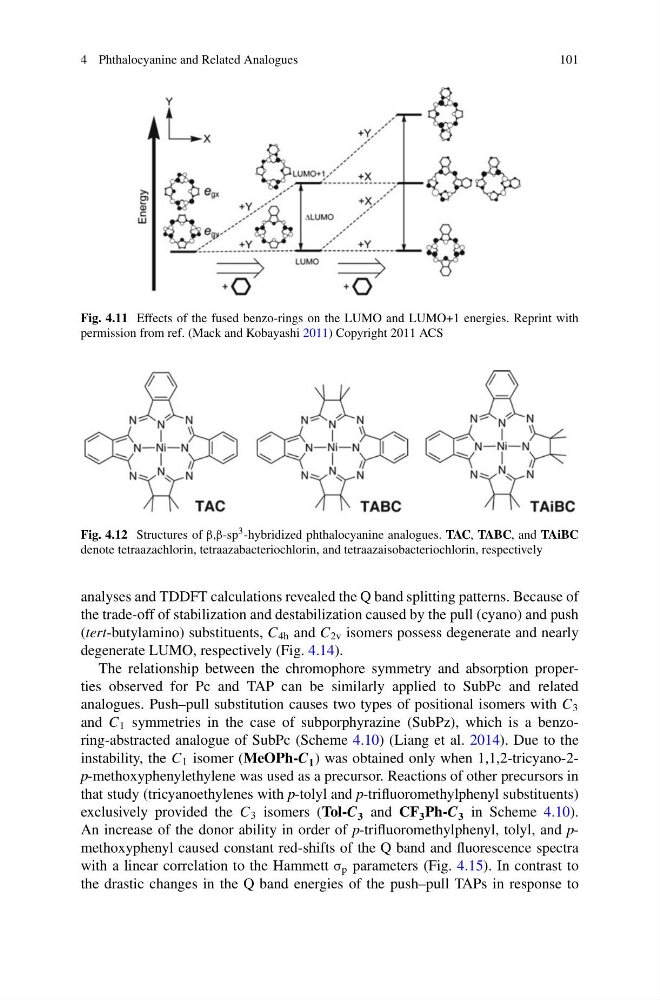
Fig. 4.11 Effects of the fused benzo-rings on the LUMO and LUMO+1 energies. Reprint with
permission from ref. (Mack and Kobayashi 2011) Copyright 2011 ACS
Fig. 4.12 Structures of β,β-sp 3 -hybridized phthalocyanine analogues. TAC, TABC, and TAiBC
denote tetraazachlorin, tetraazabacteriochlorin, and tetraazaisobacteriochlorin, respectively
analyses and TDDFT calculations revealed the Q band splitting patterns. Because of
the trade-off of stabilization and destabilization caused by the pull (cyano) and push
(tert-butylamino) substituents, C 4h and C 2v isomers possess degenerate and nearly
degenerate LUMO, respectively (Fig. 4.14).
The relationship between the chromophore symmetry and absorption properties observed for Pc and TAP can be similarly applied to SubPc and related
analogues. Push–pull substitution causes two types of positional isomers with C 3
and C 1 symmetries in the case of subporphyrazine (SubPz), which is a benzoring-abstracted analogue of SubPc (Scheme 4.10) (Liang et al. 2014). Due to the
instability, the C 1 isomer (MeOPh-C 1 ) was obtained only when 1,1,2-tricyano-2p-methoxyphenylethylene was used as a precursor. Reactions of other precursors in
that study (tricyanoethylenes with p-tolyl and p-trifluoromethylphenyl substituents)
exclusively provided the C 3 isomers (Tol-C 3 and CF 3 Ph-C 3 in Scheme 4.10).
An increase of the donor ability in order of p-trifluoromethylphenyl, tolyl, and pmethoxyphenyl caused constant red-shifts of the Q band and fluorescence spectra
with a linear correlation to the Hammett σ p parameters (Fig. 4.15). In contrast to
the drastic changes in the Q band energies of the push–pull TAPs in response to
101
Fig. 4.11 Effects of the fused benzo-rings on the LUMO and LUMO+1 energies. Reprint with
permission from ref. (Mack and Kobayashi 2011) Copyright 2011 ACS
Fig. 4.12 Structures of β,β-sp 3 -hybridized phthalocyanine analogues. TAC, TABC, and TAiBC
denote tetraazachlorin, tetraazabacteriochlorin, and tetraazaisobacteriochlorin, respectively
analyses and TDDFT calculations revealed the Q band splitting patterns. Because of
the trade-off of stabilization and destabilization caused by the pull (cyano) and push
(tert-butylamino) substituents, C 4h and C 2v isomers possess degenerate and nearly
degenerate LUMO, respectively (Fig. 4.14).
The relationship between the chromophore symmetry and absorption properties observed for Pc and TAP can be similarly applied to SubPc and related
analogues. Push–pull substitution causes two types of positional isomers with C 3
and C 1 symmetries in the case of subporphyrazine (SubPz), which is a benzoring-abstracted analogue of SubPc (Scheme 4.10) (Liang et al. 2014). Due to the
instability, the C 1 isomer (MeOPh-C 1 ) was obtained only when 1,1,2-tricyano-2p-methoxyphenylethylene was used as a precursor. Reactions of other precursors in
that study (tricyanoethylenes with p-tolyl and p-trifluoromethylphenyl substituents)
exclusively provided the C 3 isomers (Tol-C 3 and CF 3 Ph-C 3 in Scheme 4.10).
An increase of the donor ability in order of p-trifluoromethylphenyl, tolyl, and pmethoxyphenyl caused constant red-shifts of the Q band and fluorescence spectra
with a linear correlation to the Hammett σ p parameters (Fig. 4.15). In contrast to
the drastic changes in the Q band energies of the push–pull TAPs in response to