

102
S. Shimizu
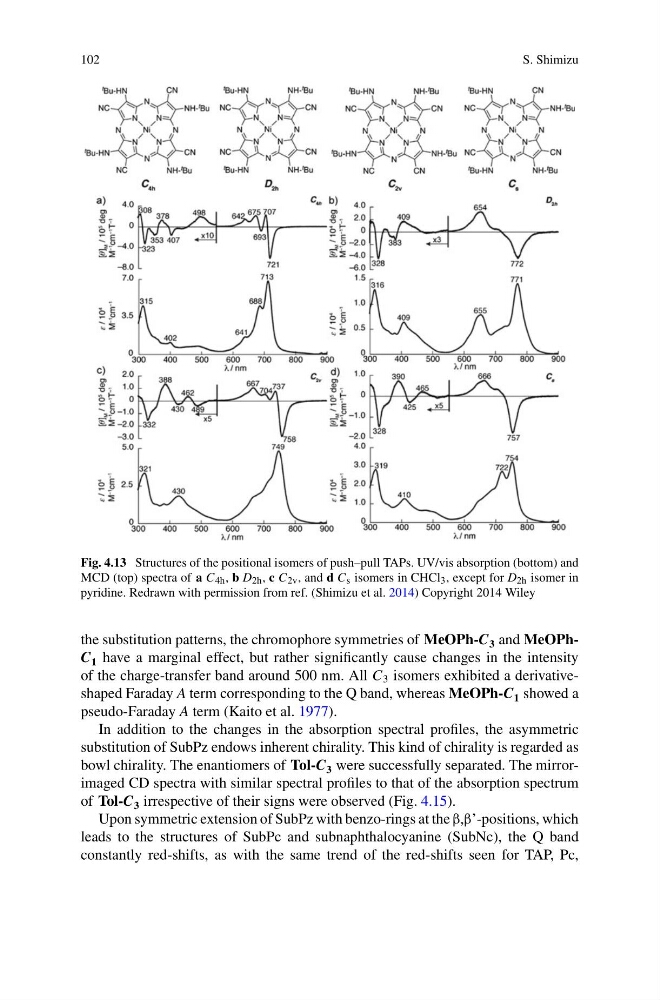
Fig. 4.13 Structures of the positional isomers of push–pull TAPs. UV/vis absorption (bottom) and
MCD (top) spectra of a C 4h , b D 2h , c C 2v , and d C s isomers in CHCl 3 , except for D 2h isomer in
pyridine. Redrawn with permission from ref. (Shimizu et al. 2014) Copyright 2014 Wiley
the substitution patterns, the chromophore symmetries of MeOPh-C 3 and MeOPhC 1 have a marginal effect, but rather significantly cause changes in the intensity
of the charge-transfer band around 500 nm. All C 3 isomers exhibited a derivativeshaped Faraday A term corresponding to the Q band, whereas MeOPh-C 1 showed a
pseudo-Faraday A term (Kaito et al. 1977).
In addition to the changes in the absorption spectral profiles, the asymmetric
substitution of SubPz endows inherent chirality. This kind of chirality is regarded as
bowl chirality. The enantiomers of Tol-C 3 were successfully separated. The mirrorimaged CD spectra with similar spectral profiles to that of the absorption spectrum
of Tol-C 3 irrespective of their signs were observed (Fig. 4.15).
Upon symmetric extension of SubPz with benzo-rings at the β,β’-positions, which
leads to the structures of SubPc and subnaphthalocyanine (SubNc), the Q band
constantly red-shifts, as with the same trend of the red-shifts seen for TAP, Pc,
S. Shimizu
Fig. 4.13 Structures of the positional isomers of push–pull TAPs. UV/vis absorption (bottom) and
MCD (top) spectra of a C 4h , b D 2h , c C 2v , and d C s isomers in CHCl 3 , except for D 2h isomer in
pyridine. Redrawn with permission from ref. (Shimizu et al. 2014) Copyright 2014 Wiley
the substitution patterns, the chromophore symmetries of MeOPh-C 3 and MeOPhC 1 have a marginal effect, but rather significantly cause changes in the intensity
of the charge-transfer band around 500 nm. All C 3 isomers exhibited a derivativeshaped Faraday A term corresponding to the Q band, whereas MeOPh-C 1 showed a
pseudo-Faraday A term (Kaito et al. 1977).
In addition to the changes in the absorption spectral profiles, the asymmetric
substitution of SubPz endows inherent chirality. This kind of chirality is regarded as
bowl chirality. The enantiomers of Tol-C 3 were successfully separated. The mirrorimaged CD spectra with similar spectral profiles to that of the absorption spectrum
of Tol-C 3 irrespective of their signs were observed (Fig. 4.15).
Upon symmetric extension of SubPz with benzo-rings at the β,β’-positions, which
leads to the structures of SubPc and subnaphthalocyanine (SubNc), the Q band
constantly red-shifts, as with the same trend of the red-shifts seen for TAP, Pc,