

100
S. Shimizu
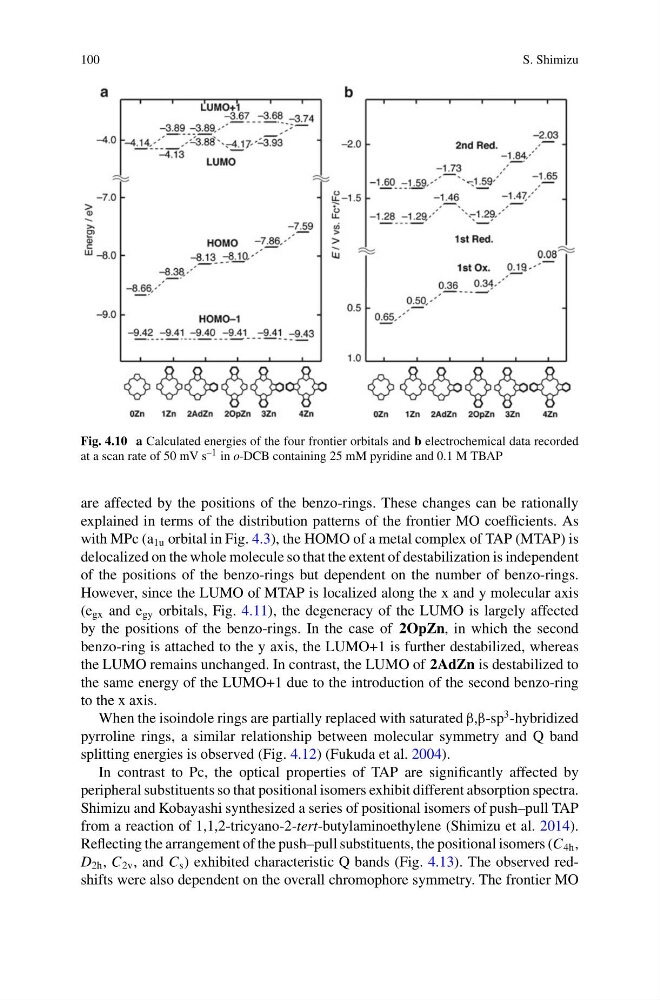
Fig. 4.10 a Calculated energies of the four frontier orbitals and b electrochemical data recorded
at a scan rate of 50 mV s –1 in o-DCB containing 25 mM pyridine and 0.1 M TBAP
are affected by the positions of the benzo-rings. These changes can be rationally
explained in terms of the distribution patterns of the frontier MO coefficients. As
with MPc (a 1u orbital in Fig. 4.3), the HOMO of a metal complex of TAP (MTAP) is
delocalized on the whole molecule so that the extent of destabilization is independent
of the positions of the benzo-rings but dependent on the number of benzo-rings.
However, since the LUMO of MTAP is localized along the x and y molecular axis
(e gx and e gy orbitals, Fig. 4.11), the degeneracy of the LUMO is largely affected
by the positions of the benzo-rings. In the case of 2OpZn, in which the second
benzo-ring is attached to the y axis, the LUMO+1 is further destabilized, whereas
the LUMO remains unchanged. In contrast, the LUMO of 2AdZn is destabilized to
the same energy of the LUMO+1 due to the introduction of the second benzo-ring
to the x axis.
When the isoindole rings are partially replaced with saturated β,β-sp
3 -hybridized
pyrroline rings, a similar relationship between molecular symmetry and Q band
splitting energies is observed (Fig. 4.12) (Fukuda et al. 2004).
In contrast to Pc, the optical properties of TAP are significantly affected by
peripheral substituents so that positional isomers exhibit different absorption spectra.
Shimizu and Kobayashi synthesized a series of positional isomers of push–pull TAP
from a reaction of 1,1,2-tricyano-2-tert-butylaminoethylene (Shimizu et al. 2014).
Reflecting the arrangement of the push–pull substituents, the positional isomers (C 4h ,
D 2h , C 2v , and C s ) exhibited characteristic Q bands (Fig. 4.13). The observed redshifts were also dependent on the overall chromophore symmetry. The frontier MO
S. Shimizu
Fig. 4.10 a Calculated energies of the four frontier orbitals and b electrochemical data recorded
at a scan rate of 50 mV s –1 in o-DCB containing 25 mM pyridine and 0.1 M TBAP
are affected by the positions of the benzo-rings. These changes can be rationally
explained in terms of the distribution patterns of the frontier MO coefficients. As
with MPc (a 1u orbital in Fig. 4.3), the HOMO of a metal complex of TAP (MTAP) is
delocalized on the whole molecule so that the extent of destabilization is independent
of the positions of the benzo-rings but dependent on the number of benzo-rings.
However, since the LUMO of MTAP is localized along the x and y molecular axis
(e gx and e gy orbitals, Fig. 4.11), the degeneracy of the LUMO is largely affected
by the positions of the benzo-rings. In the case of 2OpZn, in which the second
benzo-ring is attached to the y axis, the LUMO+1 is further destabilized, whereas
the LUMO remains unchanged. In contrast, the LUMO of 2AdZn is destabilized to
the same energy of the LUMO+1 due to the introduction of the second benzo-ring
to the x axis.
When the isoindole rings are partially replaced with saturated β,β-sp
3 -hybridized
pyrroline rings, a similar relationship between molecular symmetry and Q band
splitting energies is observed (Fig. 4.12) (Fukuda et al. 2004).
In contrast to Pc, the optical properties of TAP are significantly affected by
peripheral substituents so that positional isomers exhibit different absorption spectra.
Shimizu and Kobayashi synthesized a series of positional isomers of push–pull TAP
from a reaction of 1,1,2-tricyano-2-tert-butylaminoethylene (Shimizu et al. 2014).
Reflecting the arrangement of the push–pull substituents, the positional isomers (C 4h ,
D 2h , C 2v , and C s ) exhibited characteristic Q bands (Fig. 4.13). The observed redshifts were also dependent on the overall chromophore symmetry. The frontier MO