

4 Phthalocyanine and Related Analogues
97
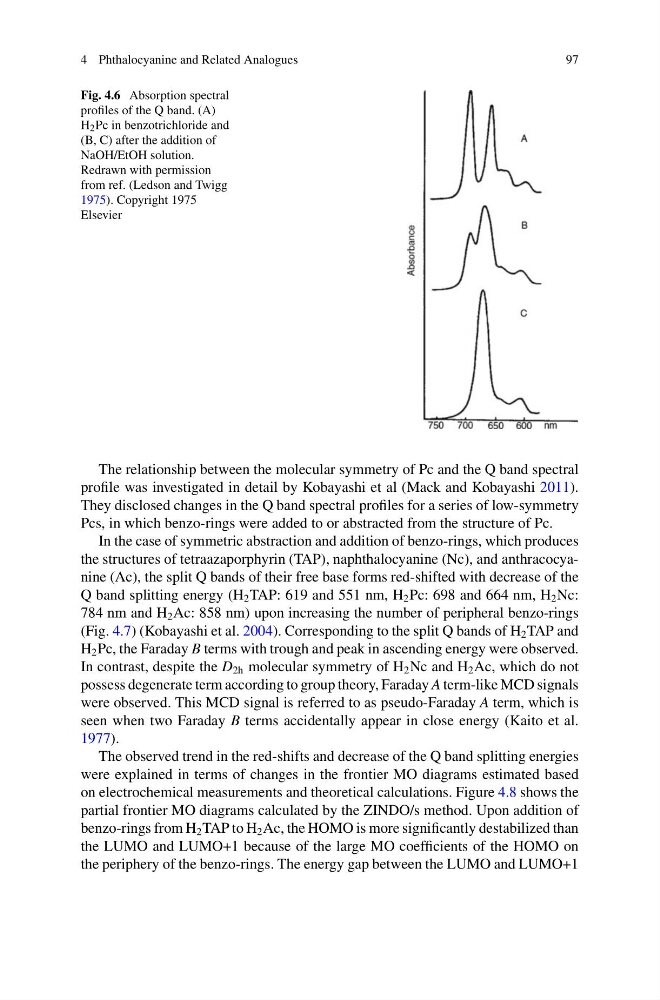
Fig. 4.6 Absorption spectral
profiles of the Q band. (A)
H 2 Pc in benzotrichloride and
(B, C) after the addition of
NaOH/EtOH solution.
Redrawn with permission
from ref. (Ledson and Twigg
1975). Copyright 1975
Elsevier
The relationship between the molecular symmetry of Pc and the Q band spectral
profile was investigated in detail by Kobayashi et al (Mack and Kobayashi 2011).
They disclosed changes in the Q band spectral profiles for a series of low-symmetry
Pcs, in which benzo-rings were added to or abstracted from the structure of Pc.
In the case of symmetric abstraction and addition of benzo-rings, which produces
the structures of tetraazaporphyrin (TAP), naphthalocyanine (Nc), and anthracocyanine (Ac), the split Q bands of their free base forms red-shifted with decrease of the
Q band splitting energy (H 2 TAP: 619 and 551 nm, H 2 Pc: 698 and 664 nm, H 2 Nc:
784 nm and H 2 Ac: 858 nm) upon increasing the number of peripheral benzo-rings
(Fig. 4.7) (Kobayashi et al. 2004). Corresponding to the split Q bands of H 2 TAP and
H 2 Pc, the Faraday B terms with trough and peak in ascending energy were observed.
In contrast, despite the D 2h molecular symmetry of H 2 Nc and H 2 Ac, which do not
possess degenerate term according to group theory, Faraday A term-like MCD signals
were observed. This MCD signal is referred to as pseudo-Faraday A term, which is
seen when two Faraday B terms accidentally appear in close energy (Kaito et al.
1977).
The observed trend in the red-shifts and decrease of the Q band splitting energies
were explained in terms of changes in the frontier MO diagrams estimated based
on electrochemical measurements and theoretical calculations. Figure 4.8 shows the
partial frontier MO diagrams calculated by the ZINDO/s method. Upon addition of
benzo-rings from H 2 TAP to H 2 Ac, the HOMO is more significantly destabilized than
the LUMO and LUMO+1 because of the large MO coefficients of the HOMO on
the periphery of the benzo-rings. The energy gap between the LUMO and LUMO+1
97
Fig. 4.6 Absorption spectral
profiles of the Q band. (A)
H 2 Pc in benzotrichloride and
(B, C) after the addition of
NaOH/EtOH solution.
Redrawn with permission
from ref. (Ledson and Twigg
1975). Copyright 1975
Elsevier
The relationship between the molecular symmetry of Pc and the Q band spectral
profile was investigated in detail by Kobayashi et al (Mack and Kobayashi 2011).
They disclosed changes in the Q band spectral profiles for a series of low-symmetry
Pcs, in which benzo-rings were added to or abstracted from the structure of Pc.
In the case of symmetric abstraction and addition of benzo-rings, which produces
the structures of tetraazaporphyrin (TAP), naphthalocyanine (Nc), and anthracocyanine (Ac), the split Q bands of their free base forms red-shifted with decrease of the
Q band splitting energy (H 2 TAP: 619 and 551 nm, H 2 Pc: 698 and 664 nm, H 2 Nc:
784 nm and H 2 Ac: 858 nm) upon increasing the number of peripheral benzo-rings
(Fig. 4.7) (Kobayashi et al. 2004). Corresponding to the split Q bands of H 2 TAP and
H 2 Pc, the Faraday B terms with trough and peak in ascending energy were observed.
In contrast, despite the D 2h molecular symmetry of H 2 Nc and H 2 Ac, which do not
possess degenerate term according to group theory, Faraday A term-like MCD signals
were observed. This MCD signal is referred to as pseudo-Faraday A term, which is
seen when two Faraday B terms accidentally appear in close energy (Kaito et al.
1977).
The observed trend in the red-shifts and decrease of the Q band splitting energies
were explained in terms of changes in the frontier MO diagrams estimated based
on electrochemical measurements and theoretical calculations. Figure 4.8 shows the
partial frontier MO diagrams calculated by the ZINDO/s method. Upon addition of
benzo-rings from H 2 TAP to H 2 Ac, the HOMO is more significantly destabilized than
the LUMO and LUMO+1 because of the large MO coefficients of the HOMO on
the periphery of the benzo-rings. The energy gap between the LUMO and LUMO+1