

96
S. Shimizu
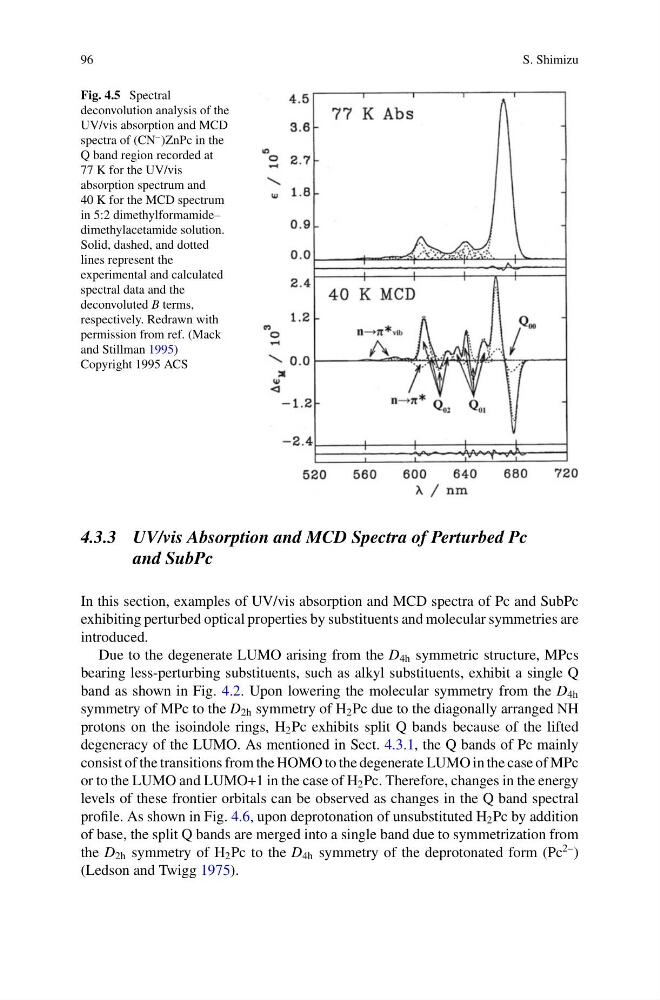
Fig. 4.5 Spectral
deconvolution analysis of the
UV/vis absorption and MCD
spectra of (CN – )ZnPc in the
Q band region recorded at
77 K for the UV/vis
absorption spectrum and
40 K for the MCD spectrum
in 5:2 dimethylformamide–
dimethylacetamide solution.
Solid, dashed, and dotted
lines represent the
experimental and calculated
spectral data and the
deconvoluted B terms,
respectively. Redrawn with
permission from ref. (Mack
and Stillman 1995)
Copyright 1995 ACS
4.3.3 UV/vis Absorption and MCD Spectra of Perturbed Pc
and SubPc
In this section, examples of UV/vis absorption and MCD spectra of Pc and SubPc
exhibiting perturbed optical properties by substituents and molecular symmetries are
introduced.
Due to the degenerate LUMO arising from the D 4h symmetric structure, MPcs
bearing less-perturbing substituents, such as alkyl substituents, exhibit a single Q
band as shown in Fig. 4.2. Upon lowering the molecular symmetry from the D 4h
symmetry of MPc to the D 2h symmetry of H 2 Pc due to the diagonally arranged NH
protons on the isoindole rings, H 2 Pc exhibits split Q bands because of the lifted
degeneracy of the LUMO. As mentioned in Sect. 4.3.1, the Q bands of Pc mainly
consist of the transitions from the HOMO to the degenerate LUMO in the case of MPc
or to the LUMO and LUMO+1 in the case of H 2 Pc. Therefore, changes in the energy
levels of these frontier orbitals can be observed as changes in the Q band spectral
profile. As shown in Fig. 4.6, upon deprotonation of unsubstituted H 2 Pc by addition
of base, the split Q bands are merged into a single band due to symmetrization from
the D 2h symmetry of H 2 Pc to the D 4h symmetry of the deprotonated form (Pc
2– )
(Ledson and Twigg 1975).
S. Shimizu
Fig. 4.5 Spectral
deconvolution analysis of the
UV/vis absorption and MCD
spectra of (CN – )ZnPc in the
Q band region recorded at
77 K for the UV/vis
absorption spectrum and
40 K for the MCD spectrum
in 5:2 dimethylformamide–
dimethylacetamide solution.
Solid, dashed, and dotted
lines represent the
experimental and calculated
spectral data and the
deconvoluted B terms,
respectively. Redrawn with
permission from ref. (Mack
and Stillman 1995)
Copyright 1995 ACS
4.3.3 UV/vis Absorption and MCD Spectra of Perturbed Pc
and SubPc
In this section, examples of UV/vis absorption and MCD spectra of Pc and SubPc
exhibiting perturbed optical properties by substituents and molecular symmetries are
introduced.
Due to the degenerate LUMO arising from the D 4h symmetric structure, MPcs
bearing less-perturbing substituents, such as alkyl substituents, exhibit a single Q
band as shown in Fig. 4.2. Upon lowering the molecular symmetry from the D 4h
symmetry of MPc to the D 2h symmetry of H 2 Pc due to the diagonally arranged NH
protons on the isoindole rings, H 2 Pc exhibits split Q bands because of the lifted
degeneracy of the LUMO. As mentioned in Sect. 4.3.1, the Q bands of Pc mainly
consist of the transitions from the HOMO to the degenerate LUMO in the case of MPc
or to the LUMO and LUMO+1 in the case of H 2 Pc. Therefore, changes in the energy
levels of these frontier orbitals can be observed as changes in the Q band spectral
profile. As shown in Fig. 4.6, upon deprotonation of unsubstituted H 2 Pc by addition
of base, the split Q bands are merged into a single band due to symmetrization from
the D 2h symmetry of H 2 Pc to the D 4h symmetry of the deprotonated form (Pc
2– )
(Ledson and Twigg 1975).