

3.2 THEORETICAL MODELS FOR REACTION
RATES
3.2.1 Temperature dependence of the rate constant
The rate of decomposition of an ensemble of nanoparticles increases with
temperature. This intuitive observation holds for any chemical reaction
and is based on the premise that temperature represents average kinetic
energy, and thus, molecules move faster at higher temperatures and are
more likely to collide with each other, providing more opportunities to
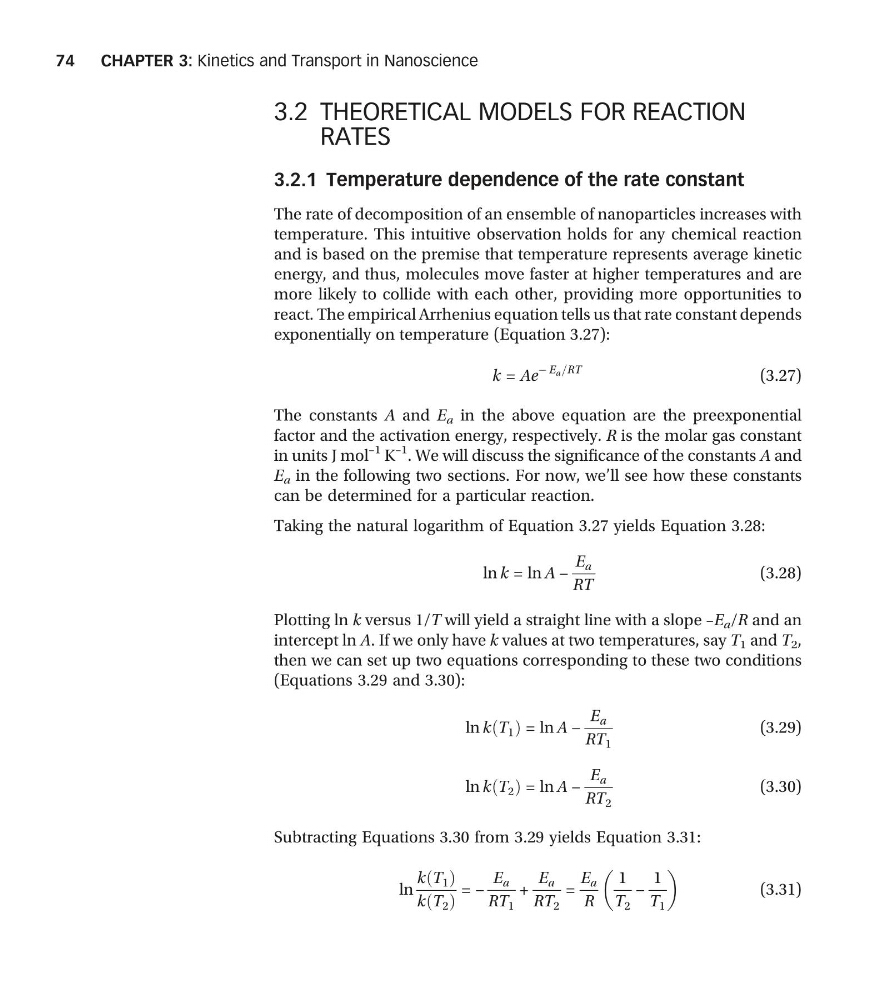
react. The empirical Arrhenius equation tells us that rate constant depends
exponentially on temperature (Equation 3.27):
k = Ae
À E a =RT
(3.27)
The constants A and E a in the above equation are the preexponential
factor and the activation energy, respectively. R is the molar gas constant
in units J mol
–1 K
–1 . We will discuss the significance of the constants A and
E a in the following two sections. For now, we’ll see how these constants
can be determined for a particular reaction.
Taking the natural logarithm of Equation 3.27 yields Equation 3.28:
ln k = ln A −
E a
RT
(3.28)
Plotting ln k versus 1/T will yield a straight line with a slope –E a /R and an
intercept ln A. If we only have k values at two temperatures, say T 1 and T 2 ,
then we can set up two equations corresponding to these two conditions
(Equations 3.29 and 3.30):
ln k T 1
ð Þ = ln A −
E a
RT 1
(3.29)
ln k T 2
ð Þ = ln A −
E a
RT 2
(3.30)
Subtracting Equations 3.30 from 3.29 yields Equation 3.31:
ln
k T 1
ð Þ
k T 2
ð Þ
= −
E a
RT 1
+
E a
RT 2
=
E a
R
1
T 2
−
1
T 1
(3.31)
CHAPTER 3: Kinetics and Transport in Nanoscience
74
RATES
3.2.1 Temperature dependence of the rate constant
The rate of decomposition of an ensemble of nanoparticles increases with
temperature. This intuitive observation holds for any chemical reaction
and is based on the premise that temperature represents average kinetic
energy, and thus, molecules move faster at higher temperatures and are
more likely to collide with each other, providing more opportunities to
react. The empirical Arrhenius equation tells us that rate constant depends
exponentially on temperature (Equation 3.27):
k = Ae
À E a =RT
(3.27)
The constants A and E a in the above equation are the preexponential
factor and the activation energy, respectively. R is the molar gas constant
in units J mol
–1 K
–1 . We will discuss the significance of the constants A and
E a in the following two sections. For now, we’ll see how these constants
can be determined for a particular reaction.
Taking the natural logarithm of Equation 3.27 yields Equation 3.28:
ln k = ln A −
E a
RT
(3.28)
Plotting ln k versus 1/T will yield a straight line with a slope –E a /R and an
intercept ln A. If we only have k values at two temperatures, say T 1 and T 2 ,
then we can set up two equations corresponding to these two conditions
(Equations 3.29 and 3.30):
ln k T 1
ð Þ = ln A −
E a
RT 1
(3.29)
ln k T 2
ð Þ = ln A −
E a
RT 2
(3.30)
Subtracting Equations 3.30 from 3.29 yields Equation 3.31:
ln
k T 1
ð Þ
k T 2
ð Þ
= −
E a
RT 1
+
E a
RT 2
=
E a
R
1
T 2
−
1
T 1
(3.31)
CHAPTER 3: Kinetics and Transport in Nanoscience
74