

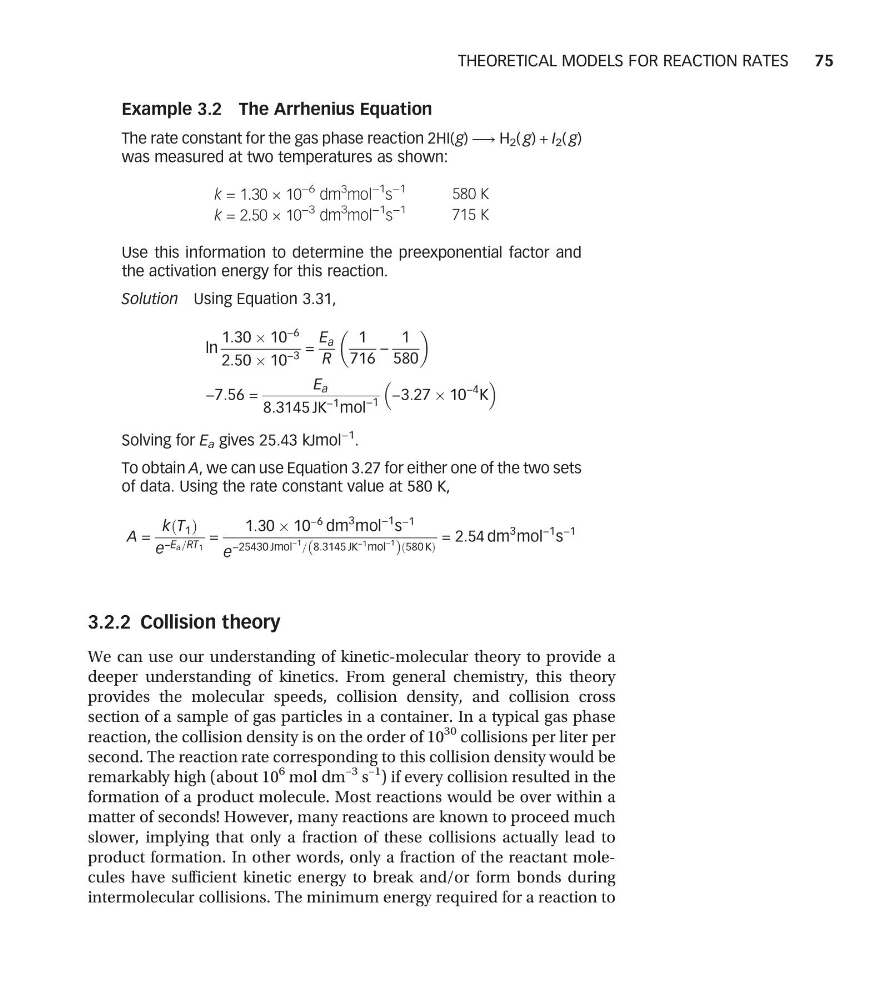
Example 3.2 The Arrhenius Equation
The rate constant for the gas phase reaction 2HI( g) ⟶ H 2 ( g) + I 2 ( g)
was measured at two temperatures as shown:
k = 1.30 × 10
−6 dm
3 mol
−1 s
−1
580 K
k = 2.50 × 10
−3 dm
3 mol
−1 s
−1
715 K
Use this information to determine the preexponential factor and
the activation energy for this reaction.
Solution Using Equation 3.31,
ln
1:30 Â 10
−6
2:50 Â 10
−3
=
E a
R
1
716
−
1
580
−7:56 =
E a
8:3145 JK
−1 mol
−1
−3:27 Â 10
−4 K
Solving for E a gives 25.43 kJmol
−1
.
To obtain A, we can use Equation 3.27 for either one of the two sets
of data. Using the rate constant value at 580 K,
A =
k T 1
ð Þ
e
−E a =RT 1
=
1:30 Â 10
−6 dm
3 mol
−1 s
−1
e
−25430 Jmol
−1 = 8:3145 JK
−1 mol
−1
ð
Þ580 K
ð
Þ
= 2:54 dm
3 mol
−1 s
−1
3.2.2 Collision theory
We can use our understanding of kinetic-molecular theory to provide a
deeper understanding of kinetics. From general chemistry, this theory
provides the molecular speeds, collision density, and collision cross
section of a sample of gas particles in a container. In a typical gas phase
reaction, the collision density is on the order of 10
30 collisions per liter per
second. The reaction rate corresponding to this collision density would be
remarkably high (about 10
6 mol dm
–3 s
–1
) if every collision resulted in the
formation of a product molecule. Most reactions would be over within a
matter of seconds! However, many reactions are known to proceed much
slower, implying that only a fraction of these collisions actually lead to
product formation. In other words, only a fraction of the reactant molecules have sufficient kinetic energy to break and/or form bonds during
intermolecular collisions. The minimum energy required for a reaction to
THEORETICAL MODELS FOR REACTION RATES
75
The rate constant for the gas phase reaction 2HI( g) ⟶ H 2 ( g) + I 2 ( g)
was measured at two temperatures as shown:
k = 1.30 × 10
−6 dm
3 mol
−1 s
−1
580 K
k = 2.50 × 10
−3 dm
3 mol
−1 s
−1
715 K
Use this information to determine the preexponential factor and
the activation energy for this reaction.
Solution Using Equation 3.31,
ln
1:30 Â 10
−6
2:50 Â 10
−3
=
E a
R
1
716
−
1
580
−7:56 =
E a
8:3145 JK
−1 mol
−1
−3:27 Â 10
−4 K
Solving for E a gives 25.43 kJmol
−1
.
To obtain A, we can use Equation 3.27 for either one of the two sets
of data. Using the rate constant value at 580 K,
A =
k T 1
ð Þ
e
−E a =RT 1
=
1:30 Â 10
−6 dm
3 mol
−1 s
−1
e
−25430 Jmol
−1 = 8:3145 JK
−1 mol
−1
ð
Þ580 K
ð
Þ
= 2:54 dm
3 mol
−1 s
−1
3.2.2 Collision theory
We can use our understanding of kinetic-molecular theory to provide a
deeper understanding of kinetics. From general chemistry, this theory
provides the molecular speeds, collision density, and collision cross
section of a sample of gas particles in a container. In a typical gas phase
reaction, the collision density is on the order of 10
30 collisions per liter per
second. The reaction rate corresponding to this collision density would be
remarkably high (about 10
6 mol dm
–3 s
–1
) if every collision resulted in the
formation of a product molecule. Most reactions would be over within a
matter of seconds! However, many reactions are known to proceed much
slower, implying that only a fraction of these collisions actually lead to
product formation. In other words, only a fraction of the reactant molecules have sufficient kinetic energy to break and/or form bonds during
intermolecular collisions. The minimum energy required for a reaction to
THEORETICAL MODELS FOR REACTION RATES
75