

take place is the activation energy (E a ), the same activation energy
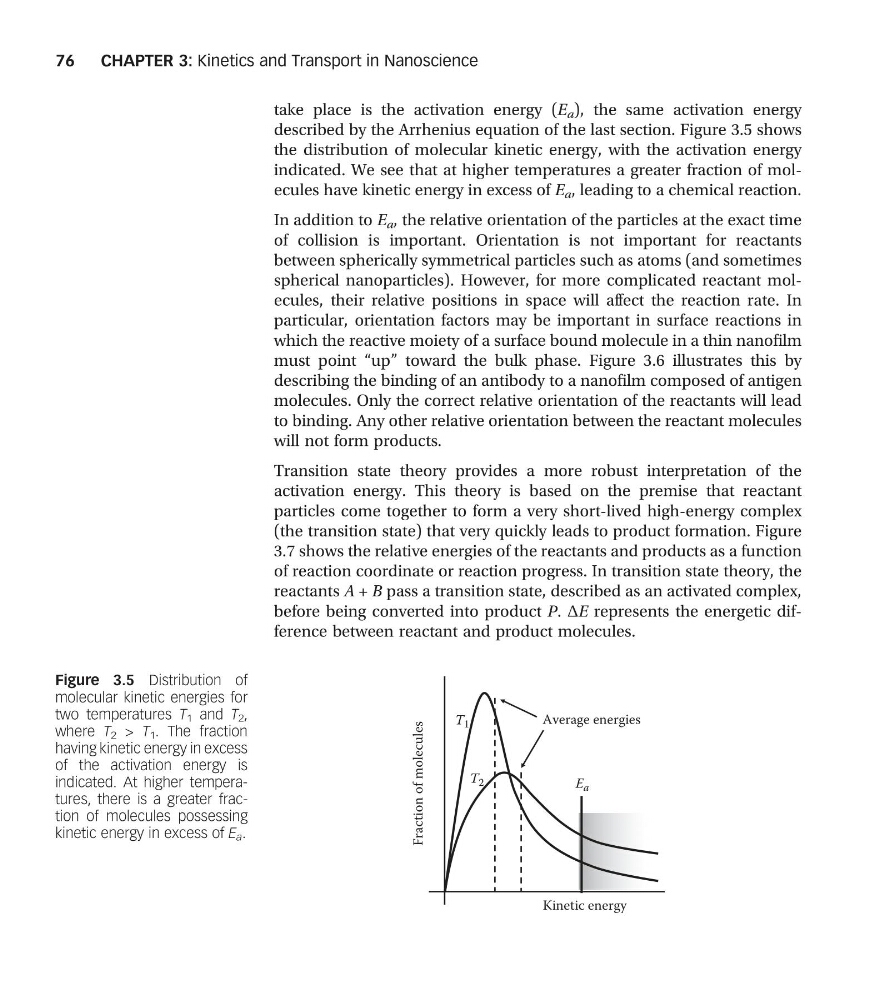
described by the Arrhenius equation of the last section. Figure 3.5 shows
the distribution of molecular kinetic energy, with the activation energy
indicated. We see that at higher temperatures a greater fraction of molecules have kinetic energy in excess of E a , leading to a chemical reaction.
In addition to E a , the relative orientation of the particles at the exact time
of collision is important. Orientation is not important for reactants
between spherically symmetrical particles such as atoms (and sometimes
spherical nanoparticles). However, for more complicated reactant molecules, their relative positions in space will affect the reaction rate. In
particular, orientation factors may be important in surface reactions in
which the reactive moiety of a surface bound molecule in a thin nanofilm
must point “up” toward the bulk phase. Figure 3.6 illustrates this by
describing the binding of an antibody to a nanofilm composed of antigen
molecules. Only the correct relative orientation of the reactants will lead
to binding. Any other relative orientation between the reactant molecules
will not form products.
Transition state theory provides a more robust interpretation of the
activation energy. This theory is based on the premise that reactant
particles come together to form a very short-lived high-energy complex
(the transition state) that very quickly leads to product formation. Figure
3.7 shows the relative energies of the reactants and products as a function
of reaction coordinate or reaction progress. In transition state theory, the
reactants A + B pass a transition state, described as an activated complex,
before being converted into product P. ΔE represents the energetic difference between reactant and product molecules.
Kinetic energy
Average energies
Fraction of molecules
E a
T 2
T 1
Figure 3.5 Distribution of
molecular kinetic energies for
two temperatures T 1 and T 2 ,
where T 2 > T 1 . The fraction
having kinetic energy in excess
of the activation energy is
indicated. At higher temperatures, there is a greater fraction of molecules possessing
kinetic energy in excess of E a .
CHAPTER 3: Kinetics and Transport in Nanoscience
76
described by the Arrhenius equation of the last section. Figure 3.5 shows
the distribution of molecular kinetic energy, with the activation energy
indicated. We see that at higher temperatures a greater fraction of molecules have kinetic energy in excess of E a , leading to a chemical reaction.
In addition to E a , the relative orientation of the particles at the exact time
of collision is important. Orientation is not important for reactants
between spherically symmetrical particles such as atoms (and sometimes
spherical nanoparticles). However, for more complicated reactant molecules, their relative positions in space will affect the reaction rate. In
particular, orientation factors may be important in surface reactions in
which the reactive moiety of a surface bound molecule in a thin nanofilm
must point “up” toward the bulk phase. Figure 3.6 illustrates this by
describing the binding of an antibody to a nanofilm composed of antigen
molecules. Only the correct relative orientation of the reactants will lead
to binding. Any other relative orientation between the reactant molecules
will not form products.
Transition state theory provides a more robust interpretation of the
activation energy. This theory is based on the premise that reactant
particles come together to form a very short-lived high-energy complex
(the transition state) that very quickly leads to product formation. Figure
3.7 shows the relative energies of the reactants and products as a function
of reaction coordinate or reaction progress. In transition state theory, the
reactants A + B pass a transition state, described as an activated complex,
before being converted into product P. ΔE represents the energetic difference between reactant and product molecules.
Kinetic energy
Average energies
Fraction of molecules
E a
T 2
T 1
Figure 3.5 Distribution of
molecular kinetic energies for
two temperatures T 1 and T 2 ,
where T 2 > T 1 . The fraction
having kinetic energy in excess
of the activation energy is
indicated. At higher temperatures, there is a greater fraction of molecules possessing
kinetic energy in excess of E a .
CHAPTER 3: Kinetics and Transport in Nanoscience
76