

3.2.3 Catalysis
A catalyst is a species that when added to a reaction mixture speeds up
the rate of the reaction. Catalysis has great relevance to reactions such as
nanoparticle synthesis, quantum dot functionalization, and to reactions
on surfaces. A catalyst increases the rate of a reaction by lowering its
activation energy (Figure 3.8). We can distinguish two types of catalysis:
homogeneous and heterogeneous. In homogeneous catalysis, the catalyst
and reactants are always in the same phase. For example, the hydrolysis
of ethyl acetate, encountered in Section 3.1.2, is catalyzed by sulfuric acid.
Another example of homogeneous catalysis is the natural destruction of
Correct
orientation
for reaction
Incorrect
orientation
for reaction
Only correct
orientation will
lead to product
formation
A
A
A
A
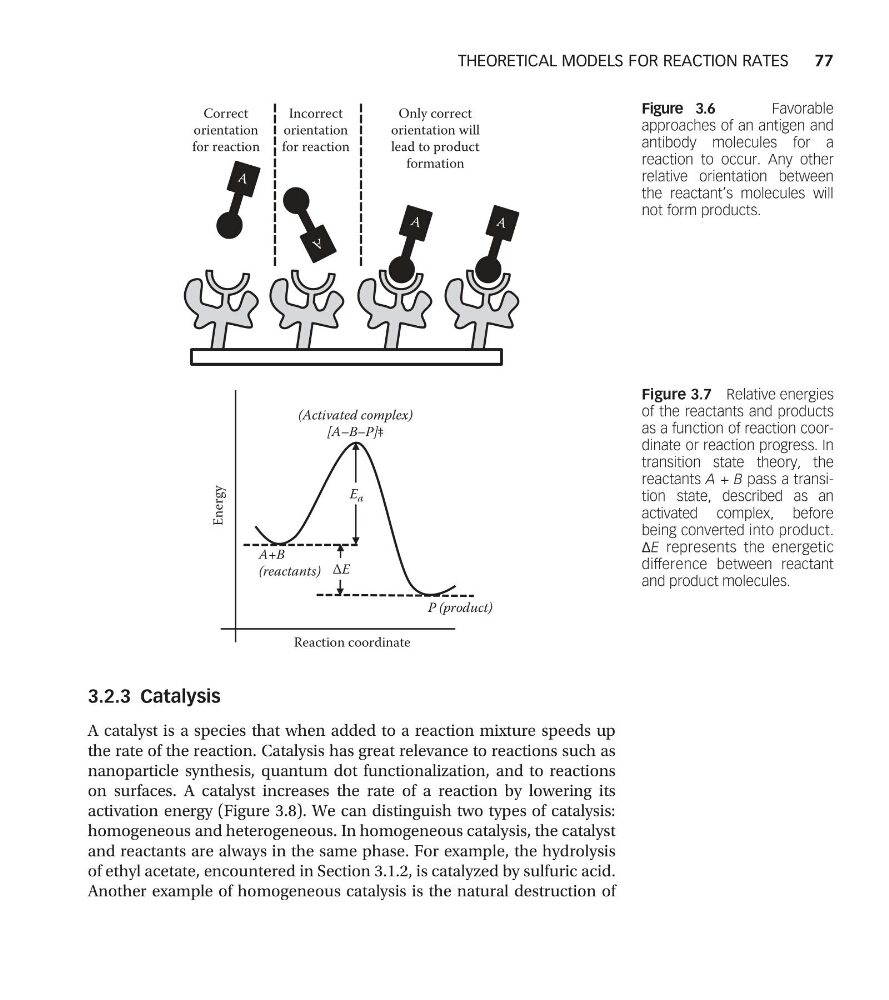
Figure 3.6
Favorable
approaches of an antigen and
antibody molecules for a
reaction to occur. Any other
relative orientation between
the reactant’s molecules will
not form products.
Reaction coordinate
Energy
A+B
(reactants)
P (product)
(Activated complex)
[A–B–P]‡
E a
ΔE
Figure 3.7 Relative energies
of the reactants and products
as a function of reaction coordinate or reaction progress. In
transition state theory, the
reactants A + B pass a transition state, described as an
activated complex, before
being converted into product.
ΔE represents the energetic
difference between reactant
and product molecules.
THEORETICAL MODELS FOR REACTION RATES
77
A catalyst is a species that when added to a reaction mixture speeds up
the rate of the reaction. Catalysis has great relevance to reactions such as
nanoparticle synthesis, quantum dot functionalization, and to reactions
on surfaces. A catalyst increases the rate of a reaction by lowering its
activation energy (Figure 3.8). We can distinguish two types of catalysis:
homogeneous and heterogeneous. In homogeneous catalysis, the catalyst
and reactants are always in the same phase. For example, the hydrolysis
of ethyl acetate, encountered in Section 3.1.2, is catalyzed by sulfuric acid.
Another example of homogeneous catalysis is the natural destruction of
Correct
orientation
for reaction
Incorrect
orientation
for reaction
Only correct
orientation will
lead to product
formation
A
A
A
A
Figure 3.6
Favorable
approaches of an antigen and
antibody molecules for a
reaction to occur. Any other
relative orientation between
the reactant’s molecules will
not form products.
Reaction coordinate
Energy
A+B
(reactants)
P (product)
(Activated complex)
[A–B–P]‡
E a
ΔE
Figure 3.7 Relative energies
of the reactants and products
as a function of reaction coordinate or reaction progress. In
transition state theory, the
reactants A + B pass a transition state, described as an
activated complex, before
being converted into product.
ΔE represents the energetic
difference between reactant
and product molecules.
THEORETICAL MODELS FOR REACTION RATES
77