

ozone in the atmosphere by species such as halogen radicals and nitric
oxide, in which all species, including the catalyst, are in the gas phase.
In heterogeneous catalysis, the catalyst is in a different phase compared to
the reactant. For example, in the Fischer–Tropsch process for converting
carbon monoxide and hydrogen into liquid hydrocarbons, the reactions
occur on surfaces of metals such as iron or cobalt. As another example,
catalytic converters in vehicles use catalysts such as platinum, palladium,
and rhodium to oxidize CO and hydrocarbons to CO 2 and to reduce
nitrogen oxides to oxygen and nitrogen. There is considerable interest in
replacing the expensive metals in these catalysts with high-surface-area
nanomaterials such as carbon nanotubes.
How do catalysts manage to lower E a ? To answer this question we must
appreciate that most reactions occur in a series of steps called elementary
steps. These steps describe the mechanism of the reaction. Furthermore,
these elementary steps add up to give a stoichiometric reaction. The overall
rate of reaction is always governed the slowest elementary step in the
mechanism. Such a step in the mechanism is known as the rate-limiting
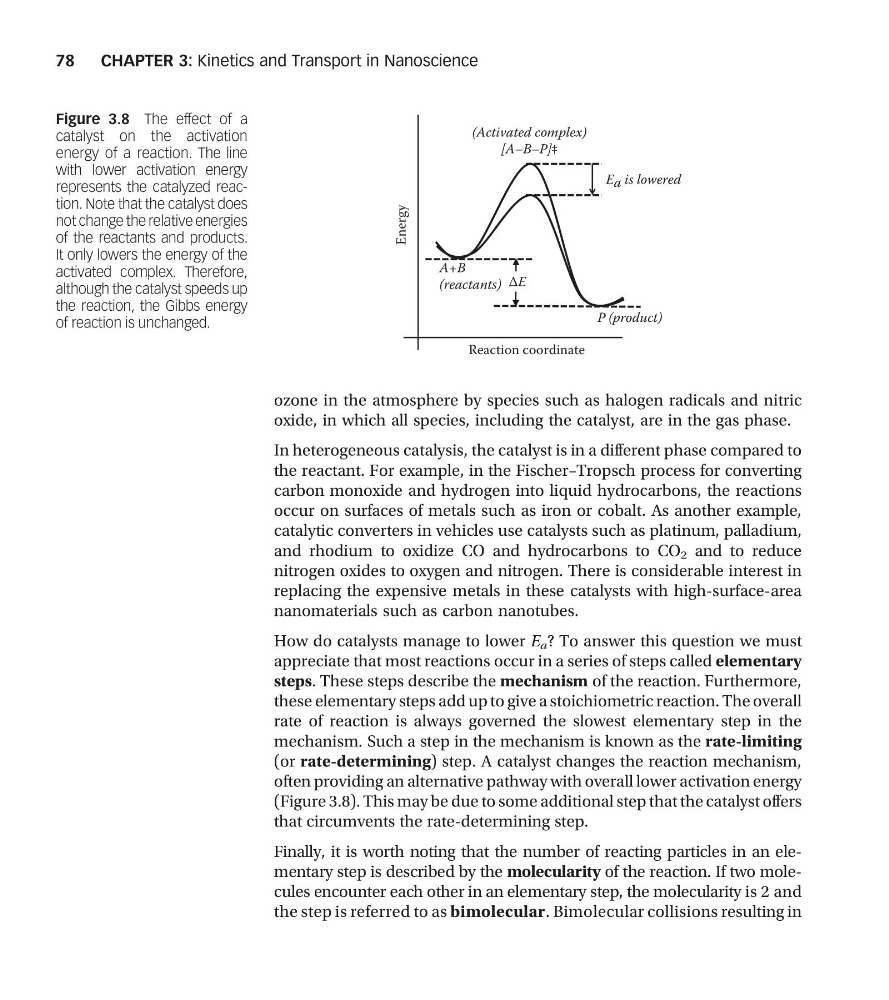
(or rate-determining) step. A catalyst changes the reaction mechanism,
often providing an alternative pathway with overall lower activation energy
(Figure 3.8). This may be due to some additional step that the catalyst offers
that circumvents the rate-determining step.
Finally, it is worth noting that the number of reacting particles in an elementary step is described by the molecularity of the reaction. If two molecules encounter each other in an elementary step, the molecularity is 2 and
the step is referred to as bimolecular. Bimolecular collisions resulting in
Reaction coordinate
Energy
A+B
(reactants)
P (product)
(Activated complex)
[A–B–P]‡
ΔE
E a is lowered
Figure 3.8 The effect of a
catalyst on the activation
energy of a reaction. The line
with lower activation energy
represents the catalyzed reaction. Note that the catalyst does
not change the relative energies
of the reactants and products.
It only lowers the energy of the
activated complex. Therefore,
although the catalyst speeds up
the reaction, the Gibbs energy
of reaction is unchanged.
CHAPTER 3: Kinetics and Transport in Nanoscience
78
oxide, in which all species, including the catalyst, are in the gas phase.
In heterogeneous catalysis, the catalyst is in a different phase compared to
the reactant. For example, in the Fischer–Tropsch process for converting
carbon monoxide and hydrogen into liquid hydrocarbons, the reactions
occur on surfaces of metals such as iron or cobalt. As another example,
catalytic converters in vehicles use catalysts such as platinum, palladium,
and rhodium to oxidize CO and hydrocarbons to CO 2 and to reduce
nitrogen oxides to oxygen and nitrogen. There is considerable interest in
replacing the expensive metals in these catalysts with high-surface-area
nanomaterials such as carbon nanotubes.
How do catalysts manage to lower E a ? To answer this question we must
appreciate that most reactions occur in a series of steps called elementary
steps. These steps describe the mechanism of the reaction. Furthermore,
these elementary steps add up to give a stoichiometric reaction. The overall
rate of reaction is always governed the slowest elementary step in the
mechanism. Such a step in the mechanism is known as the rate-limiting
(or rate-determining) step. A catalyst changes the reaction mechanism,
often providing an alternative pathway with overall lower activation energy
(Figure 3.8). This may be due to some additional step that the catalyst offers
that circumvents the rate-determining step.
Finally, it is worth noting that the number of reacting particles in an elementary step is described by the molecularity of the reaction. If two molecules encounter each other in an elementary step, the molecularity is 2 and
the step is referred to as bimolecular. Bimolecular collisions resulting in
Reaction coordinate
Energy
A+B
(reactants)
P (product)
(Activated complex)
[A–B–P]‡
ΔE
E a is lowered
Figure 3.8 The effect of a
catalyst on the activation
energy of a reaction. The line
with lower activation energy
represents the catalyzed reaction. Note that the catalyst does
not change the relative energies
of the reactants and products.
It only lowers the energy of the
activated complex. Therefore,
although the catalyst speeds up
the reaction, the Gibbs energy
of reaction is unchanged.
CHAPTER 3: Kinetics and Transport in Nanoscience
78